

7 days later and we have some results from the experiment. When we demote popular posts we see: - 8.26% fewer "show less like this" (3340 -> 3064) - 0.24% more posts in For You were liked (242438 -> 243024) - 2.43% more feed loads (438867 -> 449537) Per user and per request metrics:
Changes to the Facebook Algorithm Decreased News Visibility Between 2021-2024
Platforms, especially Facebook, are primary news sources in the US. In its widely criticized "War on News," Meta algorithmically deprioritized news and political content. We use data from 40 news organizations (5,243,302 Facebook posts, 7,875,372,958 user reactions) and 21 non-news pages (396,468 posts; 1,909,088,308 reactions) between January 1, 2016 and February 13, 2025 to examine how these changes influenced news visibility on the platform. Reactions to news declined by 78% between 2021 and 2024 while reactions to non-news pages increased, indicating targeted suppression of news visibility. Low-quality sources were especially suppressed, yet the 2025 end to "War on News" increased user reactions to news, especially low-quality ones. These changes do not reflect decreased news supply, Facebook user base, or interest in news over this period.

Bluesky feed engagement — image-count analysis
The left chart tiers authors by actual follower count (at analysis time). The right chart tiers authors by median likes per post — a proxy for effective reach. Interesting divergence: under the follower definition, medium-size accounts show no 4-img penalty; under median-engagement, the pattern is different.
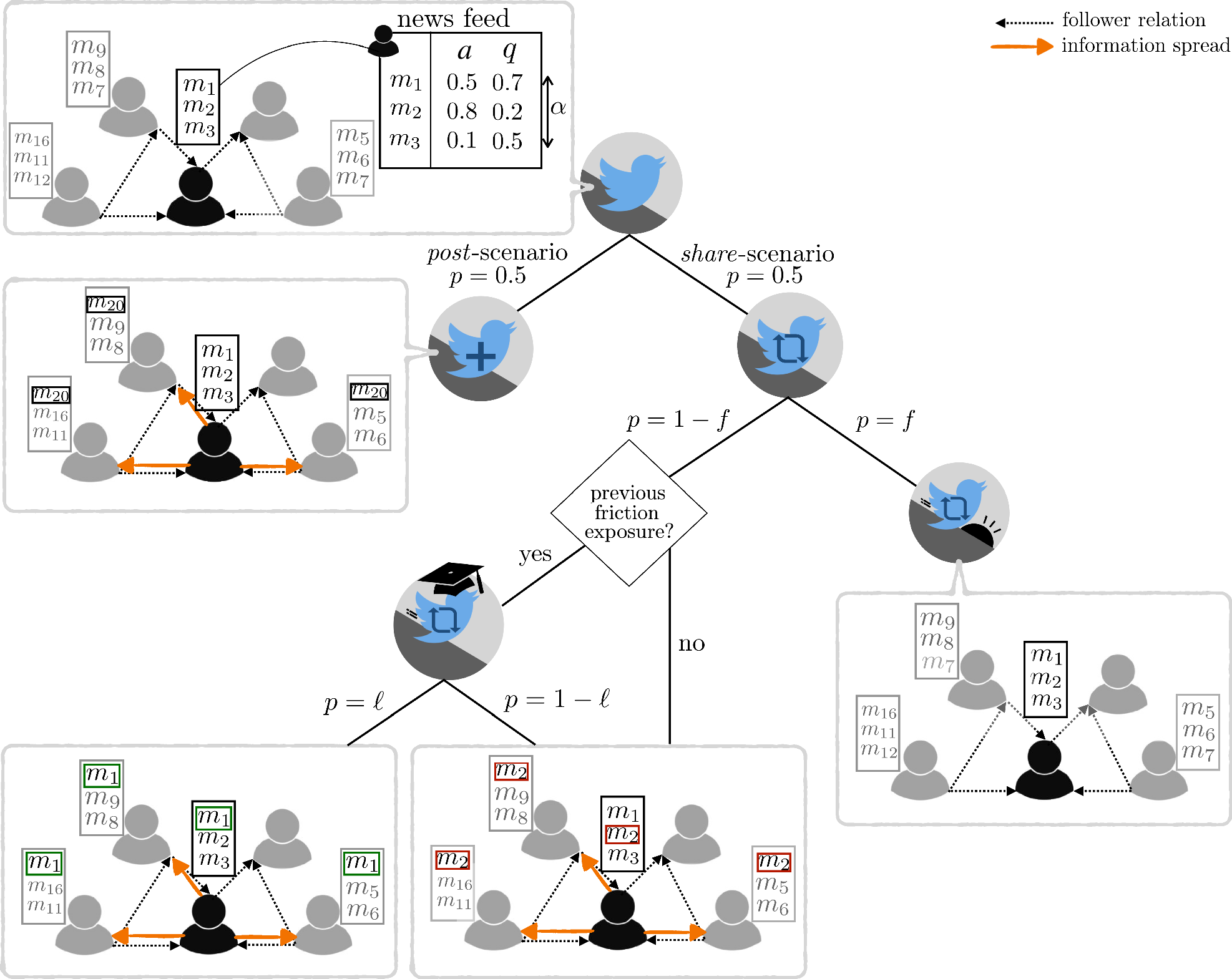
A perspective on friction interventions to curb the spread of misinformation
Social media has enabled the spread of information at unprecedented speeds and scales, and with it the proliferation of high-engagement, low-quality content. Friction—behavioral design measures that make the sharing of content more cumbersome—might be a way to raise the quality of what is spread online. In this perspective, we propose a scalable field experiment to study the effects of friction with a learning component to educate users on the platform’s community standards. Preliminary simulations from an agent-based model suggest that while friction alone may decrease the number of posts without improving their quality, it could significantly increase the average quality of posts when combined with learning. The model also suggests that too much friction could be counterproductive. Experimental interventions inspired by these findings would be minimally invasive.
Value misalignment in X’s feed algorithm is a reflection of value tensions in engagement
Social media feed algorithms rank content that is purported to be preferred by users, but the engagement behaviors that drive these algorithms are (at best) indirect proxies for users’ explicitly self-stated values. Are the resulting feeds value aligned, and if not, why? We investigate this question by annotating the basic human values expressed in participants’ X (Twitter) feeds (N = 715 US users), analyzing the relationship between the posts’ value expressions and the posts’ amplification in the ranked “For You” Page feed, and then comparing the amplified values to users’ own values. We observe that the inventory of posts from followed accounts reflects users’ self-stated values—but that there is an overall negative correlation (misalignment) between users’ explicit values and the value expressions the algorithm is more likely to amplify. We turn to engagement behavior to understand this misalignment and observe that users’ engagement behaviors can be misaligned with their stated values—likely causing the algorithm to learn and reflect these misaligned values. We also detect partisan differences consistent with this theory: While the algorithm amplifies values negatively correlated with both Democrats’ and Republicans’ self-stated values, they are more misaligned for Democrats. And in fact replying, a heavily weighted form of engagement, is associated with values that are less aligned for both Democrats’ and Republicans’ self-stated values, and is even more misaligned for Democrats. Taken together, these findings offer a glimpse into the tensions between the values that people hold and those that provoke reactions, and how these value tensions can produce misaligned outcomes.

Value misalignment in X’s feed algorithm is a reflection of value tensions in engagement
Social media feed algorithms rank content that is purported to be preferred by users, but the engagement behaviors that drive these algorithms are (at best) indirect proxies for users’ explicitly self-stated values. Are the resulting feeds value aligned, and if not, why? We investigate this question by annotating the basic human values expressed in participants’ X (Twitter) feeds (N = 715 US users), analyzing the relationship between the posts’ value expressions and the posts’ amplification in the ranked “For You” Page feed, and then comparing the amplified values to users’ own values. We observe that the inventory of posts from followed accounts reflects users’ self-stated values—but that there is an overall negative correlation (misalignment) between users’ explicit values and the value expressions the algorithm is more likely to amplify. We turn to engagement behavior to understand this misalignment and observe that users’ engagement behaviors can be misaligned with their stated values—likely causing the algorithm to learn and reflect these misaligned values. We also detect partisan differences consistent with this theory: While the algorithm amplifies values negatively correlated with both Democrats’ and Republicans’ self-stated values, they are more misaligned for Democrats. And in fact replying, a heavily weighted form of engagement, is associated with values that are less aligned for both Democrats’ and Republicans’ self-stated values, and is even more misaligned for Democrats. Taken together, these findings offer a glimpse into the tensions between the values that people hold and those that provoke reactions, and how these value tensions can produce misaligned outcomes.
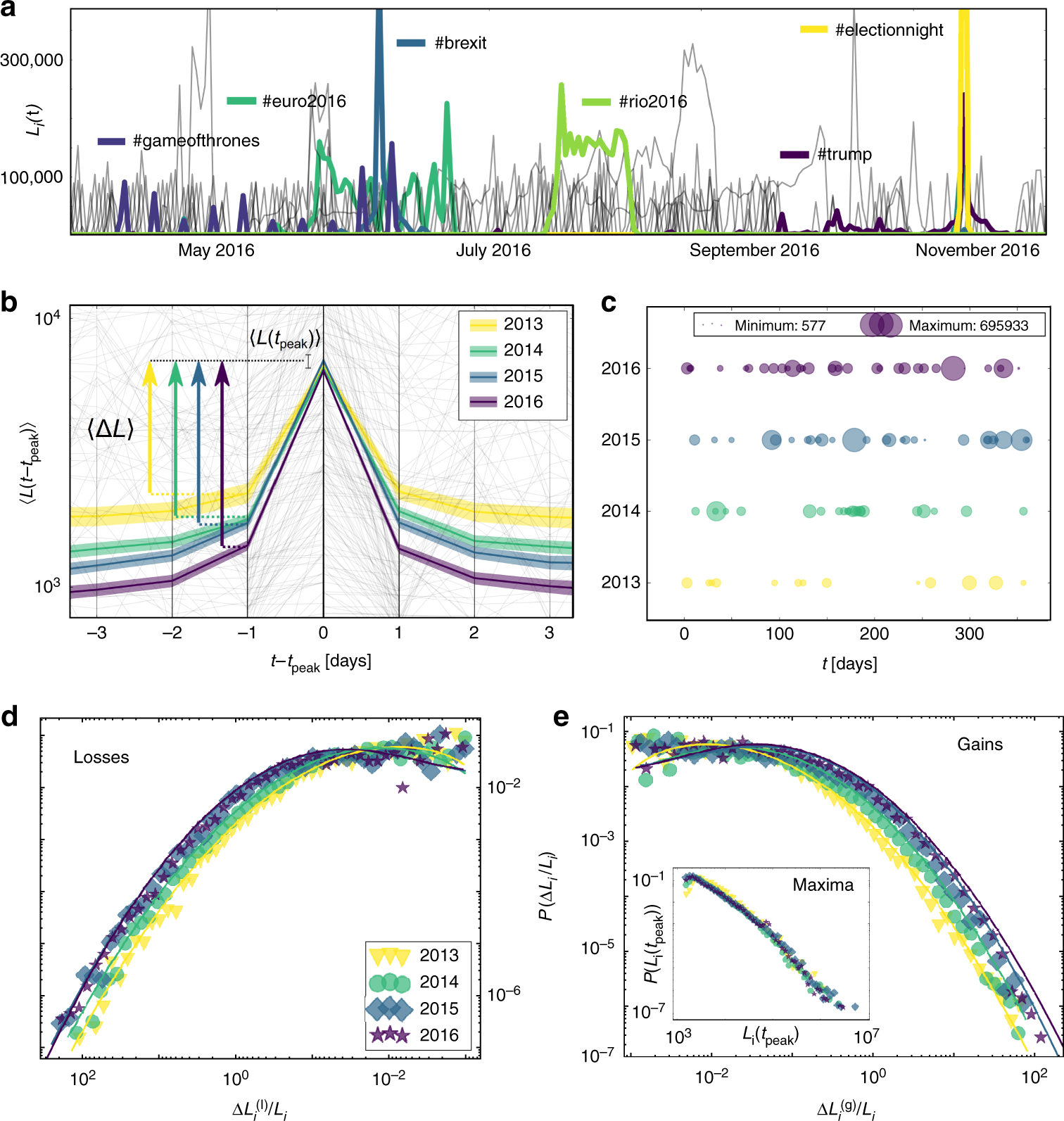
Accelerating dynamics of collective attention
With news pushed to smart phones in real time and social media reactions spreading across the globe in seconds, the public discussion can appear accelerated and temporally fragmented. In longitudinal datasets across various domains, covering multiple decades, we find increasing gradients and shortened periods in the trajectories of how cultural items receive collective attention. Is this the inevitable conclusion of the way information is disseminated and consumed? Our findings support this hypothesis. Using a simple mathematical model of topics competing for finite collective attention, we are able to explain the empirical data remarkably well. Our modeling suggests that the accelerating ups and downs of popular content are driven by increasing production and consumption of content, resulting in a more rapid exhaustion of limited attention resources. In the interplay with competition for novelty, this causes growing turnover rates and individual topics receiving shorter intervals of collective attention.
Facebook and Instagram losing users, with signs pointing to low-quality feeds
Anecdotally, I’ve been hearing for a very long time that Facebook and Instagram users are growing ever more dissatisfied with...

For You by @spacecowboy17.bsky.social
A personalized algorithmic feed based on your likes. It finds people who liked the same posts as you, and shows you what else they've liked recently. https://foryou.club

The echo chamber effect on social media
Significance We explore the key differences between the main social media platforms and how they are likely to influence information spreading and the formation of echo chambers. To assess the different dynamics, we perform a comparative analysis on more than 100 million pieces of content concerning controversial topics (e.g., gun control, vaccination, abortion) from Gab, Facebook, Reddit, and Twitter. The analysis focuses on two main dimensions: 1) homophily in the interaction networks and 2) bias in the information diffusion toward like-minded peers. Our results show that the aggregation in homophilic clusters of users dominates online dynamics. However, a direct comparison of news consumption on Facebook and Reddit shows higher segregation on Facebook. , Social media may limit the exposure to diverse perspectives and favor the formation of groups of like-minded users framing and reinforcing a shared narrative, that is, echo chambers. However, the interaction paradigms among users and feed algorithms greatly vary across social media platforms. This paper explores the key differences between the main social media platforms and how they are likely to influence information spreading and echo chambers’ formation. We perform a comparative analysis of more than 100 million pieces of content concerning several controversial topics (e.g., gun control, vaccination, abortion) from Gab, Facebook, Reddit, and Twitter. We quantify echo chambers over social media by two main ingredients: 1) homophily in the interaction networks and 2) bias in the information diffusion toward like-minded peers. Our results show that the aggregation of users in homophilic clusters dominate online interactions on Facebook and Twitter. We conclude the paper by directly comparing news consumption on Facebook and Reddit, finding higher segregation on Facebook.

We Analyzed 248K Reddit Posts: What Drives Visibility in AI Search [Study]
We analyzed 248,000 Reddit posts to uncover what makes certain threads appear in AI search results. Learn which post types, engagement levels, and formats drive visibility.

Consequences of Information Feed Integration on User Engagement and Contribution: A Natural Experiment in an Online Knowledge-Sharing Community
Many online communities that rely on effortful, voluntary content contributions offer additional content curation tools to facilitate social interactions and encourage user contributions. Any platform that offers two or more heterogeneous content types (e.g., expert knowledge and social posts) faces a choice about the presentation format: whether to display the content types separately or in an integrated information feed. We leverage a natural experiment on Zhihu, a Q&A platform that offers a social-interaction-oriented functionality called Ideas. Zhihu initially presented answers (expert knowledge content) and ideas (social posts) in two different information feeds, but the platform integrated ideas into the same information feed as answers in June 2019. We find that information feed integration significantly decreased user engagement with and contribution of both ideas and answers. We hypothesize that users decreased their engagement because the juxtaposition of incongruous types of content increased mindset switching and cognitive strain. This hypothesis is supported by an additional laboratory experiment. We also present evidence showing that contributions decreased both because of the decrease in engagement (weaker social recognition incentives) and because integration heightened concerns that posting ideas would dilute the contributor’s professional image. Our findings have important theoretical and practical implications for any platform that hosts heterogeneous content. History: Xiaoquan (Michael) Zhang served as the senior editor and Yili (Kevin) Hong served as associate editor for this article. Funding: Z. Cao acknowledges this research was funded by National Natural Science Foundation of China [Grants 72201238, 72192823]. G. Li acknowledges this research was funded by National Natural Science Foundation of China [Grant 72102047] and Shanghai Pujiang Program [Grant 21PJC006]. Supplemental Material: The e-companion is available at https://doi.org/10.1287/isre.2022.0043.
I analyzed 22k photo posts from 1014 @realnsfw.social creators to determine if the old grid layout was "broken" After controlling for account size, caption length, alt-text use, and time of day, 4-image posts still got ~39% fewer likes than 1-image posts #atdev sweetbeex.github.io/bsky-photo-number-analyses/

♍ Bee 🐝
mmm data
people love the For You feed, and it shows in the numbers. it generates around 4% of post views inside feeds on Bluesky. that's amazing especially because it's operated by one dev, @spacecowboy17.bsky.social given its popularity, we've decided to give it a bump in visibility on the feeds page.
Do our social media algorithms correctly reflect our values? Our new article published today in @pnas.org shows that the answer is often not, and that the content that gets promoted into their ranked feeds is often actively counter to our values.
Do our social media algorithms correctly reflect our values? Our new article published today in @pnas.org shows that the answer is often not, and that the content that gets promoted into their ranked feeds is often actively counter to our values.


