

The 1000 most common words in the Dutch language, with English translations
Learn Dutch • Online Dutch Grammar Course
Learn Dutch grammar: Spelling and pronunciation, verbs, pronouns, nouns and articles, word order, and more. It includes sound files and exercises, and an active forum to post your questions..
Recommended books for learning Dutch – Understanding Dutch
List of the best books for learning Dutch, regularly updated. Grammar workbooks, phrasebooks, and essential introductions to Dutch.

dict.cc | English-Dutch dictionary | Engels-Nederlands woordenboek
dict.cc English-Dutch dictionary - Engels-Nederlands woordenboek - Dutch-English translations.
Easy Dutch - Learn Dutch from the Streets!
Netherlands | EF English Proficiency Index | EF Global Site (English)
Discover the EF English Proficiency Index score for Netherlands

atproto.nl
AT Protocol has no country field, so we publish two numbers: the Dutch accounts we can point to, and a modelled total of around 230.000.

Grammatica voor NT2-docenten Alles wat je over het Nederlands wilt weten
Word een nóg betere docent NT2. Veel lestips over grammatica en schrijfvaardigheid, en (online) workshops voor ervaren en beginnende docenten.

Is Cross-Lingual Transfer in Bilingual Models Human-Like? A Study with Overlapping Word Forms in Dutch and English
Bilingual speakers show cross-lingual activation during reading, especially for words with shared surface form. Cognates (friends) typically lead to facilitation, whereas interlingual homographs (false friends) cause interference or no effect. We examine whether cross-lingual activation in bilingual language models mirrors these patterns. We train Dutch-English causal Transformers under four vocabulary-sharing conditions that manipulate whether (false) friends receive shared or language-specific embeddings. Using psycholinguistic stimuli from bilingual reading studies, we evaluate the models through surprisal and embedding similarity analyses. The models largely maintain language separation, and cross-lingual effects arise primarily when embeddings are shared. In these cases, both friends and false friends show facilitation relative to controls. Regression analyses reveal that these effects are mainly driven by frequency rather than consistency in form-meaning mapping. Only when just friends share embeddings are the qualitative patterns of bilinguals reproduced. Overall, bilingual language models capture some cross-linguistic activation effects. However, their alignment with human processing seems to critically depend on how lexical overlap is encoded, possibly limiting their explanatory adequacy as models of bilingual reading.

English language
English is a West Germanic language in the Indo-European language family. It emerged in early medieval England and has since become a global lingua franca. The namesake of the language is the Angles, one of the Germanic peoples who migrated to Britain after the end of Roman rule. English is the most spoken language in the world, primarily due to the global influences of the former British Empire and the United States. It is the most widely learned second language in the world, with more second-language speakers than native speakers. However, English is only the third-most spoken native language, after Mandarin Chinese and Spanish.

False Friends Are Not Foes: Investigating Vocabulary Overlap in Multilingual Language Models
Subword tokenizers trained on multilingual corpora naturally produce overlapping tokens across languages. Does token overlap facilitate cross-lingual transfer or instead introduce interference between languages? Prior work offers mixed evidence, partly due to varied setups and confounders, such as token frequency or subword segmentation granularity. To address this question, we devise a controlled experiment where we train bilingual autoregressive models on multiple language pairs under systematically varied vocabulary overlap settings. Crucially, we explore a new dimension to understanding how overlap affects transfer: the semantic similarity of tokens shared across languages. We first analyze our models' hidden representations and find that overlap of any kind creates embedding spaces that capture cross-lingual semantic relationships, while this effect is much weaker in models with disjoint vocabularies. On XNLI and XQuAD, we find that models with overlap outperform models with disjoint vocabularies, and that transfer performance generally improves as overlap increases. Overall, our findings highlight the advantages of token overlap in multilingual models and show that substantial shared vocabulary remains a beneficial design choice for multilingual tokenizers.
Why Do Large Language Models (LLMs) Struggle to Count Letters?
Large Language Models (LLMs) have achieved unprecedented performance on many complex tasks, being able, for example, to answer questions on almost any topic. However, they struggle with other simple tasks, such as counting the occurrences of letters in a word, as illustrated by the inability of many LLMs to count the number of "r" letters in "strawberry". Several works have studied this problem and linked it to the tokenization used by LLMs, to the intrinsic limitations of the attention mechanism, or to the lack of character-level training data. In this paper, we conduct an experimental study to evaluate the relations between the LLM errors when counting letters with 1) the frequency of the word and its components in the training dataset and 2) the complexity of the counting operation. We present a comprehensive analysis of the errors of LLMs when counting letter occurrences by evaluating a representative group of models over a large number of words. The results show a number of consistent trends in the models evaluated: 1) models are capable of recognizing the letters but not counting them; 2) the frequency of the word and tokens in the word does not have a significant impact on the LLM errors; 3) there is a positive correlation of letter frequency with errors, more frequent letters tend to have more counting errors, 4) the errors show a strong correlation with the number of letters or tokens in a word and 5) the strongest correlation occurs with the number of letters with counts larger than one, with most models being unable to correctly count words in which letters appear more than twice.
Why Do Large Language Models (LLMs) Struggle to Count Letters?
Large Language Models (LLMs) have achieved unprecedented performance on many complex tasks, being able, for example, to answer questions on almost any topic. However, they struggle with other simple tasks, such as counting the occurrences of letters in a word, as illustrated by the inability of many LLMs to count the number of "r" letters in "strawberry". Several works have studied this problem and linked it to the tokenization used by LLMs, to the intrinsic limitations of the attention mechanism, or to the lack of character-level training data. In this paper, we conduct an experimental study to evaluate the relations between the LLM errors when counting letters with 1) the frequency of the word and its components in the training dataset and 2) the complexity of the counting operation. We present a comprehensive analysis of the errors of LLMs when counting letter occurrences by evaluating a representative group of models over a large number of words. The results show a number of consistent trends in the models evaluated: 1) models are capable of recognizing the letters but not counting them; 2) the frequency of the word and tokens in the word does not have a significant impact on the LLM errors; 3) there is a positive correlation of letter frequency with errors, more frequent letters tend to have more counting errors, 4) the errors show a strong correlation with the number of letters or tokens in a word and 5) the strongest correlation occurs with the number of letters with counts larger than one, with most models being unable to correctly count words in which letters appear more than twice.
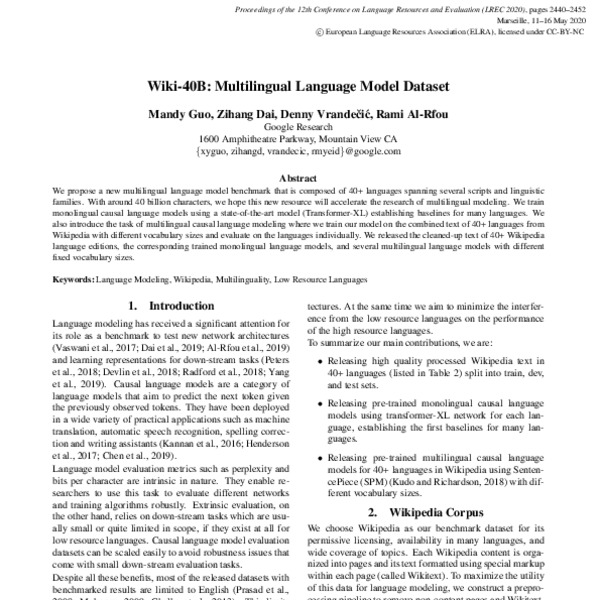
Wiki-40B: Multilingual Language Model Dataset
We propose a new multilingual language model benchmark that is composed of 40+ languages spanning several scripts and linguistic families. With around 40 billion characters, we hope this new resource will accelerate the research of multilingual modeling. We train monolingual causal language models using a state-of-the-art model (Transformer-XL) establishing baselines for many languages. We also introduce the task of multilingual causal language modeling where we train our model on the combined text of 40+ languages from Wikipedia with different vocabulary sizes and evaluate on the languages individually. We released the cleaned-up text of 40+ Wikipedia language editions, the corresponding trained monolingual language models, and several multilingual language models with different fixed vocabulary sizes.
lexicon.community
lexicon.community has 7 repositories available. Follow their code on GitHub.

Over 300 words to use instead of said
desktop version of over 300 words to use instead of said by emotion.
When I worked in software dev, I was taught to check three non-English languages when testing text strings: German to test the largest possible version of a string, Japanese or Chinese to test the shortest possible version, and Thai to check the TALLEST possible version.
