

The new social software is subtly designed to reduce the huge, viral surges of attention we see on Twitter
Mastodon Status Check
My social-media life has been Fediverse-first for a year now. I stick my head into Bluesky and Threads regularly, but visit Twitter rarely if at all. This piece takes a close look at Mastodon-land as things stand in late summer 2023. What’s working, what’s not, what are the alternatives? [Originally published August 2023, updated November 27th for my one-year Twitter-exit anniversary.]

Mastodon - Decentralized social media
Learn more about Mastodon, the radically different, free and open-source decentralized social media platform.

Mastodon Exit Interview
I am currently winding down the Mastodon bots I used to post sunrise and sunset times. The precipitating event is that the admin of the instance hosting the associated accounts demanded they be made nigh-undiscoverable, but the underlying cause is that it’s become increasing clear that Mastodon isn’t, and won’t ever be, a good platform for “asynchronous ephemeral notifications of any kind”. I’d also argue (more controversially) that it’s simply not good infrastructure for social networking of any kind. There are lots of interesting people using Mastodon, and I’m sure it will live on as a good-enough space for certain niche groups. But there is no question that it will never offer the fun of early Twitter, let alone the vibrancy of Twitter during its growth phase. I’ve long since dropped Mastodon from my home screen, and have switched to Bluesky for text-centric social media.
Mastodon Features That Twitter Should Steal (but Won’t)
Elon Musk's platform could learn a thing or two from its most popular alternative—like how to build a social platform people actually want to be on.

How The Enshittification Of Social Media Is Decreasing The Switching Costs And Enabling Something New
In the last few weeks I’ve written about how Elon Musk’s “changes” to how Twitter is running have done an amazing job convincing people to join Mastodon. And I’ve also…

Private and Public Mastodon
Here’s how to get into a lot of trouble: Suppose you (like me) love the intellectual wealth found in free-form text on the Internet. And (like me) are a reasonably competent programmer. And (like me) have derived value and pleasure searching Twitter. And (like me) you look at this nifty new Fediverse thing and see that it has nice Web APIs so you could build an app to vacuum up all the stories and laments and cheers and dunks and love letters and index ’em and let everyone search ’em and find wonderful things! So you lurch into the Mastodon conversation, all excited, and blurt out “Hey folks, I’m gonna index all this stuff and let the world in!” That’s when you get your face torn off.
How Does Mastodon Work? - Kev Quirk
I’ve spoken about Mastodon numerous times on this blog. It is the social media platform I use more than any other, but for a new user it can be confusing because it doesn’t work like other social media sites.
Can Mastodon seize the moment from Twitter?
How Mastodon was prepared for Elon Musk’s Twitter to fail.

Cage the Mastodon
A year ago I wrote about Mastodon’s improvements over Twitter’s lacking protections against abuse and harassment. Development in that area has not been standing still, and it’s about time we do another comparison.
Archive: New COVID-19 ‘Citizen Science’ Initiative Lets Any Adult with a Smartphone Help to Fight Coronavirus
The online study would try to help researchers gain insight into how the virus is spreading and identify ways to predict and reduce the number of new infections.

Scientists no Longer Find Twitter Professionally Useful, and have Switched to Bluesky
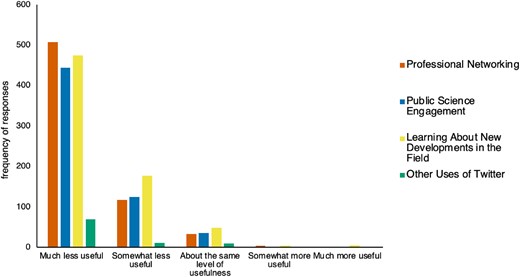
Synopsis Social media has become widely used by the scientific community for a variety of professional uses, including networking and public outreach. For the past decade, Twitter has been a primary home of scientists on social media. In recent years, new leadership at Twitter has made substantive changes that have resulted in increases in the prevalence of pseudoscience, conspiracy theory, and harassment on the platform, causing many scientists to seek alternatives. Bluesky has been suggested as a good alternative to Twitter, but the phenomenon of academics switching social media platforms has not previously been studied. Here we report on the results of a survey distributed to scientists on Twitter and Bluesky (n = 813). Results overwhelmingly confirm that changes to Twitter have made the social media platform no longer professionally useful or pleasant, and that many scientists have abandoned it in favor of Bluesky. Results show that for every reported professional benefit that scientists once gained from Twitter, scientists can now gain that benefit more effectively on Bluesky than on Twitter.
Making Social Media Social
As some of you might know, I am part of a team of people moderating a Mastodon server. And as so many of those servers we’ve been having some problems with fake signups lately. This is about how we mitigated the issue and how it was beneficial beyond that. So for those who don’t know […]

Recently I’ve been thinking about a couple of... - Adam Wood
Recently I’ve been thinking about a couple of different tech-related things that sort of overlap. One is the (emerging) shape of the new social web; the other is a pull I’m feeling to try and lessen reliance on American companies. I’ve been interested in / concerned by what became of social media for some time.1 Since the sundering of Twitter in 2022, I’ve kept an eye on the various alternatives, with particular interest in Mastodon and Bluesky. Actually, to be more accurate, my interest has been in the protocols behind those platforms: ActivityPub and AT Protocol respectively. Both have their...

The Failed Migration of Academic Twitter: A Case Study of...
Following changes in Twitter's ownership in 2022 and subsequent changes to content moderation policies, many in academia looked to move their discourse elsewhere and migration to Mastodon was...

interesting interviews with Bluesky and Mastodon users about integrating genAI in social media. pre-print just uploaded last week. tl;dr is that in conversation folks are less "pro"/"anti" and more nuanced about use-cases, boundaries, social impact.

"Okay, I've Actually Softened My Take on This": How People in Decentralized Social Media Reason about the Appropriateness of Generative AI
arxiv.org