


As marketers, we're constantly assaulted with new information. But I fight the overwhelm with a proven system. Readwise Reader helps me stay on top of the news and discover helpful content.
Readwise Reader: The first read-it-later app built for power readers.
Save everything to one place to overcome content overload, search instantly, and highlight like a pro.
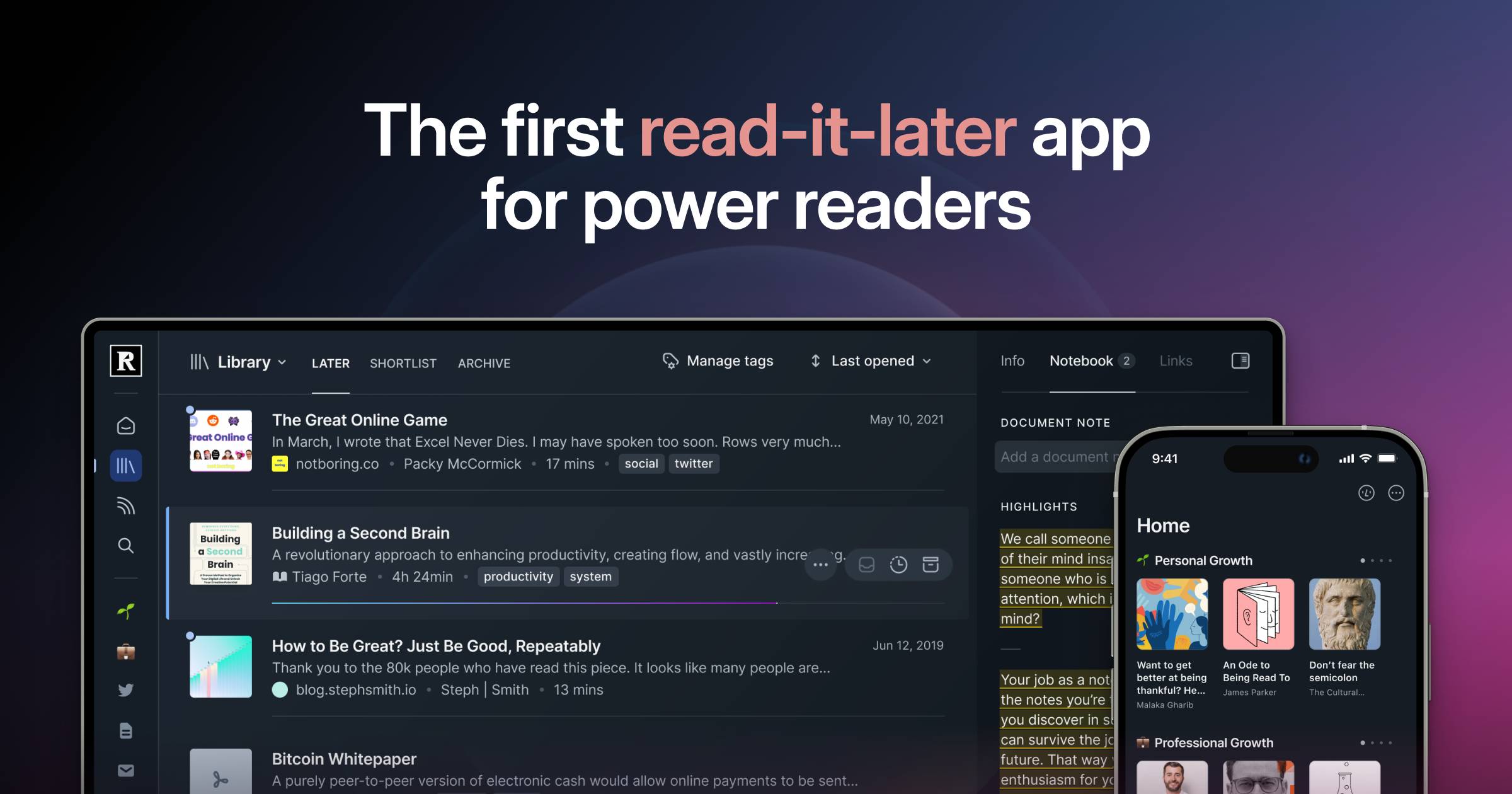
The Next Chapter of Reader: Public Beta
Today, we're excited to announce the public beta of our own, fully-integrated reading app (known as "Reader"). Get started for free at readwise.io/read. What is Reader? In case you missed our original manifesto, Reader is a more powerful, more flexible version of the classic read-it-later app. If you've

Getting Started with Reader
Welcome to the essential beginners tutorial for Reader: our very own read-it-later app that helps you bring *all* of your reading into one place. That includes articles, books, PDFs, RSS feeds, email newsletters, Tweets, and videos. 🎁 Sign up for a free 30-day trial: https://readwise.io/read *This video will teach you everything you need to get started:* 00:00 The Problem 00:15 What is Reader? 00:33 Installing web extension and mobile apps 00:40 Adding new documents on desktop 01:14 Uploading files from desktop 01:23 Subscribing to email newsletters 01:37 Importing your library from Pocket, Instapaper, or Omnivore 01:44 Saving documents on mobile 01:50 What's the difference between Library and Feed? 02:38 Importing feeds from another app 02:49 Home section 03:08 Keyboard shortcuts 03:50 Full-text search 04:05 Reading and highlighting 04:20 Exporting and searching your highlights 04:40 Text-to-speech 05:00 What is Ghostreader? 05:47 De-activate AI features 06:00 Submitting feedback and questions *More Resources:* How To Set Up Your Reader Feed: https://www.youtube.com/watch?v=uDr9N0rV4EE Organizing Your Documents in Reader: https://www.youtube.com/watch?v=uefrzMb5qBc

Readwise
Grow wiser and retain books better: Readwise sends you a daily email resurfacing your best highlights from Kindle, Instapaper, iBooks, and more.
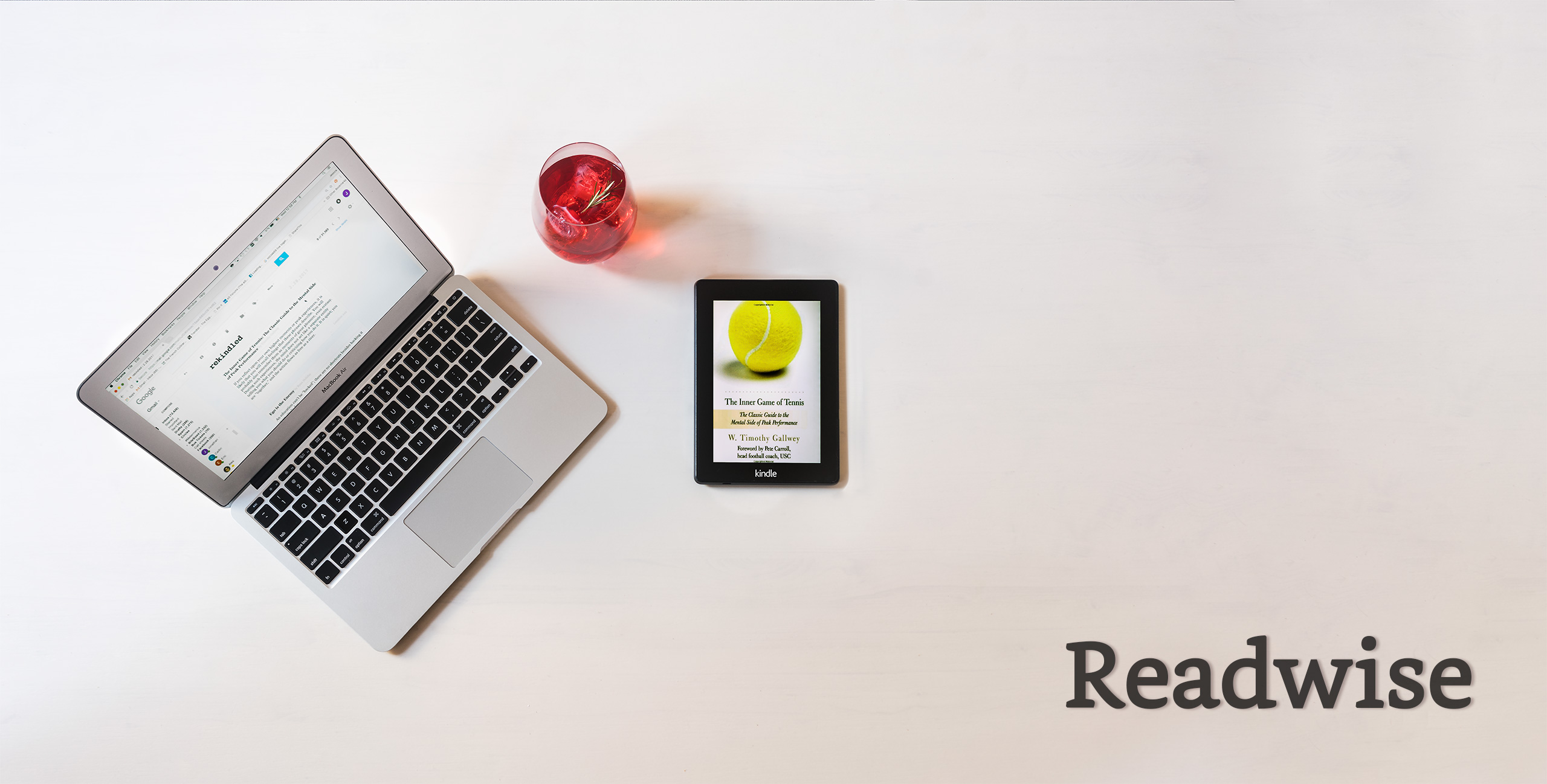
E-reader innovation has stalled | TechCrunch
Next month marks 10 years since the first Kindle debuted. It’s a virtual lifetime in consumer electronics terms, but compared to its mobile brethren, e-readers’ pace of innovation has been glacial. Why has the e-reader stagnated?
Creative Reading: Scaffolding Reading for Transformation
Reading augmentation systems increasingly help readers process text at scale. While these tools address real constraints of time and cognitive load, they often implicitly frame reading as...

Why We're Bootstrapping Readwise
Our mission here at Readwise is to improve the practice of reading through technology by an order of magnitude. While we have some strong opinions and good ideas (we think) on how to build such a product (indeed, we've already started!), what was less obvious was: How do we fund
Readwise Reader: Top 15 Features, Tips, and Tricks!
The revolt of the reader | The Observation Deck
Reading is important to me. While I’m not a quick reader nor an especially voracious one, I have found that long-form reading has had a profound influence on me over my life. And because reading is important to me, writing is too: writing not only allows us to convey our ideas, but the very act forces us to test and distill them — at once making our ideas more robust while providing the vehicle by which to share them.
‘Reading is so sexy’: gen Z turns to physical books and libraries
Book sales boom as readers escape the ‘oversaturation and noise of the wild west digital landscape’

Creative Reading: Scaffolding Reading for Transformation
Reading augmentation systems increasingly help readers process text at scale. While these tools address real constraints of time and cognitive load, they often implicitly frame reading as information transmission, or "reading to discard," delegating interpretation and effort to the machine. Yet this delegation changes the outcome of reading. For example, in scholarly reading, deciding what a research text implies and why it matters is central to the work of scholarly production. We propose creative reading as an alternative goal: reading augmentation that supports readers in creating both readings and themselves as readers. By putting literary and narrative theories into conversation with scholarly sensemaking and creativity support, we present a provocation-oriented design space for valuing the process of reading as a way of preserving a plurality of readings and transforming readers over time.
BeeLine Reader: helping readers finish what they start
BeeLine Reader's award-winning technology helps readers stay focused for longer. Available for publishers, schools, and individual readers.
The Secret Power of ‘Read It Later’ Apps
The Secret Power of ‘Read It Later’ Apps By Tiago Forte of Forte Labs At the end of 2014 I received an email informing me that I had read over a million words in the ‘read it later’ app …
The Secret Power of ‘Read It Later’ Apps
The Secret Power of ‘Read It Later’ Apps By Tiago Forte of Forte Labs At the end of 2014 I received an email informing me that I had read over a million words in the ‘read it later’ app …
How to create reading experiences that "go beyond information transmission and toward reader transformation.” Great paper by @blue-phia.bsky.social @lepidopterane.bsky.social @yijunliu.bsky.social Sarah Sterman @sh1m.bsky.social @maxkreminski.bsky.social arxiv.org/abs/2606.04308 >
