Talk #3 Files, algorithms, media, software as lived practice, and personal software
The community-first software era
Some ideas about how to encode our values into the tools we use

doctrine — vit
The vit doctrine: software should live. A social system for personalized software where the unit of exchange is capability.
doctrine — vit
The vit doctrine: software should live. A social system for personalized software where the unit of exchange is capability.
Perfect Software - Software for an Audience of One
We have many names to describe personal tools. Malleable software speaks to how it behaves. Home-cooked software speaks to who makes it.
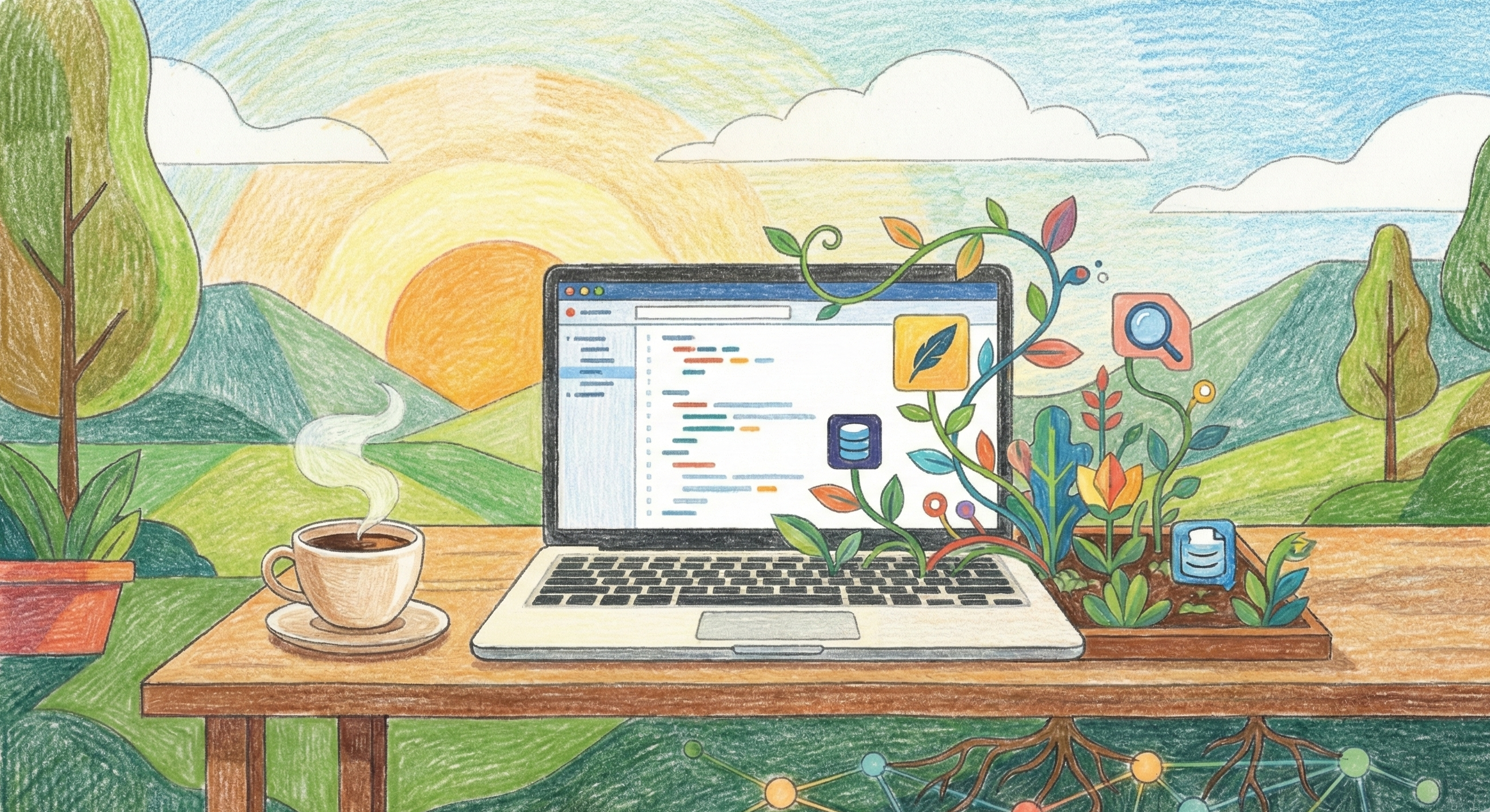
The Local Relational Technologist
Who can we rely on for meaningful software in our communities?
Principles for crafting software
My principles for deciding what to work on and how to build it.

Geoffrey Litt
Welcome! I work on malleable software: computing environments where anyone can adapt their software to meet their needs with minimal friction. To see what that means to me, read this essay or listen to this interview.

Live Coding: A User's Manual
Live Coding: A User's Manual, published by MIT Press

“I think there’s a lot of value in these.” – Unsung
A blog about software craft and quality

Exploratory and Live, Programming and Coding: A Literature Study Comparing Perspectives on Liveness
Various programming tools, languages, and environments give programmers the impression of changing a program while it is running. This experience of liveness has been discussed for over two decades and a broad spectrum of research on this topic exists. Amongst others, this work has been carried out in the communities around three major ideas which incorporate liveness as an important aspect: live programming, exploratory programming, and live coding. While there have been publications on the focus of each particular community, the overall spectrum of liveness across these three communities has not been investigated yet. Thus, we want to delineate the variety of research on liveness. At the same time, we want to investigate overlaps and differences in the values and contributions between the three communities. Therefore, we conducted a literature study with a sample of 212 publications on the terms retrieved from three major indexing services. On this sample, we conducted a thematic analysis regarding the following aspects: motivation for liveness, application domains, intended outcomes of running a system, and types of contributions. We also gathered bibliographic information such as related keywords and prominent publications. Besides other characteristics the results show that the field of exploratory programming is mostly about technical designs and empirical studies on tools for general-purpose programming. In contrast, publications on live coding have the most variety in their motivations and methodologies with a majority being empirical studies with users. As expected, most publications on live coding are applied to performance art. Finally, research on live programming is mostly motivated by making programming more accessible and easier to understand, evaluating their tool designs through empirical studies with users. In delineating the spectrum of work on liveness, we hope to make the individual communities more aware of the work of the others. Further, by giving an overview of the values and methods of the individual communities, we hope to provide researchers new to the field of liveness with an initial overview.

Reflections: The ecosystem is moving
At Open Whisper Systems, we’ve been developing open source “consumer-facing” software for the past four years. We want to share some of the things we’ve learned while doing it. As a software developer, I envy writers, musicians, and filmmakers. Unlike software, when they create something, it is...


The End of Software
To understand how software will change, we can benefit from studying how technology has changed other industries. History tends to rhyme, if you listen. Before the internet, media behaved very differently—it was expensive to create. You had to pay people to make content, edit it, and distribute ...
Composure
On yet another foray into the list of opinions I have that I’m sure are making me progressively more unemployable by the day, I asked some people on the internet: who is doing interesting work on software composability these days and where do I find them?