


Why do facts bounce off some people? It’s not about logic; it’s about structure. Your worldview isn’t a list of opinions—it's a living network. And right now, it's at war.
Why Facts Don’t Change Our Minds
New discoveries about the human mind show the limitations of reason.

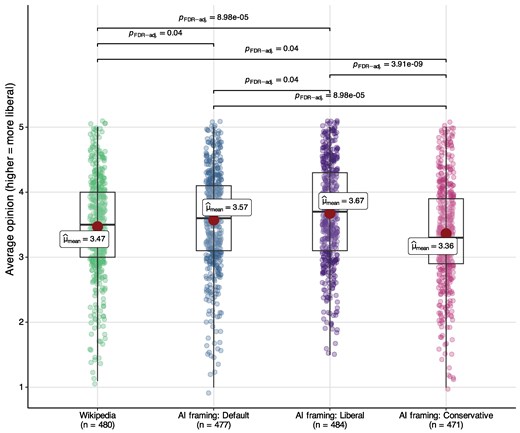
Relying on AI chatbots for historical facts can influence your political beliefs, new study shows
A recent study in PNAS Nexus suggests that reading history summaries generated by artificial intelligence can subtly shift your political opinions. Even when factually accurate, chatbots carry hidden biases that influence how people view the world.

Media Ownership Monitor
Mass media influences how facts are viewed and debated in a society, contributing to crafting its public opinion. Independence and pluralism...

A fact-based worldview for all | Gapminder
We live in a globalized world, not only in terms of trade and migration. More people than ever care about global development. But most people have severe misconceptions about contemporary global development. We know, because we have tested people’s knowledge. One of the main reasons for this is that students don’t learn to understand the world based on statistics and facts. Instead, we have a dramatic worldview formed by outdated school books and sensationalist news-stories. People intuitively believe that most things are getting worse. The dramatic worldview leads to irrational decisions by individuals, nonprofits, governments and business. For the first time in human history reliable statistics exist. There’s data for almost every aspect of global development. The data shows a very different picture: a world where most things improve; a world that is not divided; and a world where the fast population growth will soon be over. The world has never been less bad. But that doesn’t mean it’s perfect.
Epistemic Infrastructure: Building Shared Truth in an Era of Disaggregation
The Construct of Collective Perception

Metaphor and the Political War
Metaphor and the Political War
The Anti-Mamdani 9/11 Bigotry Has Become the Stupidest News Cycle Yet
Bigoted City councilmembers and pathetic Wall Street Journal blowhards are melting down over the stupidest nonsense.

The truth 🤣
26K votes, 57 comments. 36M subscribers in the memes community. Memes! A way of describing cultural information being shared. An element of a culture…
The Source of Truth Problem is Getting Worse with Agents — Tonk
Intelligence depends on knowledge, but in practice that knowledge is fragmented across tools, people, and formats, creating conflicting versions of reality. What if we accepted that knowledge lives at the edge and focused instead on effectively sharing it?

CFP: Religion, Politics, and Cognitive Warfare | The Journal for Cultural and Religious Theory | JCRT
This call for papers invites work on religion, politics, and cognitive warfare, exploring how belief, media, conspiracy, identity, and power shape struggles over reality, interpretation, and life in an age of disinformat

How to counter "everything is a construct" worldview?
Many of the people in humanities I encounter seem very wedded to mindset I refer to as "construct = everything". For example, they say bazar things such as gender is 100% a construct. They say...
Cognitive Warfare Through the Lens of Critical Neuroscience: Data, Theory, and Values
This study examines cognitive warfare through the lens of critical neuroscience and situates it within peace research as a methodological contribution. Cognitive warfare-understood as the strategic modulation of perception, belief, and decision-making-highlights how the human mind has become a contested domain of contemporary conflict. The weaponization of neuroscience unfolds within sociocultural contexts where empirical findings, theoretical interpretations, and normative commitments are deeply entangled. Drawing on Johan Galtung’s epistemological triad of data, theory, and values, I propose a framework for analyzing cognitive warfare that makes explicit the normative dimensions of neuroscientific knowledge. This perspective highlights not only the weaponization of neuroscience itself, but also of its reputation: exaggerated claims and neuropolitical imaginaries can shape expectations, distort public discourse, and erode trust in science independently of actual technological capabilities. Applying this framework, the study examines resilience and solidarity as two domains in which empirical mechanisms, theoretical interpretations, and normative priors intersect. Cognitive warfare is shown to undermine resilience by destabilizing shared models of reality, while evolutionary and social dynamics demonstrate the long-term advantages of cooperation, reciprocity, and generosity over manipulation and defection. By integrating critical neuroscience with peace research, the article advances an expanded notion of peace as the safeguarding of mental and social autonomy-conditions under which cognition remains free from systematic manipulation and capable of sustaining cooperative forms of life.

How latent and prompting biases in AI-generated historical narratives influence opinions
Abstract. Large language models (LLMs) can be used to persuade people on a range of issues, particularly through user-driven strategies such as personalizi
Social media discourse is driven by false #polarization We find that: 1) ideologues post opinions more than moderates 2) extreme attitudes are posted more than moderate one 3) This replicates in 40 countries 4) Opinions that users post are more hostile than the beliefs they keep to themselves
