


Authors: Ahmed ElKady, Ahmed Y. Radwan, Shaina Raza Mixture-of-Experts (MoE) models carry far more parameters than they activate. For each token that passes through, a learned router selects only a […]
DynaMoE: Dynamic Token-Level Expert Activation with Layer-Wise Adaptive Capacity for Mixture-of-Experts Neural Networks
Mixture-of-Experts (MoE) architectures have emerged as a powerful paradigm for scaling neural networks while maintaining computational efficiency. However, standard MoE implementations rely on two rigid design assumptions: (1) fixed Top-K routing where exactly K experts are activated per token, and (2) uniform expert allocation across all layers. This paper introduces DynaMoE, a novel MoE framework that relaxes both constraints through dynamic token-level expert activation and layer-wise adaptive capacity allocation. DynaMoE introduces a principled routing mechanism where the number of active experts per token varies based on input complexity. Concurrently, the framework implements six distinct scheduling strategies for distributing expert capacity across network depth, including descending, ascending, pyramid, and wave patterns. We theoretically analyze the expressivity gains of dynamic routing and derive bounds on computational efficiency. Through extensive experiments on MNIST, Fashion-MNIST, CIFAR-10 (image classification), and Recycling-the-Web (language modeling) across multiple model scales, we demonstrate that DynaMoE achieves superior parameter efficiency compared to static baselines. Our key finding is that optimal expert schedules are task- and scale-dependent: descending schedules (concentrating capacity in early layers) outperform uniform baselines on image classification. For language modeling, optimal schedules vary by model size, descending for Tiny, ascending for Small, and uniform for Medium. Furthermore, dynamic routing reduces gradient variance during training, leading to improved convergence stability. DynaMoE establishes a new framework for adaptive computation in neural networks, providing principled guidance for MoE architecture design.

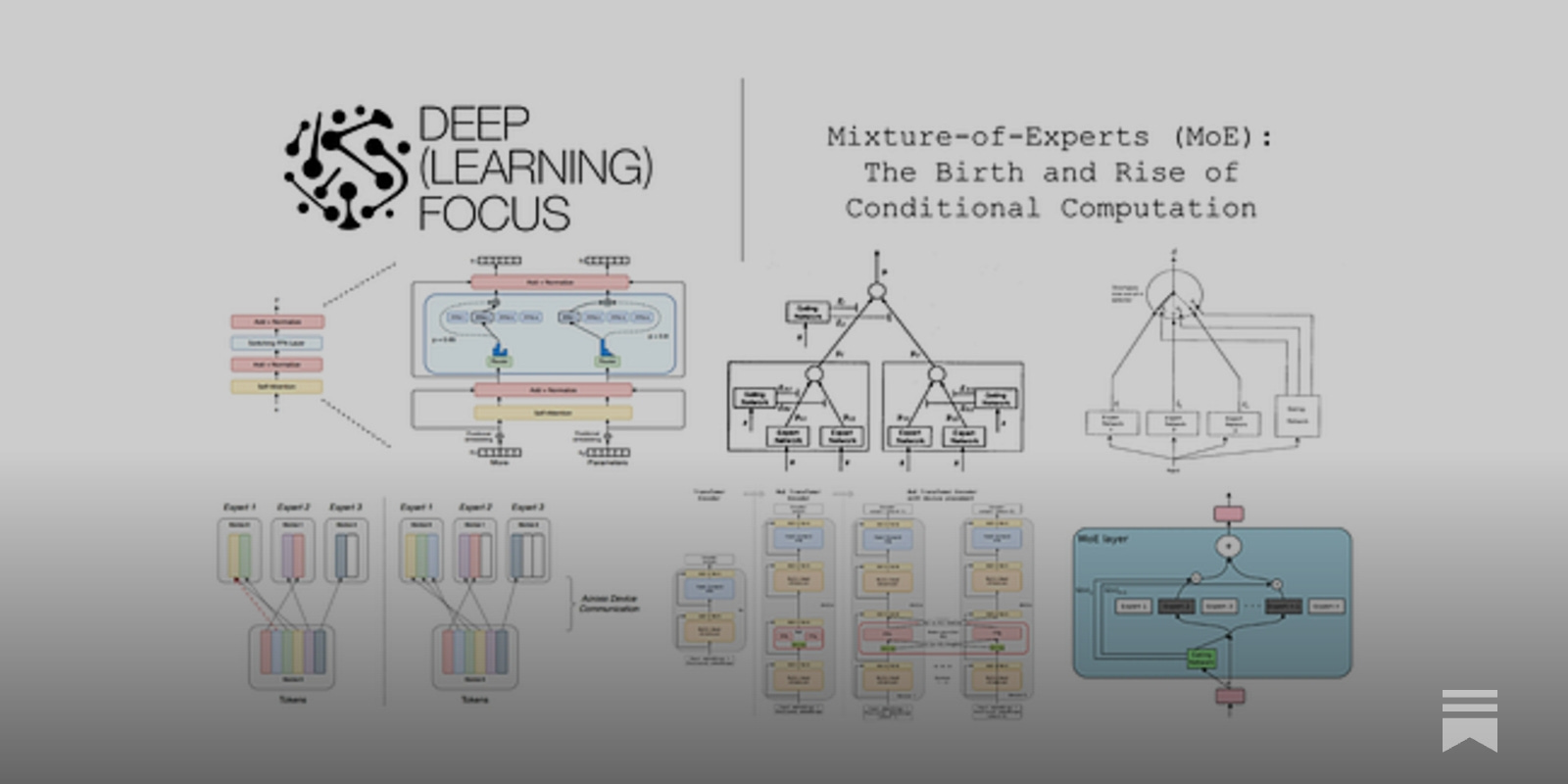
Mixture-of-Experts (MoE): The Birth and Rise of Conditional Computation
What two decades of research taught us about sparse language models...
ST-MoE: Designing Stable and Transferable Sparse Expert Models
Scale has opened new frontiers in natural language processing -- but at a high cost. In response, Mixture-of-Experts (MoE) and Switch Transformers have been proposed as an energy efficient path to even larger and more capable language models. But advancing the state-of-the-art across a broad set of natural language tasks has been hindered by training instabilities and uncertain quality during fine-tuning. Our work focuses on these issues and acts as a design guide. We conclude by scaling a sparse model to 269B parameters, with a computational cost comparable to a 32B dense encoder-decoder Transformer (Stable and Transferable Mixture-of-Experts or ST-MoE-32B). For the first time, a sparse model achieves state-of-the-art performance in transfer learning, across a diverse set of tasks including reasoning (SuperGLUE, ARC Easy, ARC Challenge), summarization (XSum, CNN-DM), closed book question answering (WebQA, Natural Questions), and adversarially constructed tasks (Winogrande, ANLI R3).
Kimi K2: Open Agentic Intelligence
Kimi K2 is our latest Mixture-of-Experts model with 32 billion activated parameters and 1 trillion total parameters. It achieves state-of-the-art performance in frontier knowledge, math, and coding among non-thinking models.
Inkling: Our Open-Weights Model
Our first open-weights model: multimodal, Mixture-of-Experts, with controllable reasoning effort. Available to fine-tune on Tinker.

Mixture-of-Experts Meets Instruction Tuning:A Winning Combination for Large Language Models
Sparse Mixture-of-Experts (MoE) is a neural architecture design that can be utilized to add learnable parameters to Large Language Models (LLMs) without increasing inference cost. Instruction tuning is a technique for training LLMs to follow instructions. We advocate combining these two approaches, as we find that MoE models benefit more from instruction tuning than dense models. In particular, we conduct empirical studies across three experimental setups: (i) Direct finetuning on individual downstream tasks devoid of instruction tuning; (ii) Instructiontuning followed by in-context few-shot or zero-shot generalization on downstream tasks; and (iii) Instruction tuning supplemented by further finetuning on individual downstream tasks. In the first scenario, MoE models overall underperform dense models of identical computational capacity. This narrative, however, dramatically changes with the introduction of instruction tuning (second and third scenario), used independently or in conjunction with task-specific finetuning. Our most powerful model, FLAN-MOE-32B, surpasses the performance of FLAN-PALM-62B on four benchmark tasks, while using only a third of the FLOPs. The advancements embodied byFLAN-MOE inspire a reevaluation of the design principles of large-scale, high-performance language models in the framework of task-agnostic learning.
GLaM: Efficient Scaling of Language Models with Mixture-of-Experts
Scaling language models with more data, compute and parameters has driven significant progress in natural language processing. For example, thanks to scaling, GPT-3 was able to achieve strong results on in-context learning tasks. However, training these large dense models requires significant amounts of computing resources. In this paper, we propose and develop a family of language models named GLaM (Generalist Language Model), which uses a sparsely activated mixture-of-experts architecture to scale the model capacity while also incurring substantially less training cost compared to dense variants. The largest GLaM has 1.2 trillion parameters, which is approximately 7x larger than GPT-3. It consumes only 1/3 of the energy used to train GPT-3 and requires half of the computation flops for inference, while still achieving better overall zero-shot and one-shot performance across 29 NLP tasks.
LukeW | Rethinking Networking for the AI/ML Era
In her AI Speaker Series presentation at Sutter Hill Ventures, Google Distinguished Engineer Nandita Dukkipati explained how AI/ML workloads have completely bro...

Algorithmic Data Minimization for Machine Learning over...
Machine learning can analyze vast amounts of data generated by IoT devices to identify patterns, make predictions, and enable real-time decision-making. By processing sensor data, machine learning...
Andrej Karpathy on Twitter / X
The race for LLM "cognitive core" - a few billion param model that maximally sacrifices encyclopedic knowledge for capability. It lives always-on and by default on every computer as the kernel of LLM personal computing.Its features are slowly crystalizing:- Natively multimodal… https://t.co/2jsVevkTSJ— Andrej Karpathy (@karpathy) June 27, 2025
Neural Networks: Zero To Hero
Dataset Distillation
Model distillation aims to distill the knowledge of a complex model into a simpler one. In this paper, we consider an alternative formulation called {\em dataset distillation}: we keep the model fixed and instead attempt to distill the knowledge from a large training dataset into a small one. The idea is to {\em synthesize} a small number of data points that do not need to come from the correct data distribution, but will, when given to the learning algorithm as training data, approximate the model trained on the original data. For example, we show that it is possible to compress $60,000$ MNIST training images into just $10$ synthetic {\em distilled images} (one per class) and achieve close to original performance with only a few steps of gradient descent, given a particular fixed network initialization. We evaluate our method in a wide range of initialization settings and with different learning objectives. Experiments on multiple datasets show the advantage of our approach compared to alternative methods in most settings.
DeepSeek_V4.pdf · deepseek-ai/DeepSeek-V4-Pro at main
We’re on a journey to advance and democratize artificial intelligence through open source and open science.
katanemo/Arch-Router-1.5B · Hugging Face
We’re on a journey to advance and democratize artificial intelligence through open source and open science.

Kimi K2 0711 - API Pricing & Benchmarks
Kimi K2 Instruct is a large-scale Mixture-of-Experts (MoE) language model developed by Moonshot AI, featuring 1 trillion total parameters with 32 billion active per forward pass. $0.57 per million input tokens, $2.30 per million output tokens. 131,072 token context window, maximum output of 32,768 tokens. Includes independent benchmarks from Artificial Analysis.
