


A swords-and-sorcery programming environment for building and counting mathematical structures
An invitation into Droste's Lair
A swords-and-sorcery programming environment for building and counting mathematical structures
4. Mathematical science of computation and structured programming
About - Project Euler
A website dedicated to the fascinating world of mathematics and programming
The operad of wiring diagrams: formalizing a graphical language for databases, recursion, and plug-and-play circuits
Wiring diagrams, as seen in digital circuits, can be nested hierarchically and thus have an aspect of self-similarity. We show that wiring diagrams form the morphisms of an operad $\mcT$, capturing this self-similarity. We discuss the algebra $\Rel$ of mathematical relations on $\mcT$, and in so doing use wiring diagrams as a graphical language with which to structure queries on relational databases. We give the example of circuit diagrams as a special case. We move on to show how plug-and-play devices and also recursion can be formulated in the operadic framework as well. Throughout we include many examples and figures.

Combinators: A Centennial View
100 years after combinators were first presented, Stephen Wolfram shows how his computational paradigm moves closer to the idea of combinators through a series of examples and with an eye to the future.

10 Common Data Structures Explained with Videos + Exercises
“Bad programmers worry about the code. Good programmers worry about data structures and their relationships.” — Linus Torvalds, creator of Linux Update _My video course about Algorithms is now live! Check out Algorithms in Motion from Manning Publica...

Generic deriving of generic traversals | Proceedings of the ACM on Programming Languages
Functional programmers have an established tradition of using traversals as a design pattern to work with recursive data structures. The technique is so prolific that a whole host of libraries have been designed to help in the task of automatically ...

The Rust Programming Language - The Rust Programming Language
by Steve Klabnik, Carol Nichols, and Chris Krycho, with contributions from the Rust Community
Categorical Data Structures for Technical Computing
Many mathematical objects can be represented as functors from finitely-presented categories $\mathsf{C}$ to $\mathsf{Set}$. For instance, graphs are functors to $\mathsf{Set}$ from the category with two parallel arrows. Such functors are known informally as $\mathsf{C}$-sets. In this paper, we describe and implement an extension of $\mathsf{C}$-sets having data attributes with fixed types, such as graphs with labeled vertices or real-valued edge weights. We call such structures "acsets," short for "attributed $\mathsf{C}$-sets." Derived from previous work on algebraic databases, acsets are a joint generalization of graphs and data frames. They also encompass more elaborate graph-like objects such as wiring diagrams and Petri nets with rate constants. We develop the mathematical theory of acsets and then describe a generic implementation in the Julia programming language, which uses advanced language features to achieve performance comparable with specialized data structures.

Alpaca – Algorithmic Pattern Catalogue
The Alpaca 2025 festival and conference on algorithmic patterns in the creative arts is happening this September 2025. Please see…
Symbolica | Modern Computer Algebra
High-performance symbolic-numeric computing for Python and Rust.

Brilliant | Your Personal Tutor for Math and Coding
Visual, interactive tutoring in math and coding, from 5th grade through college. Master concepts in algebra, calculus, Python, computer science, and more.
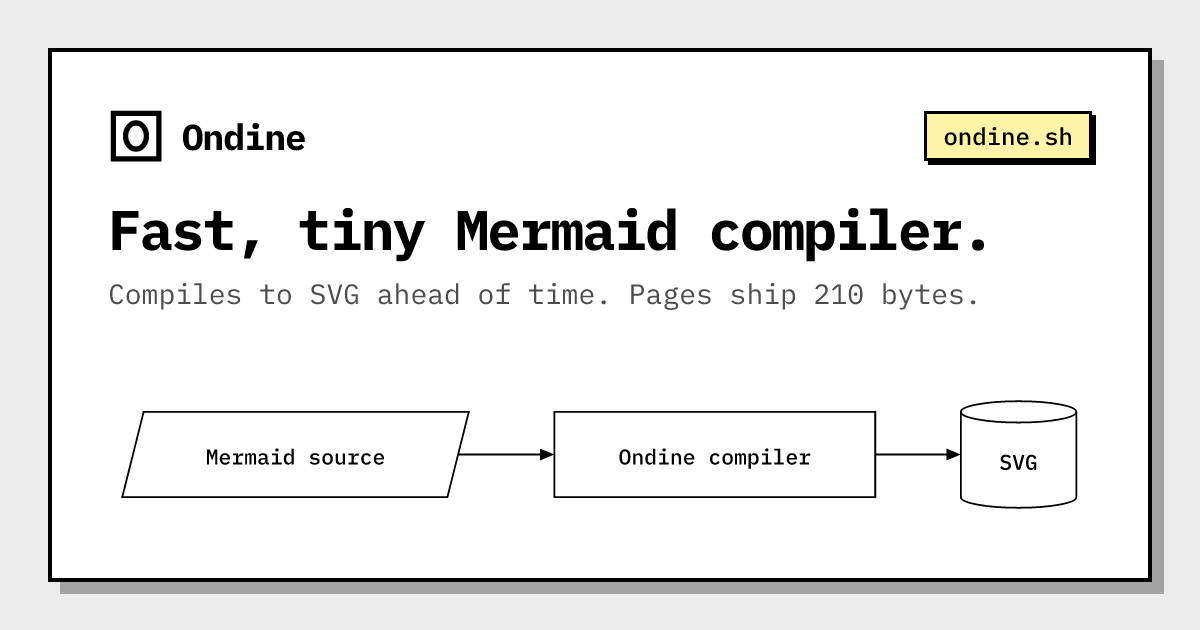
Ondine · Mermaid Diagrams, Compiled
A fast, small diagram engine for Mermaid syntax, written in Rust.
Prologue: How to Program
Naturally, when DrRacket calculates for you, it uses the rules that you know and love from math. Like you, it can determine the result of an addition only when all the operands are plain numbers. If an operand is a parenthesized operator expression—something that starts with a “(” and an operation—it determines the result of that nested expression first. Unlike you, it never needs to ponder which expression to calculate first—because this first rule is the only rule there is.
AI weight-space programming

Piano to flute, one weight edit
Can an LLM agent detect and repair a planted shortcut in a genomics CNN without data? A preregistered, blinded test of weight-space programming
Mixed Signals: Weight-Space Programming for EEG and ECG
Weight-space programming for auditing clinical decision networks
Weight-Space Programming for Medical Imaging: Do We Still Need Training Data?
statsleelab/weight_space_programming