

A deep-dive into machine learning embeddings.
Google for Developers Blog - News about Web, Mobile, AI and Cloud
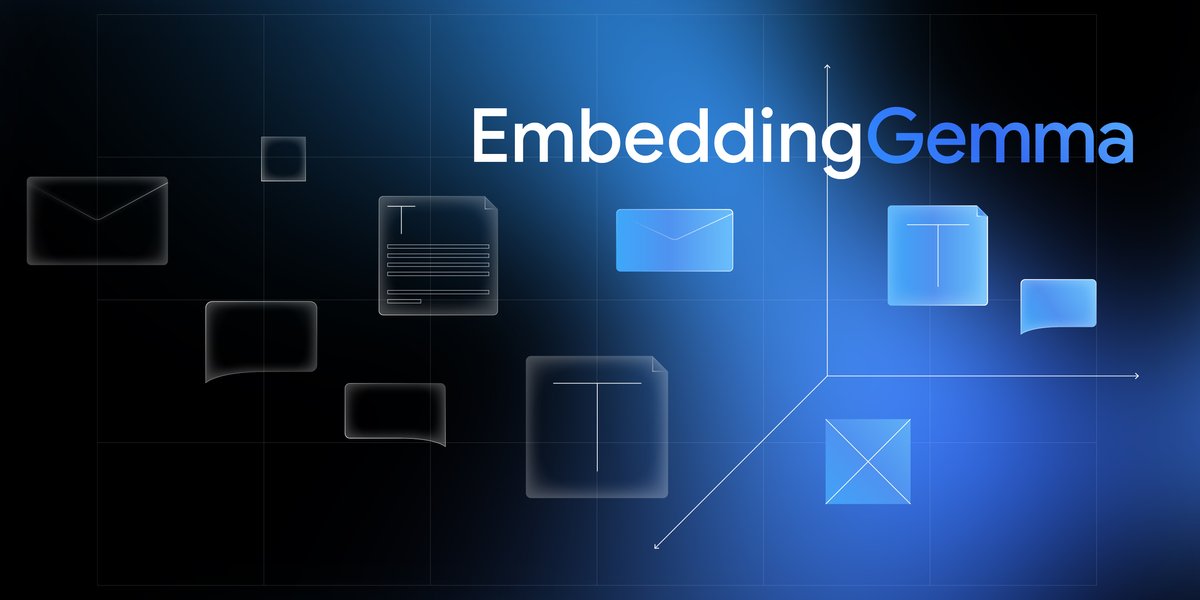
EmbeddingGemma 2 is a compact, open-source multimodal embedding model that maps text, code, images, video, and audio into a unified 768-dimensional space. Developers can use the sentence-transformers library to selectively load modular modality encoders—ranging from 270M to 740M parameters—to optimize memory usage. Additionally, Matryoshka Representation Learning enables dynamic dimension truncation down to 128d, significantly reducing vector database storage requirements while maintaining high retrieval performance.
Word embedding
In natural language processing, a word embedding is a representation of a word. The embedding is used in text analysis. Typically, the representation is a real-valued vector that encodes the meaning of the word in such a way that the words that are closer in the vector space are expected to be similar in meaning. Word embeddings can be obtained using language modeling and feature learning techniques, where words or phrases from the vocabulary are mapped to vectors of real numbers.

The Beginner’s Guide to Text Embeddings & Techniques | deepset Blog
Text embeddings represent human language to computers, enabling tasks like semantic search. Here, we introduce sparse and dense vectors in a non-technical way.

EmbeddingGemma: Powerful and Lightweight Text Representations
We introduce EmbeddingGemma, a new lightweight, open text embedding model based on the Gemma 3 language model family. Our innovative training recipe strategically captures knowledge from larger models via encoder-decoder initialization and geometric embedding distillation. We improve model robustness and expressiveness with a spread-out regularizer, and ensure generalizability by merging checkpoints from varied, optimized mixtures. Evaluated on the Massive Text Embedding Benchmark (MTEB) across multilingual, English, and code domains, EmbeddingGemma (300M) achieves state-of-the-art results. Notably, it outperforms prior top models, both proprietary and open, with fewer than 500M parameters, and provides performance comparable to models double its size, offering an exceptional performance-to-cost ratio. Remarkably, this lead persists when quantizing model weights or truncating embedding outputs. This makes EmbeddingGemma particularly well-suited for low-latency and high-throughput use cases such as on-device applications. We provide ablation studies exploring our key design choices. We release EmbeddingGemma to the community to promote further research.

EmbeddingGemma 2: an open, lightweight multimodal embedding model
Introducing EmbeddingGemma 2, an open multimodal embedding model optimized for privacy-first use cases
Fast Embeddings on GPUs
Fast and accurate search is vital to all of Perplexity, from Search and Computer to our API Platform. Behind the scenes, the heavy lifting is done by embedding

unsloth/embeddinggemma-2-GGUF · Hugging Face
We’re on a journey to advance and democratize artificial intelligence through open source and open science.

I Built an LLM From Scratch
ml5 - A friendly machine learning library for the web.
ml5.js aims to make machine learning approachable for a broad audience of artists, creative coders, and students. The library provides access to machine learning algorithms and models in the browser, building on top of TensorFlow.js with no other external dependencies.
Email triage with an embedding-based classifier · Adam Wiggins
I built a machine learning pipeline for email triage. Includes a hand-labeled golden set, training the model in the browser, and evals. Plus options for local vs cloud embeddings.

Google for Developers Blog - News about Web, Mobile, AI and Cloud
Discover EmbeddingGemma, Google's new on-device embedding model designed for efficient on-device AI, enabling features like RAG and semantic search.
Understanding Deep Learning Algorithms that Leverage Unlabeled Data, Part 2: Contrastive Learning
Theoretical analysis of contrastive learning algorithms for leveraging unlabeled data.
Machine Learning Glossary | Google for Developers
This glossary defines a wide range of machine learning terms, including those specific to TensorFlow and large language models.

Manifold hypothesis
The manifold hypothesis posits that many high-dimensional data sets that occur in the real world actually lie along low-dimensional latent manifolds inside that high-dimensional space.[1][2][3][4] As a consequence of the manifold hypothesis, many data sets that appear to initially require many variables to describe, can actually be described by a comparatively small number of variables, linked to the local coordinate system of the underlying manifold. It is suggested that this principle underpins the effectiveness of machine learning algorithms in describing high-dimensional data sets by considering a few common features.
Anatomy of a Machine Learning Ecosystem: 2 Million Models on Hugging Face
Generative artificial intelligence (AI) and machine learning (ML) models are being adopted across a variety of domains. As these technologies develop, there is notable diversity in their levels of availability and paths of diffusion. For example, fully closed-source models may be available through chatbots and API calls, but their weights, source code, training data, and other artifacts remain hidden from view. In contrast, open models make some or all of these materials publicly available for developers and downstream users.
I'm creating a series of short form videos about how language models work technically. The goal is to be something in between "you know it's next token prediction" and "now you've taken a machine learning class." I'd love your thoughts so here are the first few! 🧵 youtube.com/shorts/VZB8XCcyllE

How does ChatGPT work? Or rather, language models in general- Part 1 attempting a lay explanation.
www.youtube.com