

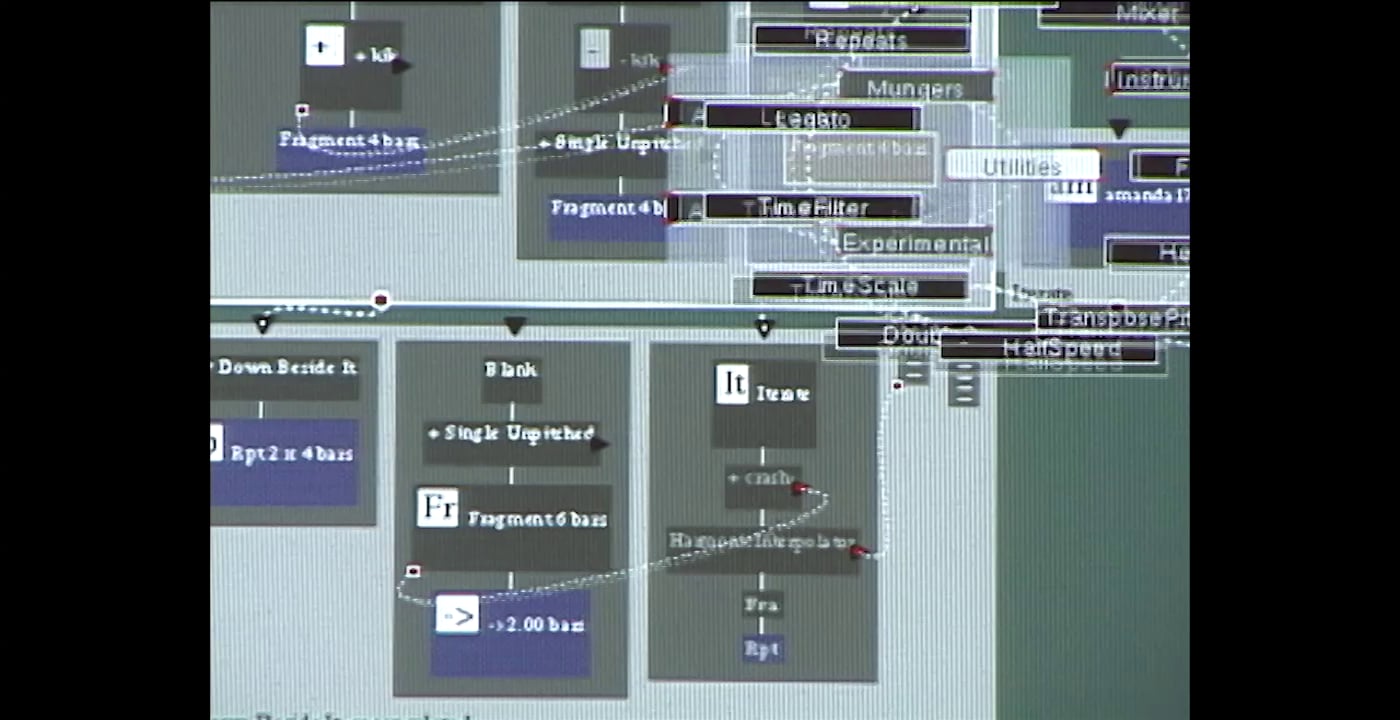
lobe ui // 2000 undulant interface for genetic music manipulation system. a tool for professional music synthesis, lobe needed a ui that would allow composers and producers to string together very large networks of processing nodes, each with some number of adjustable parameters and each with potential connections to one, two, or three other nodes. because depicting the node network at full detail would require thousands of times more screen space than is available, the ui invents a technique called "local quantized zooming" in which a single node can be caused to fold or unfold levels of detail, thus requiring more or less screen space. the work was also an opportunity to exercise two important interface design principles: (1) transitions between states -- animation -- can be information-bearing and context-preserving; (2) quiet, pseudoperiodic motion can disambiguate relationships that might otherwise be too dense or subtle to apprehend. designed and implemented for seminal music production studio 'tomandandy'. genetic music algorithms by jay hardesty and andy milburn.
“It’s unfamiliar, intimidating, and seemingly impenetrable for producers raised on DAWs like Ableton Live - but it can unlock a whole new world of creativity”: I tried a music tracker and it rewired my brain (in a good way)
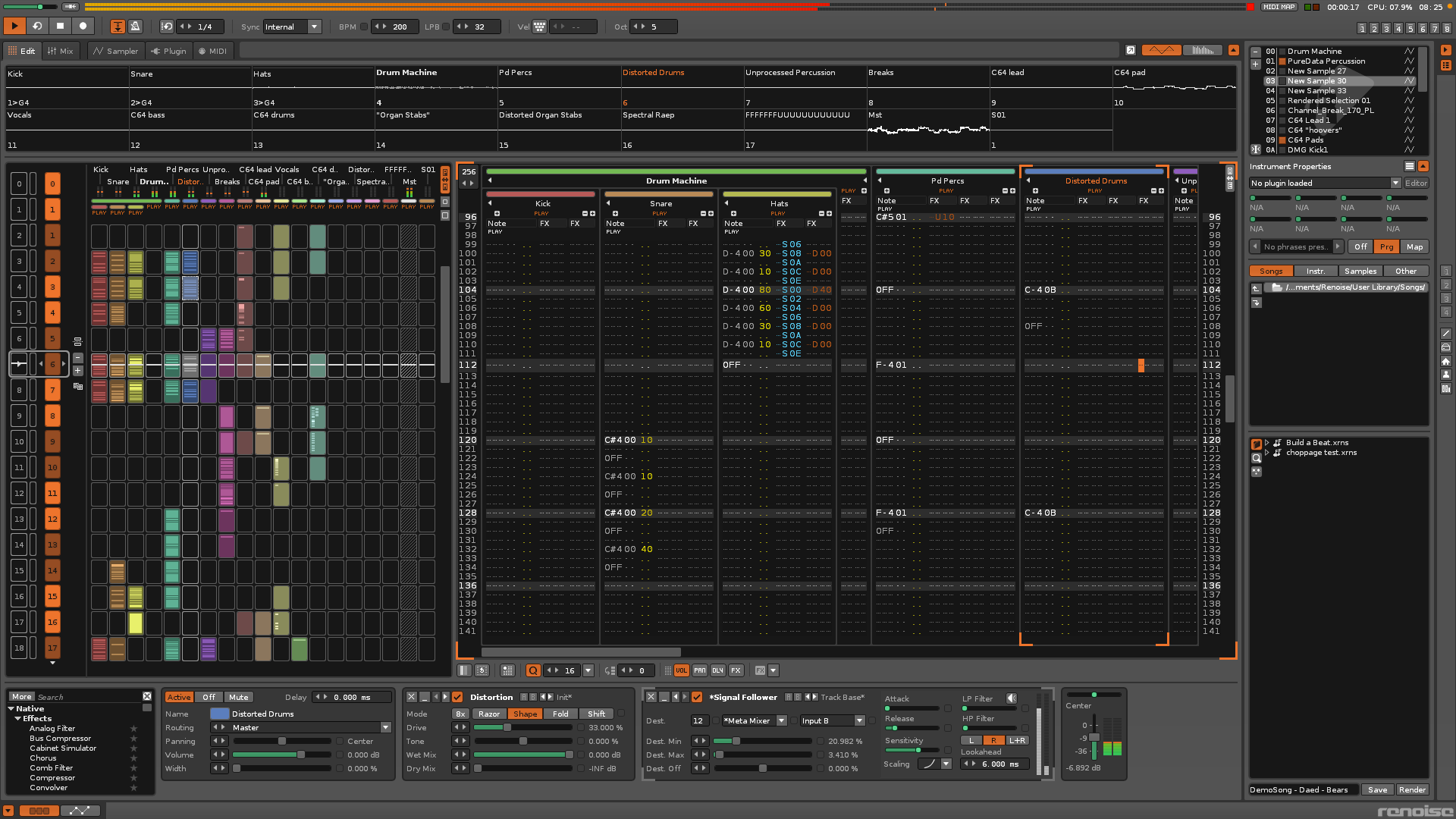
Beloved by artists from Aphex Twin to Deadmau5, trackers swap the trusty piano roll for a text-based, vertically-scrolling interface that looks like something out of The Matrix. Let's find out how deep the tracker rabbit hole goes
The Curious Case of Zoomable User Interfaces and AI
The Millions of Songs Mashed Into AI-Generated Music
Explore the astonishing amount of music available to AI developers.

EuterPen: Unleashing Creative Expression in Music Score Writing
The Algorithmic Flattening of Sound: Computational Evidence and Justice Implications of AI Music Homogenization
This paper audits whether large-scale generative music systems exhibit measurable musical homogenization relative to human-produced music, and develops a justice-centered account of why this matters. We audit two commercially deployed systems (Suno and Lyria 3) across four genres (Afrobeats, K-pop, Dance Pop, and Heavy Metal). For each system and genre, we generate 100 tracks and compare them against human corpora of equal size, using 72 music information retrieval (MIR) features and multiple diagnostics of dispersion, redundancy, and separability. We define homogenization as reduced acoustic variation in standard computational audio features including rhythm and timing, timbre/spectral shape, and dynamics, both within genres and across genre boundaries. We also generate tracks using only a genre name as the prompt, with no additional instructions, to reveal each system's default musical tendencies. The results show two structurally distinct homogenizing tendencies. Lyria reduces within-genre acoustic diversity, while Suno collapses the acoustic distinctions between genres without compressing within-genre spread. Neither system follows user prompts faithfully, indicating that the observed patterns reflect learned priors rather than prompt constraints. The two systems do not converge on a common acoustic profile and are more acoustically distant from each other than two random human subsamples would typically be. Nevertheless, a standard classifier distinguishes AI from human tracks near-perfectly on MIR features alone. We argue that these patterns matter not as an aesthetic curiosity but as a justice-relevant condition, shaping which musical styles become legible, valued, and economically rewarded as generated outputs increasingly circulate at scale.

Our New SAM Audio Model Transforms Audio Editing
We're introducing SAM Audio, a state-of-the-art AI model that enables you to segment sound.

ENDOGEN: a deep experimental exploratorium of lowercase synthesis - CDM Create Digital Music
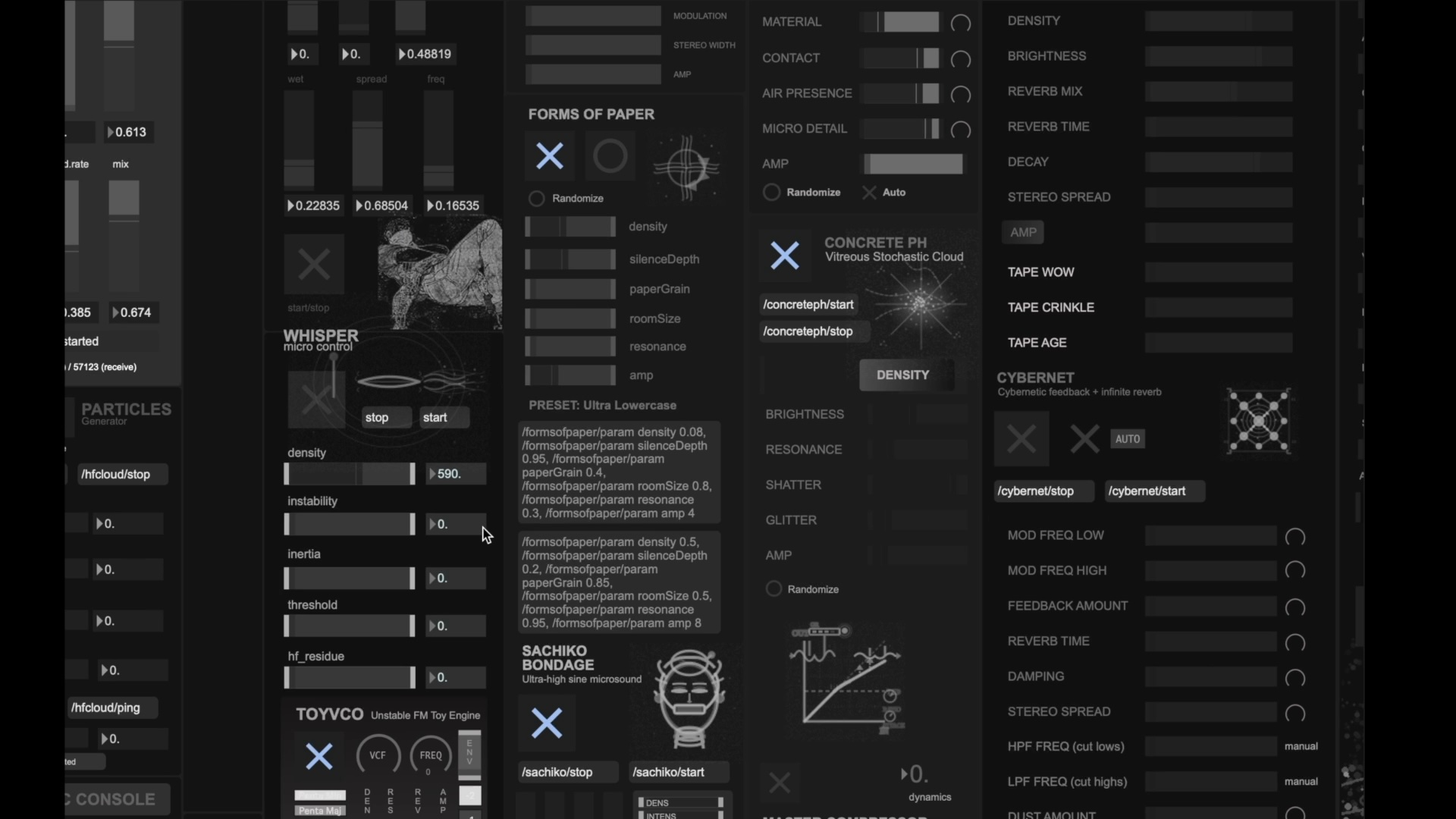
Enter an organic sound machine that will take you to an imagined sound world somewhere between a temple garden and a half-awake dream. ENDOGEN is a dazzling tool, built in Max and SuperCollider, that explores notions of lowercase synthesis. There's a lot to cover as far as what it can do -- but you should also feel empowered to play and get lost.
Art of Noise
A multi-sensory exploration of how design has changed the way we’ve experienced music over the past 100 years.

Cuelume. Interaction sounds for the web
Cuelume is a tiny, dependency-free library of carefully designed interaction sounds, synthesized live with Web Audio.

Cuelume. Interaction sounds for the web
Cuelume is a tiny, dependency-free library of carefully designed interaction sounds, synthesized live with Web Audio.
AI music tools challenge Bay Area musicians
AI music tools challenge Bay Area musicians: As affordable AI platforms spread, artists debate creativity, copyright and survival.

Malleable Music Ensembles
A framework using generalized algebraic theories and categorical lenses to enable interoperable, local-first networked music ensembles.
Awesome Generative UI - AI-Powered User Interface Generation Resources
Discover the best Generative UI resources: research papers, real-world cases, video tutorials, and open-source projects about AI-driven dynamic interface generation. Explore how LLMs like Gemini, Claude, and GPT are revolutionizing UI/UX design.
Why We’re Taking a Human‑First Stand on AI‑Generated Music — Qobuz Community
Artificial intelligence is transforming the music industry at an unprecedented pace. Faced with the explosion of AI-generated content and the legitimate questions it raises, Qobuz has chosen transparency. This charter establishes our framework: how we use AI, where we draw our lines, and what commi

