

Join the web’s most supportive community of creators and get high-quality tools for hosting, sharing, and streaming videos in gorgeous HD with no ads.
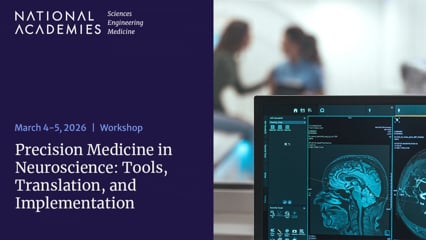
Precision Medicine in Neuroscience: Tools, Translation, and Implementation: A Workshop
Precision medicine approaches are rapidly transforming neuroscience, driven by advances in genetics, neuroimaging, biomarkers, and data science. These tools enable more refined disease classification, improved diagnosis, and treatments tailored to individual patients across neurological and psychiatric disorders. However, challenges remain in translating these advances into routine research and clinical practice. On March 4–5, the National Academies’ Forum on Neuroscience and Nervous System Disorders, in collaboration with the Forum on Drug Discovery, Development, and Translation and the Roundtable on Genomics and Precision Health, will host a workshop exploring opportunities, challenges, and strategies for integrating precision medicine into neuroscience research and care.

Inventing the future: A neuroscience research roadmap
The past decade of transformative advances in neurotechnology portends an exciting future for neuroscience. This NeuroView charts a strategic path to accelerate and integrate research discovery and speed the development of new cures for human brain disorders.

#digitalbrainproject #neuroscience #artificialintelligence #openscience #callforprojects #research #ai #brain | Fondation Adolphe de Rothschild
The Rothschild Foundation Hospital is excited to launch the Digital Brain Project, a $5M collaborative research initiative to build an open source foundational model of the brain through open-access neural data. Apply by May 15th for up to $500k in funding. Help crack the neural code 👉digitalbrainproject.org Our objective is to develop a standardized, publicly available dataset of human brain recordings to accelerate fundamental research in cognitive neuroscience, AI system development, and clinical health. Our independent, multidisciplinary Scientific Committee oversees data collection, ethical review, privacy, and open science practices of our project — setting standards for large-scale brain research. The Digital Brain Project is conceived as an open collaborative infrastructure, at the intersection of neuroscience, artificial intelligence, and data science. It aims to accelerate data development, a key bottleneck to developing a foundational AI model of the human brain. Key Focus Areas: 1️⃣ Brain recording data related to visual processing, language functions and cognitive actions 2️⃣ Rigorous quality, privacy, and ethical control, along with procedures for standardizing data across sites 3️⃣ Support for teams selected by an international multidisciplinary Scientific Committee Call for applications: Research teams working in neuroscience, neuroimaging, or artificial intelligence are invited to submit their applications by May 15, 2026. Selected teams will receive up to $500k USD funding to support their work. We appreciate our Scientific Committee (Lune Bellec Anne-Marie Kermarrec Arthur Mensch Russell Poldrack Lucia Melloni Jose Alain Sahel) for their independent scientific leadership, and partners Université de Montréal and AI at Meta for collaborating on this exciting project. #DigitalBrainProject #Neuroscience #ArtificialIntelligence #OpenScience #Callforprojects #Research #AI #Brain -------------------------------------------------------------- Pierre Bourdillon Julie Boyle Elisa Cascardi Jean-Rémi King Guillaume Le Hénanff Amélie Yavchitz Julien Gottsmann Fabrice VERRIELE Charlotte Cardin-Taillia

Massively Scalable Neurotechnologies
Backed by £50m, this programme sits within the Scalable Neural Interfaces opportunity space and is seeking radically new ways to deliver responsive neurotechnologies to the brain without brain surgery.
Computational Psychiatry Needs Systems Neuroscience
This piece was originally published in The Transmitter. I am adapting it here with some additional context for readers of this newsletter.
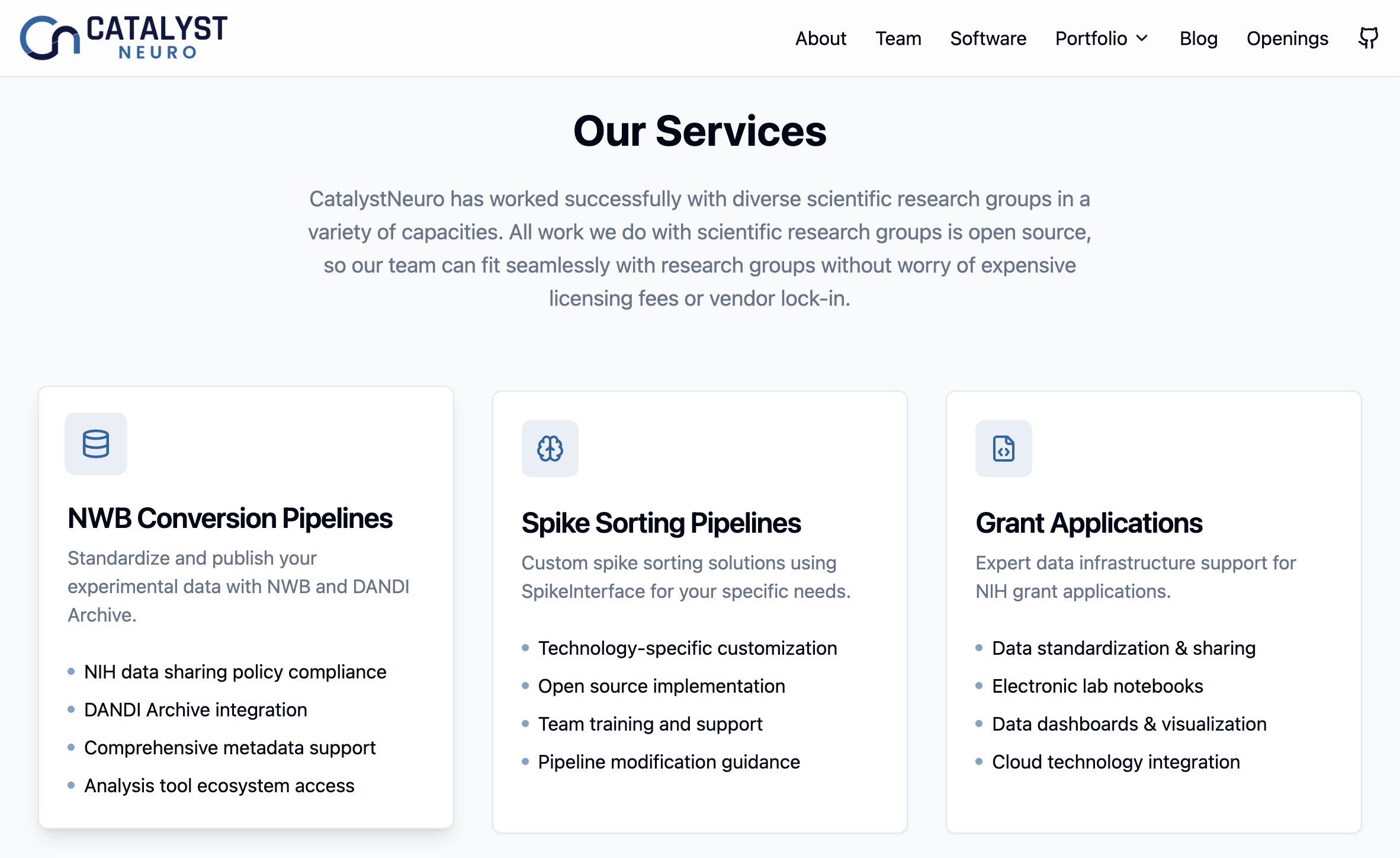
CatalystNeuro - Neurophysiology Data & Software Solutions
CatalystNeuro empowers neuroscience labs with data standardization, NWB conversions, spike sorting pipelines, and open-source software tools for neurophysiology research.
Leading Innovation in Psychiatric Treatment | Alto Neuroscience
We leverage brain biology to develop personalized medicines, helping patients get better faster.
#neuroscience #ai #python #opensource #neuroai | Jean-Rémi King
⚡ We're happy to release NeuralSet: a fast, simple, and scalable Python framework for Neuro-AI. Already supports: 🧠 fMRI, EEG, MEG, iEEG, spikes… recordings 💬 text, 🔊 audio, ▶️ video, 🏞️ image… embeddings 📦 `pip install neuralset` 💻 Code: https://lnkd.in/eamwxBUY 📄 Paper: https://lnkd.in/epbreyDy Made possible thanks to: Hubert Banville, Katie Begany, Corentin Bel, Yohann Benchetrit, Teon Brooks, Marlène Careil, Simon Dahan, Stéphane d'Ascoli, Alexandre Défossez, Linnea Evanson, PhD, Pablo J. Diego Simón, Julien Gadonneix, Sophia Houhamdi, Shubh Khanna, Jarod Lévy, Pierre Orhan, Antoine Ratouchniak, Joséphine Raugel, Andrea Elena Santos Revilla, Alexis Thual, Lucy (Mingfang) Zhang, Jérémy RAPIN #Neuroscience #AI #Python #OpenSource #NeuroAI
#neuroscience #ai #python #opensource #neuroai | Jean-Rémi King | 34 comments
⚡ We're happy to release NeuralSet: a fast, simple, and scalable Python framework for Neuro-AI. Already supports: 🧠 fMRI, EEG, MEG, iEEG, spikes… recordings 💬 text, 🔊 audio, ▶️ video, 🏞️ image… embeddings 📦 `pip install neuralset` 💻 Code: https://lnkd.in/eamwxBUY 📄 Paper: https://lnkd.in/epbreyDy Made possible thanks to: Hubert Banville, Katie Begany, Corentin Bel, Yohann Benchetrit, Teon Brooks, Marlène Careil, Simon Dahan, Stéphane d'Ascoli, Alexandre Défossez, Linnea Evanson, PhD, Pablo J. Diego Simón, Julien Gadonneix, Sophia Houhamdi, Shubh Khanna, Jarod Lévy, Pierre Orhan, Antoine Ratouchniak, Joséphine Raugel, Andrea Elena Santos Revilla, Alexis Thual, Lucy (Mingfang) Zhang, Jérémy RAPIN #Neuroscience #AI #Python #OpenSource #NeuroAI | 34 comments on LinkedIn
#neuroscience #ai #python #opensource #neuroai | Jean-Rémi King | 34 comments
⚡ We're happy to release NeuralSet: a fast, simple, and scalable Python framework for Neuro-AI. Already supports: 🧠 fMRI, EEG, MEG, iEEG, spikes… recordings 💬 text, 🔊 audio, ▶️ video, 🏞️ image… embeddings 📦 `pip install neuralset` 💻 Code: https://lnkd.in/eamwxBUY 📄 Paper: https://lnkd.in/epbreyDy Made possible thanks to: Hubert Banville, Katie Begany, Corentin Bel, Yohann Benchetrit, Teon Brooks, Marlène Careil, Simon Dahan, Stéphane d'Ascoli, Alexandre Défossez, Linnea Evanson, PhD, Pablo J. Diego Simón, Julien Gadonneix, Sophia Houhamdi, Shubh Khanna, Jarod Lévy, Pierre Orhan, Antoine Ratouchniak, Joséphine Raugel, Andrea Elena Santos Revilla, Alexis Thual, Lucy (Mingfang) Zhang, Jérémy RAPIN #Neuroscience #AI #Python #OpenSource #NeuroAI | 34 comments on LinkedIn
DANDI
DANDI: Distributed Archives for Neurophysiology Data Integration The DANDI platform is supported by the BRAIN Initiative for publishing, sharing, and processing neurophysiology data. The archive accepts cellular neurophysiology data including electrophysiology, optophysiology, and behavioral time-series, and images from immunostaining experiments. The platform is now available for data upload and distribution. The storage of data in the archive is also supported by the Amazon Opendata program. The data in the archive can be browsed using the Data Portal. For detailed instructions on how to interact (view, upload, download, process) with DANDI click here.
NeuroNYC
As the global leader in finance, policy, art, research, and medicine, the region is well-positioned to lead neurotech. We help foster and promote the local neurotech ecosystem: clinics, companies, funders, labs, and users.

Data Hosting & Sharing: The Open MEG Archive (OMEGA)
Welcome to the Open MEG Archive (OMEGA) The Open MEG Archive (OMEGA) is the fruit of a collaboration between the McConnell Brain Imaging Centre (BIC) of the Montreal Neurological Institute-Hospital

Introducing TRIBE v2: AI Model Predicts Human Brain Responses | AI at Meta posted on the topic | LinkedIn
Today we're introducing TRIBE v2, a foundation model trained to predict how the human brain responds to almost any sight or sound. Building on our Algonauts 2025 award-winning architecture, TRIBE v2 draws on 500+ hours of fMRI recordings from 700+ people to create a digital twin of neural activity. It enables zero-shot predictions for new subjects, languages, and tasks, consistently outperforming standard modeling approaches. We’re releasing the model, codebase, paper, and an interactive demo to help researchers advance neuroscience, apply brain insights to build better AI, and use computational simulation to speed up breakthroughs in neurological disease diagnosis and treatment. Try the demo and learn more here: https://go.meta.me/tribe2 | 175 comments on LinkedIn
Center for Precision Psychiatry & Mental Health
The Stavros Niarchos Foundation Center for Precision Psychiatry is a joint effort of the Columbia Department of Psychiatry at CUIMC and Columbia’s Zuckerman Mind Brain Behavior Institute.