

Just a place to ramble visually
Reintroducing Spaces - Daniel's Leaflets
Zooming out and re-motivating the design of spaces, the new primitive for non-public data on atproto.
Reintroducing Spaces - Daniel's Leaflets
Zooming out and re-motivating the design of spaces, the new primitive for non-public data on atproto.
Reintroducing Spaces - Daniel's Leaflets
Zooming out and re-motivating the design of spaces, the new primitive for non-public data on atproto.
The Curious Case of Zoomable User Interfaces and AI
Fullscreen rendering - Claude Code Docs
Enable a smoother, flicker-free rendering mode with mouse support and stable memory usage in long conversations.

Prof. Judy Fan: Cognitive Tools for Making the Invisible Visible
Prof. Judy Fan: Cognitive Tools for Making the Invisible Visible
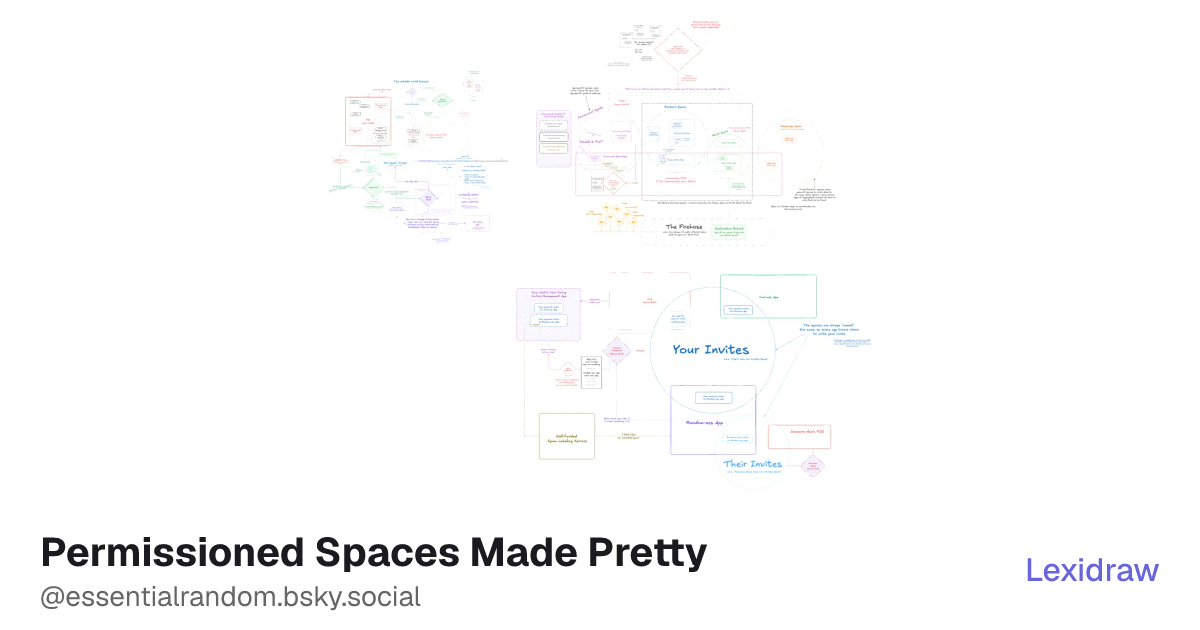
Permissioned Spaces Made Pretty — Lexidraw
A drawing by @essentialrandom.bsky.social on Lexidraw
visualising data structures and algorithms through animation - VisuAlgo
VisuAlgo was conceptualised in 2011 by Associate Professor Steven Halim (NUS School of Computing) as a tool to help his students better understand data structures and algorithms, by allowing them to learn the basics on their own and at their own pace. Together with his students from the National University of Singapore, a series of visualizations were developed and consolidated, from simple sorting algorithms to complex graph data structures. Though specifically designed for the use of NUS students taking various data structure and algorithm classes (CS1010/equivalent, CS2040/equivalent (inclusive of IT5003)), CS3230, CS3233, and CS4234), as advocators of online learning, we hope that curious minds around the world will find these visualizations useful as well.
Amelia Wattenberger 🪷 on Twitter / X
exploring ways we can "step back" from text/code and make sense of it,the way do in maps or how we can "fit more" in our visual system, it just gets smaller and decreases resolution.here's a fun one: extract the main concepts and throw them on a sphere, keep spinning to go… pic.twitter.com/yzh42EcBTe— Amelia Wattenberger 🪷 (@Wattenberger) July 6, 2026
Pad++: A Zooming User Interface (1998)
The Glimmer — thefugue.space
A brief history of my attempts to bring Spatial Computing to the wider audience..

Lexicon Embeds Overview
There’s an excellent discussion and thread about syntax highlighting of code blocks happening today: I think most notably there’s some alignment around using a lexicon to represent code blocks (say Tangled’s strings) and embedding those, rather than just doing syntax highlighting w/in the constraints of a bsky post. This seems like a good place to hammer a bunch of things out.

The Unbearable Brightness of Seeing
Is “frame architecture” our escape route from the dogma trap of endless culture wars?

ggtime: A Grammar of Temporal Graphics
Visualizing changes over time is fundamental to learning from the past and anticipating the future. However, temporal semantics can be complicated, and existing visualization tools often struggle to accurately represent these complexities. It is common to use bespoke plot helper functions designed to produce specific graphics, due to the absence of flexible general tools that respect temporal semantics. We address this problem by proposing a grammar of temporal graphics, and an associated software implementation, 'ggtime', that encodes temporal semantics into a declarative grammar for visualizing temporal data. The grammar introduces new composable elements that support visualization across linear, cyclical, quasi-cyclical, and other granularities; standardization of irregular durations; and alignment of time points across different granularities and time zones. It is designed for interoperability with other semantic variables, allowing navigation across the space of visualizations while preserving temporal semantics.

LIMINAL SPACES
Liminal spaces have become an internet aesthetic whereby photographs of places which are meant to be traversed (implying a temporary stay) are framed and presented as a final image. These spaces imply where people should be, but are not. The aesthetic also spreads to depictions of empty nostalgic spaces and the internet has branched into themed subgenres of liminal space (such as the backrooms, the poolrooms, the sublevels etc).