

This document defines a set of ECMAScript APIs in WebIDL to allow data to be sent and received from another browser or device implementing the QUIC protocol. The specification for multiplexing of QUIC with STUN/TURN/ZRTP/DTLS/RTP/RTCP [[RFC9443]] was developed within the IETF AVTCORE Working Group.
A p2p Vision for QUIC
Using QUIC to achieve everything needed for NAT traversal, from address discovery to proxying UDP
Media over QUIC
Media over QUIC is a new live media protocol designed for simplicity and scale. It uses new browser technologies like WebTransport and WebCodecs to deliver media with latency that rivals WebRTC.

Implement QUIC and HTTP/3 in the browser for WebTransport
FOSDEM 2026 - iroh p2p connections
iroh is a library to establish direct connections between two peers, wherever they are on the internet. It takes care of using different transports and holepunching as needed, to reliably establish connectivity. To the application a normal QUIC connection is presented. The aim is to be a connection layer for p2p, providing greater user agency.

NAT traversal and hole punching: from UDP to QUIC with iroh
How hole punching works, why TCP and plain UDP fall short, and how QUIC and iroh make direct P2P connections reliable.
Filling the remaining gap between WebSocket, WebRTC and WebTranspor
Existing web platform facilities for network communication include WebSocket and WebRTC. Each mandates a specific protocol, ensures TLS, and respects the Same Origin Policy. The proposed WebTransport is similar in these respects.
Going Peer to Peer with QUIC
Marten Seemann and I just published an entry on his blog, A p2p Vision for QUIC. This is a technical argument, explaining how a series of small improvements to the QUIC standards would suffice to make QUIC a great peer-to-peer (P2P) protocol. I personally love it, because the Internet suffers greatly from excessive centralization, with big platforms acting as gatekeepers. Currently, pretty much all user activities on the Internet are mediated by “services in the cloud”. Take for example something as simple as a security camera in your home. People want to check the camera images when they are outside the home. They cannot connect to the camera or even a home server directly, because the home network is “behind a NAT” – and very possibly behind multiple layers of NAT, given the scarcity of IPv4 addresses. The practical solution is to export the images from the camera to a “service in the cloud”, and to let user contact that service from their cellphone. It works, but it has obvious issues for privacy, security, or even continuity of service: if the cloud service stops, the camera gets bricked. The proposed QUIC architecture would provide a generic solution using the Masque standard for relaying QUIC, combine with QUIC NAT traversal extensions to migrate connections from “using the relay” to “directly P2P”, as shown in the following diagram. +------------------------------+ | Step 1: phone contacts | v the camera through +---|---+ +-----------+-+ the relay | Phone | | Masque ^ | +---|---+ | Relay | | | +-----------|-+ +-------------------------+ | | Step 2: phone and camera cooperate +-----|----|-+ and establish a "hole" in the NAT. | NAT | | | +-----|----|-+ Step 3: traffic flows directly | | between phone and camera without +-|----|-+ burdening the relay | Camera | +--------+ The standards to achieve that are almost ready. The relaying of incoming connections is described in the UDP Listen, already adopted in the Masque Working Group. A draft submitted to the IETF QUIC Working Group describes the Using QUIC to Traverse NAT, and another describes QUIC Address Discovery. I have already implemented the Address Discovery draft in picoquic, and intend to promptly implement the other two drafts. Using QUIC has many advantages. The communications are encrypted end to end, even when they are going through the relay, which has nice security and privacy benefits. The relay is uses standards and is not dependent on the application; if a relay goes out of business, just pick another one. In the weird cases where the NAT traversal fails, the application still works. There are of course many more applications of P2P possible, such as for example direct video calls between two homes, video games and more. The vision is clear: we can do all those applications using QUIC.
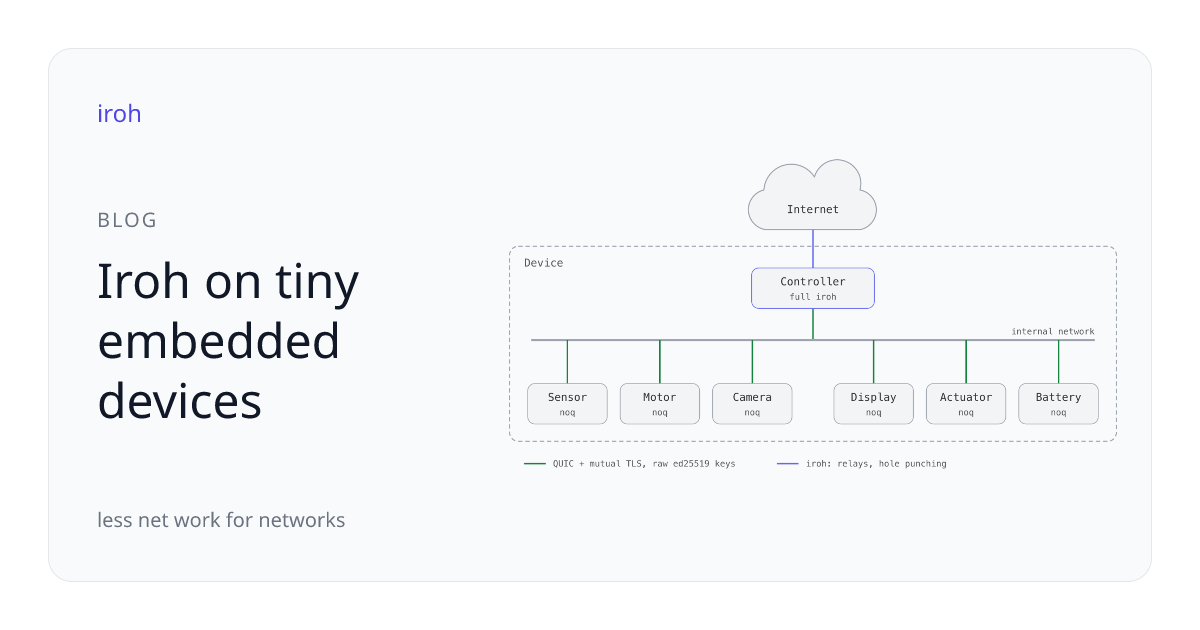
Iroh on tiny embedded devices
How to get mTLS encrypted QUIC connections even on tiny embedded devices
WebRTC: Making a peer-to-peer game using JavaScript
I recently had the chance to work on a prototype for a video chat service. It was an excellent opportunity to become more closely…
ATOM: AT Protocol Over MoQ Transport
This document specifies how the Authenticated Transfer (AT) Protocol can leverage Media over QUIC Transport (MOQT) for efficient data synchronization across decentralized social networks. The AT Protocol's firehose event stream and repository synchronization mechanisms map naturally to MOQT's publish/subscribe model, enabling scalable relay infrastructure, priority-based delivery, and improved resilience for large-scale social data distribution. This specification addresses the challenges of the current WebSocket- based transport and demonstrates how MOQT's relay architecture, group-based caching, and multiplexed streams provide significant benefits for AT Protocol deployments at scale.
datum-cloud/app
A desktop app for safely exposing local services on the Internet via Iroh tunnels using QUIC. Built in rust.
EmbarkStudios/quilkin
Quilkin is a non-transparent UDP proxy specifically designed for use with large scale multiplayer dedicated game server deployments, to ensure security, access control, telemetry data, metrics and more.
quilling.dev/ratlogin
An OIDC provider for AT Protocol OAuth. Rust port of apenwarr/atlogin.
FEP-1042: Peer to Peer Fediverse Identities
Hey folks, we at [Distributed Press](https://distributed.press) have been working on making a bridge between peer to peer or "dweb" protocols and ActivityPub implementations over the past year and wanted to solidify our approach so that others can interoperate. Here's is an initial draft expla...
particularly excited about this because webrtc data channels mean you can add just about any p2p functionality. for example, you could get around the latency issues with my yjs demo by exchanging updates peer-to-peer rather than using the firehose.

Jake Lazaroff
couldn't make it to #atmosphereconf so i've been cooking at home instead i'm pretty excited about this one: a way to build real-time collaborative apps with *no dedicated sync infrastructure* — just some static files and atproto