

“We have no new masters because digital technology is more than an invention, tool, or genre,” wrote Jerry Saltz recently in his review of the New Museum Triennial. “It is a whole new landscape, a new biology, one that is changing us as much as we are changing it—and could one day live on the moon or inside us. Either way, we are digital’s bitches.”
Digital Art Enters the Museum Age — Social Software
We explore code and systems as a medium for creating new forms of art. We consider "software" in an expanded sense, examining the ways that we are programmed by technology around us and the ways we can write software to make change in the world.
The Digital Life Collective
The Digital Life Collective is an enabler. If you think we should be doing something we're not currently doing, we're here to help you and your project make the change you want to see in the world.
Decent Imaginaries
The digital sphere appears to be at an inflection point and we need to imagine what comes next as this era rots and burns. Imagining a renewed, decentralised world is difficult, but we can pull it off.
Everything is miscellaneous : the power of the new digital disorder
Includes bibliographical references (p. [235]-257) and index; Prologue : information in space -- The new order of order -- Alphabetization and its discontents -- The geography of knowledge -- Lumps and splits -- The laws of the jungle -- Smart leaves -- Social knowing -- What nothing says -- Messiness as a virtue -- The work of knowledge -- Coda : misc; Philosopher Weinberger shows how the digital revolution is radically changing the way we make sense of our lives. Human beings constantly collect, label, and organize data--but today, the shift from the physical to the digital is mixing, burning, and ripping our lives apart. In the past, everything had its one place--the physical world demanded it--but now everything has its places: multiple categories, multiple shelves. Everything is suddenly miscellaneous. Weinberger charts the new principles of digital order that are remaking business, education, politics, science, and culture. He examines how Rand McNally decides what information not to include in a physical map (and why Google Earth is winning that battle), how Staples stores emulate online shopping to increase sales, why your children's teachers will stop having them memorize facts, and how the shift to digital music stands as the model for the future.--From publisher description; From A to Z, Everything Is Miscellaneous will completely reshape the way you think - and what you know - about the world. Includes information on alphabetical order, Amaxon.com, animals, Aristotle, authority, Bettmann Archive, blogs (weblogs), books, broadcasting, British Broadcasting Corporation (BBC), business, card catalog, categories and categorization, clusters, companies, Colon Classification, conversation, Melvil Dewey, Dewey Decimal Classification system, Encyclopaedia Britannica, encyclopedia, essentialism, experts, faceted classification system, first order of order, Flickr.com, Google, Great Books of the Western World, ancient Greeks, health and medical information, identifiers, index, inventory tracking, knowledge, labels, leaf and leaves, libraries, Library of Congress, links, Carolus Linnaeus, lumping and splitting, maps and mapping, marketing, meaning, metadata, multiple listing services (MLS), names of people, neutrality or neutral point of view, New York Public Library, Online Computer Library Center (OCLC), order and organization, people, physical space, everything having place, Plato, race, S.R. Ranganathan, Eleanor Rosch, Joshua Schacter, science, second order of order, simplicity, social constructivism, social knowledge, social networks, sorting, species, standardization, tags, taxonomies, third order of roder, topical categorization, tree, Uniform Product Code (UPC), users, Jimmy Wales, web, Wikipedia, etc

Emergence: the connected lives of ants, brains, cities and software
In the tradition of Being Digital and The Tipping Point…

Escaping the Calculating Machine
Rhizome champions born-digital art and culture through commissions, exhibitions, scholarship, and digital preservation.

Thoughts on Cyberpositionality: The Construction of Digital Communities in Digital Spaces, Damien Patrick Williams
I found Rebecca Monteleone, Martin Perez Comisso, and Elma Hajric’s “Cyberpositionality: Sociotechnical Location in the Digital Age” (2024) to be an extremely timely and important article which can…

Advancing Women & Technology: Empowering Futures Through Digital Skills: 2025: News and Resources: About Us: Center of Excellence for Women & Technology: Indiana University Bloomington
In today’s fast-paced digital world, technology isn’t just a career path-it’s a compelling tool for empowerment.
Digital Degrowth: Radically Rethinking our Digital Futures
We are fast approaching the point of “peak digital”, with the continued mass production and excessive consumption of digital technologies set to become a key driver of climate crisis, ecological breakdown and ongoing societal instability.<br /> <br /><i>Digital Degrowth</i> is a call to completely rethink our digital futures in these fast-changing times. It explores how degrowth thinking and alternate forms of “radically sustainable computing” might support ambitions of sustainable, scaled-down and equitable ways of living with digital technologies. Neil Selwyn proposes a rebalancing of digital technology use: digital degrowth is not a call for simply making reduced use of the digital technologies that we already have – rather it is an argument to reimagine digital practices that maximise societal benefits with minimal environmental and social impact. Drawing on illustrative examples from across computer science, hacker and environmental activist communities, this book examines how core degrowth principles of conviviality, autonomy and care are already being used to reimagine alternate forms of digital technology.<br /> <br />Original and stimulating, this is essential reading for students and scholars of media and communication, sustainability studies, political ecology, computer/data sciences, and across the social sciences.

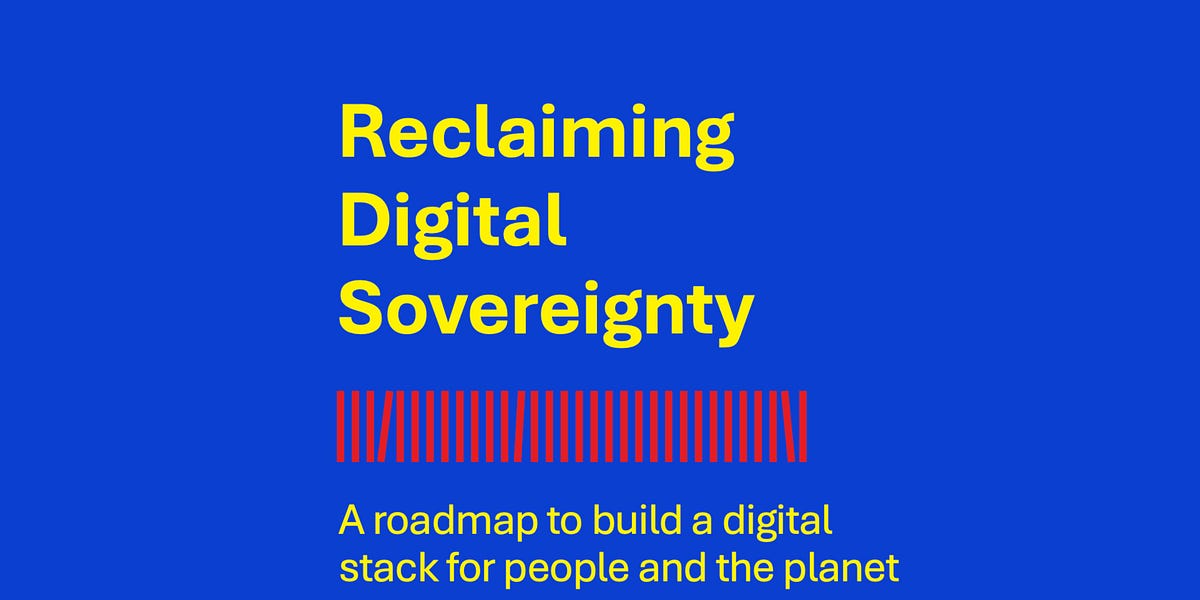
Why we must reclaim digital sovereignty
A new white paper envisions a radically different technological future
Digital Gardens | The Paper Pilot
The Paper Pilot's digital garden of thoughts on philosophy, politics, and sociology
Digital Freedom
Roberta Fischli & Thomas Beschorner argue that our digital future is not preprogrammed: it’s about time we start thinking about what it should look like.
The cinematograph, the "noematograph," and the future of AI art
From the cinematograph to the "noematograph," the Hugh-winning author explores how technology has, and may still, breed new artistic forms.

Interface Aesthetics: An Introduction
Rhizome champions born-digital art and culture through commissions, exhibitions, scholarship, and digital preservation.


Digital gardening

Digital gardens in theory and practice
oleeskild/obsidian-digital-garden
Tranquil PDS
Garden and the Stream - thoughts
Digital Gardens (by owais) — Semble
digital gardens (by treethought) — Semble