


a personal manifesto and declaration - also known as I am threading a connection through all the notes I've sent myself over the last six months
Manifesto: An Online Creative's Social Web Dethroning - HK★TMK
"Oh great, now he's writing manifestos…" Don't worry. It's just a personal one to solidify and manifest how I want to use the Social Web once my detox concludes.
Toward a durable writing stack – Writings and rehearsals by Nathan Schneider
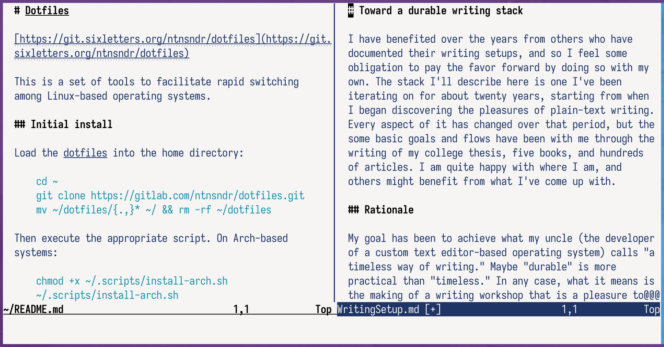
I have benefited over the years from others who have documented their writing setups, and so I feel some obligation to pay the favor forward by doing so with my own. The stack I’ll describe here is one I’ve been iterating on for about twenty years, starting from when I began discovering the pleasures of plain-text writing. Every aspect of it has changed over that period, but the some basic goals and flows have been with me through the writing of my college thesis, five books, and hundreds of articles. I am quite happy with where I am, and others might benefit from what I’ve come up with.
Libra Season: iPhone Modernism by Travis Diehl
The shock-of-the-new is back in literature, rebooted for screen time – and with it, the question: To what end should writing reflect our networked selves?

Interconnected, a blog by Matt Webb
My notebook and space for thinking out loud since February 2000.

The Resonant Computing Manifesto by Techdirt
The Social Meaning of the Personal Computer: Or, Why the Personal Computer Revolution Was No Revolution
This essay presents a processual model of the personal computing movement that depicts the PC's birth within the context of complex and often contradictory social strategies, each of which used the meaning of computer technology in a distinctive way. It suggests that innovators are constrained by such processes to depict new artifacts in culturally meaningful ways, so that it is difficult for them to conceive of their technologies in radical terms. The rhetoric of "revolution" aside, innovators found it expedient to draw from the stock of meanings at hand as they created new meaning-frameworks for their artifacts. The result is that the new artifacts did not express a coherent or effective political vision and failed to have the intended social effects. This study implies that new technologies frequently reproduce existing social and meaning systems; if they do bring about social change, the changes may differ from those intended by the innovators.
The Social Meaning of the Personal Computer: Or, Why the Personal Computer Revolution Was No Revolution
This essay presents a processual model of the personal computing movement that depicts the PC's birth within the context of complex and often contradictory social strategies, each of which used the meaning of computer technology in a distinctive way. It suggests that innovators are constrained by such processes to depict new artifacts in culturally meaningful ways, so that it is difficult for them to conceive of their technologies in radical terms. The rhetoric of "revolution" aside, innovators found it expedient to draw from the stock of meanings at hand as they created new meaning-frameworks for their artifacts. The result is that the new artifacts did not express a coherent or effective political vision and failed to have the intended social effects. This study implies that new technologies frequently reproduce existing social and meaning systems; if they do bring about social change, the changes may differ from those intended by the innovators.
Subverting the Dominant Metaphor // Dietrich Ayala, Protocol Labs
The Politics of Design: A (Not So) Global Design Manual for Visual Communication
A (Not So) Global Design Manual for Visual Communication

On Writing #3
Periodically I like to gather various observations about writing, and share my perspective.

Creative Reading: Scaffolding Reading for Transformation
However, recent work on augmenting reading largely focuses on making reading more efficient, especially in knowledge-intensive contexts where people must rapidly make sense of research papers and other complex documents (Lo et al., 2024). These systems often aim to help readers skim, summarize, and synthesize large volumes of information in order to reduce cognitive effort and accelerate document- and corpus-level sensemaking at scale (Gu et al., 2025; Lo et al., 2024; Fok et al., 2023). At one extreme, the form of reading implicitly envisioned by these systems may resemble what we call “reading to discard”: extracting the essential, actionable informational core of a document as quickly and efficiently as possible, so that the rest can be swiftly tossed aside—much like we often process inbound mail. This motivates us to ask what scaffolding approaches might resist “reading to discard,” what alternative forms of reading we might scaffold, and what alternative views and values of reading might guide the conversation.
A personal essay about how I’ve been feeling and thinking about this new technology that I’m contributing to and what it might to do to us all. togelius.blogspot.com/2026/08/losing-my-religion.ht…
Losing my religion
togelius.blogspot.com
