

Talk about technology, long familiar to science-fiction readers and writers, is getting popular in Academia too. Particularly interesting to humanists is the connection between technology and whatever their own particular subject happens to be; I've attended three such formal symposia in the last five years, six including SF conventions, and including informal discussions among students, in writing classes, SF classes, and elsewhere, somewhere between fifty and sixty.
Technopoly: The Surrender of Culture to Technology
A witty, often terrifying that chronicles our transform…

Technological Metamodernism (Sep 2024)
Technological Metamodernism A four-week course with Stephen Reid and special guests Telegram group: https://t.me/+4CC9lfZMBN04ZTdk Substack post announcing the open-sourcing of the notes: https://stephenreid.substack.com/p/technological-metamodernism-course This work is licensed under Cre...

Becca Lewis - Reactionary Futurism - 2025/2027 Rogers Chair Series
Changing Minds: Computers, Learning, and Literacy
An impassioned guide to how computers can fundamentally change how we learn and think.Andrea diSessa's career as a scholar, technologist, and teacher has b
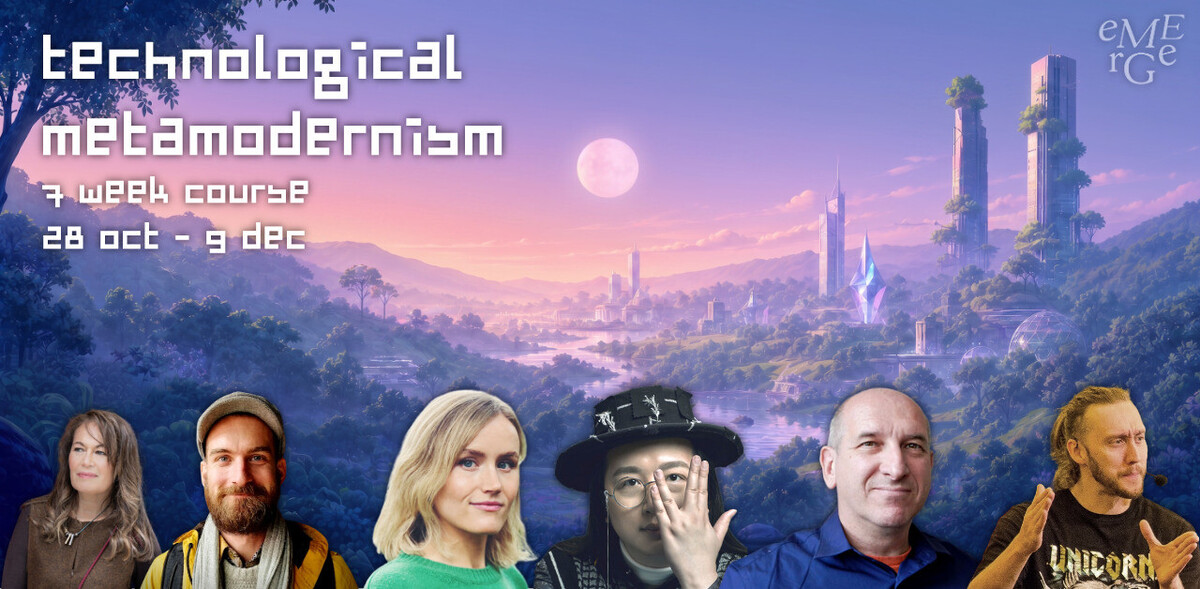
Technological Metamodernism: A seven-week course
Wed 28th Oct 2026, 1pm – Wed 9th Dec 2026, 2pm EDT (UTC -04:00)
Coordination Tech in Science: Letters, Journals, and Whatever Comes Next | shishyko!
To modernize our scientific infrastructure, we need new contextualization and coordination technologies that decouple trust from legacy branding — shifting from gatekeeping on write to algorithmic contextualization on read.
Wired women : gender and new realities in cyberspace
Come in, CQ: the body on the wire / Ellen Ullman -- The memoirs of a token: an aging Berkeley feminist examines Wired / Paulina Borsook -- How hard can it be? / Karen Coyle -- Closure was never a goal in this piece / Judy Malloy and Cathy Marshall -- Estrogen brigades and "big tits" threads: media fandom online and off / Susan Clerc -- Elites, lamers, narcs and whores: exploring the computer underground / Netta "grayarea" Gilboa -- We are geeks, and we are not guys: the systers mailing list / L. Jean Camp -- Not for the faint of heart: contemplations on Usenet / Judy Anderson "yduJ" -- The price of admission: harassment and free speech in the wild, wild West / Stephanie Brail -- Sex, fear and condescension on campus: cybercensorship at Carnegie Mellon / Donna M. Riley -- Cocktails and thumbtacks in the old West: what would Emily Post say? / Laurel A. Sutton -- "So please stop, thank you": girls online / Michele Evard -- MUDder? I hardly know 'er: adventures of a feminist MUDder / Lori Kendall -- Like magic, only real / Tari Lin Fanderclai -- Coming apart at the seams: sex, text and the virtual body / Shannon McRae; Includes bibliographical references; Ellen Ullman shares an email courtship - Paulina Borsook exposes gender attitudes at the digerati's magazine of record - Karen Coyle on overcoming macho stereotypes - Judy Malloy and Cathy Marshall reflect on their art/research collaboration - Susan Clerc and the zeal of media fandom - Netta Gilboa explores hackers' attitudes toward women - Jean Camp on the Internet's safe havens - Judy Anderson's advice on dodging Usenet flames - Stephanie Brail seeks the line between free speech and harassment - Donna Riley reveals the story of the Clitoral Hoods - Laurel Sutton and the nuances of netiquette - Michele Evard takes news-groups to the fifth grade - Lori Kendall wonders if gender is meaningless online - Tari Lin Fanderclai on MUDs as a powerful teaching tool - Shannon McRae takes a look at "virtual sex"

Telepath: building a new kind of computer
So, we made a thing: Let’s back up: for as long as I can remember, I’ve been obsessed with computers, fascinated not just by what they can do but what they could become. Like many, I took my early inspiration from science fiction. I dreamed of someday having something like the Enterprise’s computer. And why not? Science fiction has always driven scientists, engineers, and inventors to create real things that change the world.
Topics — Real Life
ABOUT TOPICS: Since we began Real Life in the summer of 2016, we’ve run many essays across a range of topics, with a particular focus on the personal and cultural implications of living with technology. Our aim is not to track the news cycle so much as the longstanding social issues that inform and transcend it. We wanted to make it easier to read and explore Real Life beyond our chronological archive, so we’ve created these Topics to gather in one place the work we’ve published on some key themes. More Topics will be added to this page over time.

AT Protocol: explanation for non-techies? - Debbie's Blatherings - by Debbie Ridpath Ohi
Working on an explanation without tech jargon, for fellow creatives
🧩 Don't make Tech your entire personality.
This is one of those articles that I wanted to write for many days, but I kept delaying it until, a...

The 1989 CBC Massey Lectures, "The Real World of Technology"
Technology has always been a part of human existence. Today though, says the experimental physicist, Ursula M. Franklin, technology has large-scale effects on culture itself. Ursula Franklin is an experimental physicist, University Professor Emeritus at the University of Toronto, a former board member of the National Research Council and the Science Council of Canada, and a companion of the Order...

Thoughts on Cyberpositionality: The Construction of Digital Communities in Digital Spaces, Damien Patrick Williams
I found Rebecca Monteleone, Martin Perez Comisso, and Elma Hajric’s “Cyberpositionality: Sociotechnical Location in the Digital Age” (2024) to be an extremely timely and important article which can…

During the 1980s and 1990s, networks of evangelists and venture capitalists fused technological boosterism with reactionary social ideals. Our video of the week examines the deep roots of Silicon Valley's shift toward the right. Featuring @beccalew.bsky.social at @westernu.ca buff.ly/ydgntnc
If you’re an AT Proto enthusiast, do yourself a favour and read @yanisvaroufakis.bsky.social ‘s “Technofeudalism”. I swear you’ll have an eureka moment of understanding the real potential of AT Proto within society.

