


Why public data needs private consent
Government to ease data consent rules for AI development | The Asahi Shimbun Asia & Japan Watch
To accelerate artificial intelligence development, the government plans to relax consent requirements for access to personal information while introducing tougher penalties for intentional misuse.

A Path Forward: Rights and Rules to Protect Privacy in the United States – Open Policy & Advocacy
Privacy is on the tip of everyone’s tongue. Lawmakers are discussing how to legislate it, big tech is desperate to show they care about it, and everyday people are looking ...

Why data ownership is the wrong approach to protecting privacy | Brookings
Cameron Kerry and John B. Morris argue that assigning property rights to consumer data would slow down the free flow of information online.

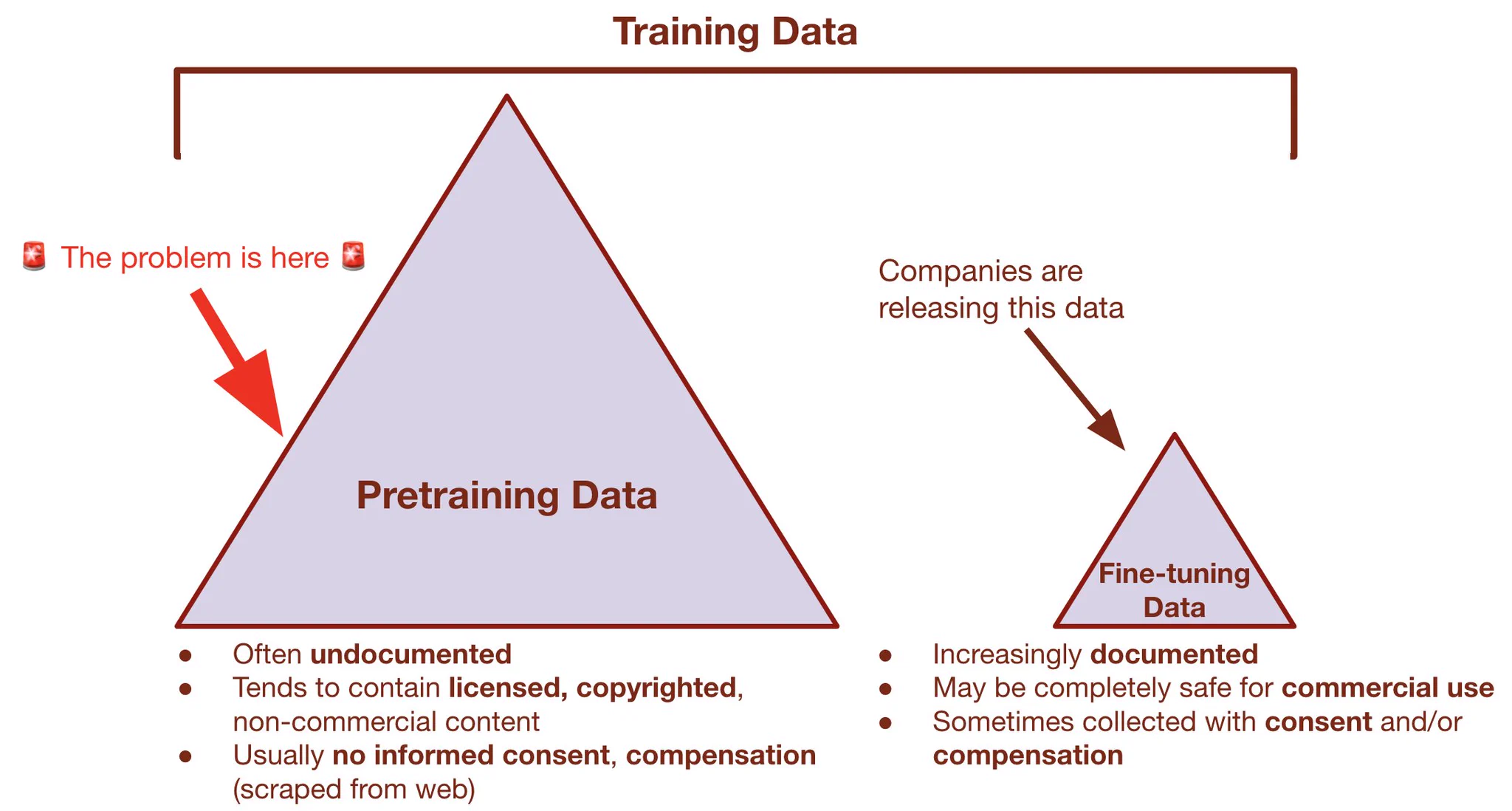
Okay. Inspired by news & @stealcase, let me clarify something. When AI companies release "open training data" for a model, they're generally sharing *fine-tuning* data. The big issues w data and consent are NOT of this type. The issues are with the MAIN DATA used in training.🧵
Okay. Inspired by news & @stealcase, let me clarify something.When AI companies release "open training data" for a model, they're generally sharing *fine-tuning* data. The big issues w data and consent are NOT of this type. The issues are with the MAIN DATA used in training.🧵 pic.twitter.com/k02k37x9CF— MMitchell (@mmitchell_ai) April 12, 2023
Creating Privacy Preserving AI with Substra
We’re on a journey to advance and democratize artificial intelligence through open source and open science.
Artificial Intelligence and the Purpose of Social Systems
The law and ethics of Western democratic states have their basis in liberalism. This extends to regulation and ethical discussion of technology and businesses doing data processing. Liberalism relies on the privacy and autonomy of individuals, their ordering through a public market, and, more recently, a measure of equality guaranteed by the state. We argue that these forms of regulation and ethical analysis are largely incompatible with the techno-political and techno-economic dimensions of artificial intelligence. By analyzing liberal regulatory solutions in the form of privacy and data protection, regulation of public markets, and fairness in AI, we expose how the data economy and artificial intelligence have transcended liberal legal imagination. Organizations use artificial intelligence to exceed the bounded rationality of individuals and each other. This has led to the private consolidation of markets and an unequal hierarchy of control operating mainly for the purpose of shareholder value. An artificial intelligence will be only as ethical as the purpose of the social system that operates it. Inspired by the science of artificial life as an alternative to artificial intelligence, we consider data intermediaries: sociotechnical systems composed of individuals associated around collectively pursued purposes. An attention cooperative, that prioritizes its incoming and outgoing data flows, is one model of a social system that could form and maintain its own autonomous purpose.

AI and Doctrinal Collapse
Artificial intelligence runs on data. But the two legal regimes that govern data—information privacy law and copyright law—are under pressure. Formally, each re

The Internet Was Built by Movements w Sasha Costanza-Chock
User Privacy and Large Language Models: An Analysis of Frontier Developers' Privacy Policies
Hundreds of millions of people now regularly interact with large language models via chatbots. Model developers are eager to acquire new sources of high-quality training data as they race to improve model capabilities and win market share. This paper analyzes the privacy policies of six U.S. frontier AI developers to understand how they use their users' chats to train models. Drawing primarily on the California Consumer Privacy Act, we develop a novel qualitative coding schema that we apply to each developer's relevant privacy policies to compare data collection and use practices across the six companies. We find that all six developers appear to employ their users' chat data to train and improve their models by default, and that some retain this data indefinitely. Developers may collect and train on personal information disclosed in chats, including sensitive information such as biometric and health data, as well as files uploaded by users. Four of the six companies we examined appear to include children's chat data for model training, as well as customer data from other products. On the whole, developers' privacy policies often lack essential information about their practices, highlighting the need for greater transparency and accountability. We address the implications of users' lack of consent for the use of their chat data for model training, data security issues arising from indefinite chat data retention, and training on children's chat data. We conclude by providing recommendations to policymakers and developers to address the data privacy challenges posed by LLM-powered chatbots.

User Privacy and Large Language Models: An Analysis of Frontier Developers' Privacy Policies
Hundreds of millions of people now regularly interact with large language models via chatbots. Model developers are eager to acquire new sources of high-quality training data as they race to improve model capabilities and win market share. This paper analyzes the privacy policies of six U.S. frontier AI developers to understand how they use their users' chats to train models. Drawing primarily on the California Consumer Privacy Act, we develop a novel qualitative coding schema that we apply to each developer's relevant privacy policies to compare data collection and use practices across the six companies. We find that all six developers appear to employ their users' chat data to train and improve their models by default, and that some retain this data indefinitely. Developers may collect and train on personal information disclosed in chats, including sensitive information such as biometric and health data, as well as files uploaded by users. Four of the six companies we examined appear to include children's chat data for model training, as well as customer data from other products. On the whole, developers' privacy policies often lack essential information about their practices, highlighting the need for greater transparency and accountability. We address the implications of users' lack of consent for the use of their chat data for model training, data security issues arising from indefinite chat data retention, and training on children's chat data. We conclude by providing recommendations to policymakers and developers to address the data privacy challenges posed by LLM-powered chatbots.
Japan relaxes privacy laws to make AI development easy
: Opting out of personal data use won't be an option because Minister says that's a 'very big obstacle' to AI adoption

What AI Asks of Open Access - The Scholarly Kitchen
As AI systems increasingly reason from the scientific literature, the integrity signals that make research trustworthy - open data, structured metadata, robust retraction processes - matter more than ever. PLOS CEO Alison Mudditt on why open access publishers have a different set of obligations in an AI world.

To protect the web, we need to renegotiate its value.
Public Knowledge and Creative Commons have laid out a compelling case for what must be done to protect the open web in the face of AI. It's going to take work.
Teen safety, freedom, and privacy
Explore OpenAI’s approach to balancing teen safety, freedom, and privacy in AI use.
Let Me Let You Own Your Data
Why do I have to choose between my web app respecting people’s privacy and it, like… having basic functionality?
We need private AI before it's too late | Proton
Big Tech companies are building AI aligned with their surveillance capitalism business model. We need a privacy-first and responsible AI alternative today.
