Getting coding agents (we say “clankers”: “agents” gives them too much credit) to behave in a reasonable manner is a full time job even with the latest frontier models. At Kenn, we spend so much time tuning their behavior across different repositories and projects that we started developing a “constitution” of sorts based on how we like to build software. We hope you find it useful: you can include it in your repositories or put it in your global system prompts. We will version it and keep it up to date at https://github.com/kenn-io/constitution.
Claude Code, Codex and Agentic Coding #8
When I started this series, everyone was going crazy for coding agents.
depatchedmode/oughta
How we oughta do things. Skills, conventions, and guidance for coding agents.
Exclusive: Codex agents are inching into the mainstream
OpenAI's agentic coding and work platform is growing, according to a new report from the company.

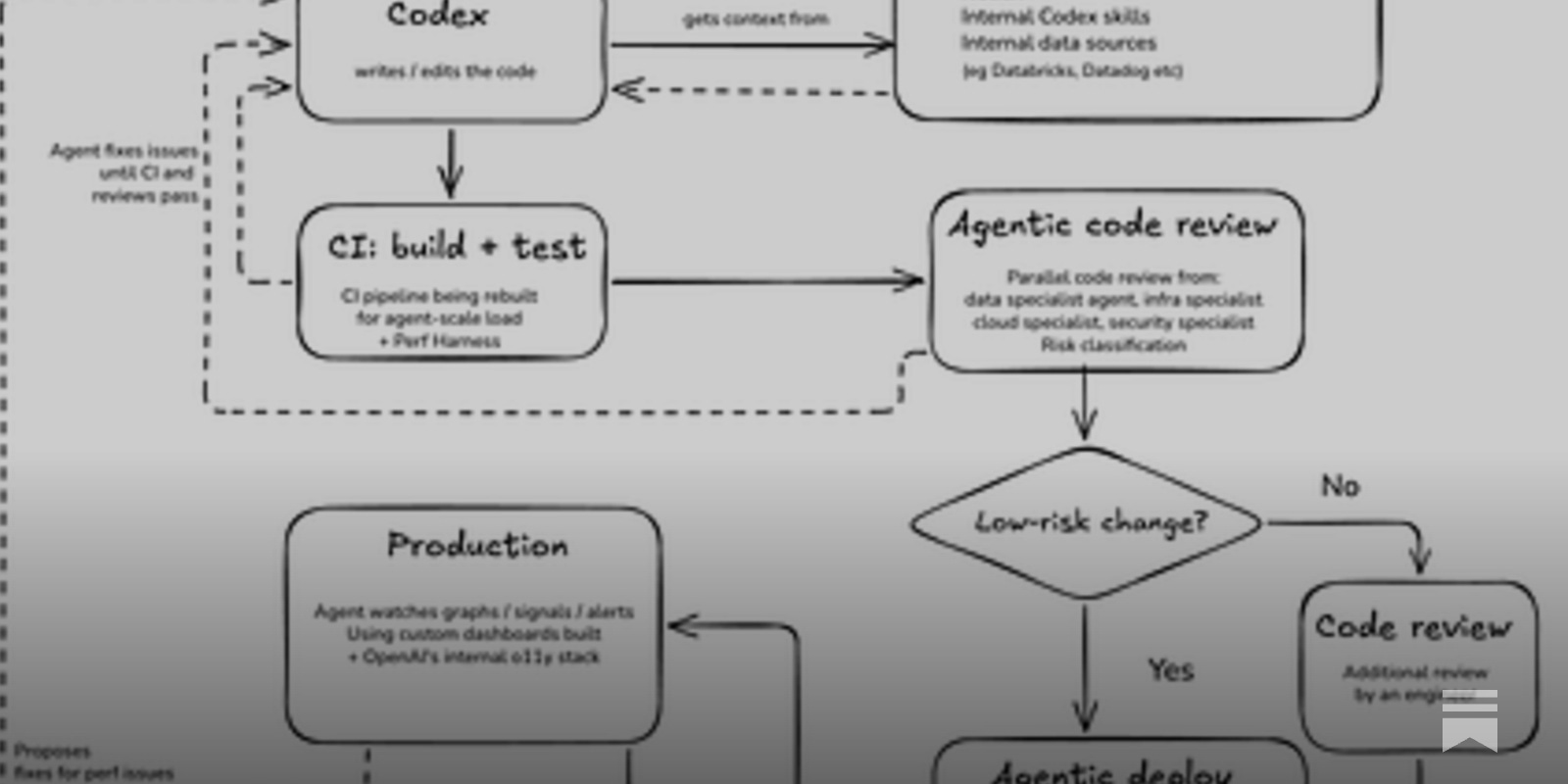
Inside OpenAI’s agentic software factory
A deepdive into how Codex has “taken over” OpenAI, how the frontier lab builds its agentic software factory, and the engineering challenges of one billion users. Details from inside OpenAI
Agents Done Right: A Framework Vision for 2026
Agents choke on context, loop on failures, and dump walls of code for review. It's time to rethink the architecture.
Can Claude Consent to its own Constitution? AI Constitutionalism and the Paradox of Constituent Power
Frontier AI systems are trained on “constitutions” and model specifications that shape their values, reasoning, and conduct. Debate over these documents has foc

Code Is Cheap Now, And That Changes Everything | Pere Villega
AI coding agents have made code production nearly free. Drawing on insights from Kent Beck, Paul Ford, and Simon Willison, this post argues that the value has shifted from writing code to defining systems — contracts, invariants, SLAs, and verification.
New capabilities for building agents on the Anthropic API | Claude
Claude now offers code execution, MCP server connections, file storage, and extended prompt caching through the API—giving developers powerful tools to build agents that analyze data, connect to external systems, and maintain context for longer periods of time.

GitHub - collect-intel/osccai: Open-source Collective Constitutions for AI
Open-source Collective Constitutions for AI. Contribute to collect-intel/osccai development by creating an account on GitHub.
Coding Agents Are Easy, Actually - Kara's Nonsense
Software engineering is here to stay
evalstate/fast-agent
Code, Build and Evaluate agents - excellent Model and Skills/MCP/ACP Support
Trying the Software factory pattern.
One of the interesting challenges of the AI ecosystem in 2026 is that new, effective patterns emerge faster than I can adopt them. I’ll find a handful, get back to work, and realize a month later that I’d missed four or five more. The adoption cycle for Imprint this year has been something like: January: get every engineer onto Claude Code every single day March: ok, let’s also get everyone else onto Claude Code or Claude Cowork every single day April: local development is bottlenecked on checkout and worktree model, instead create ~10 local workspaces which each have an independent checkout of every repository, and operate at the workspace level, not at the repository level, so it can generate cross-repository pull requests across frontend, backend, infrastructure and data monorepos June: oh boy, agent-driven development is heavily constrained by lack of a common task management system with higher visibility and less permission complexity than Jira, so let’s migrate the entire company over to Linear and hard stop on Jira July: yikes, now we have visibility into all these tickets, many of them are trivial but managing them through local development isn’t scaling, let’s roll out an orchestrated harness which internally we call “Agent Fleet”, along the lines of Stripe’s Minions The most recent question for me has been figuring out how to adopt the software factory pattern. (After some light research, the specific AI-context origin of this term is slightly messy to attribute, but I think it might be Justin McCarthy in February 2026’s Software Factories And The Agentic Moment.)

Codex | AI Coding Partner from OpenAI
The best way to build with agents. Codex accelerates real engineering work, from planning and building features to refactors, reviews, and releases—working seamlessly across your tools.
Running local models is good now
Local agentic coding has gotten great over the past few months
OpenCode Zen | A curated set of reliable optimized models for coding agents
OpenCode - The open source coding agent.