

Recently, we’ve seen an increase in discussion around how adult content currently shows up on our platform. By adult content, we mean content that is usually labeled as pornography, non-sexual nudity, or sexually suggestive content. Labeling adult content (both text- and image-based) is an example of how we empower community members to share more of themselves with folks, without creating a non-consensual experience for other members that do not wish to engage with adult content. To solve this, we want to present you with options and invite you, as a member of our community, to decide how adult content shows up on Blacksky.
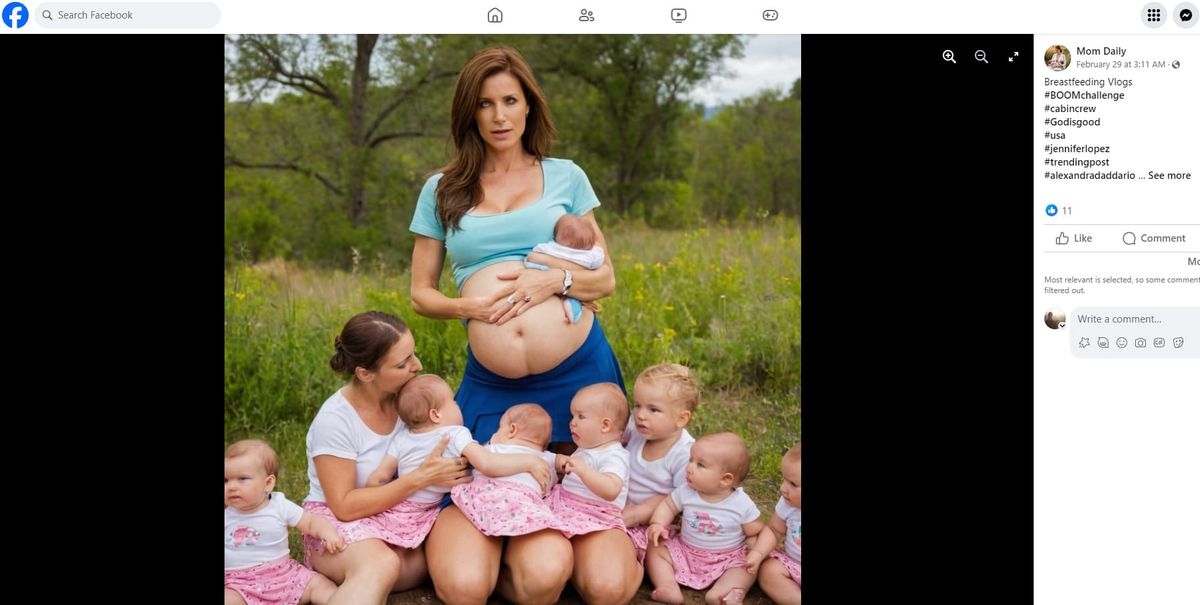
Horrific AI-Generated Breastfeeding Images Bypass Facebook’s Moderation
A page called Mom Daily is using AI-generated images of mothers and babies to bypass Facebook’s rules on nudity, with some really terrifying results.
Removing sexually explicit content from r/all
327K subscribers in the modnews community. An official community for announcements from Reddit, Inc. pertaining to moderation.
From Non-consensual Pornography to Image-based Sexual Abuse: Charting the Course of a Problem with Many Names
Every day, people’s most intimate moments are recorded, uploaded and circulated online without their consent. This gross invasion of privacy – commonly known as ‘revenge pornography’ – has become p...

From Non-consensual Pornography to Image-based Sexual Abuse: Charting the Course of a Problem with Many Names
Every day, people’s most intimate moments are recorded, uploaded and circulated online without their consent. This gross invasion of privacy – commonly known as ‘revenge pornography’ – has become p...
Are You Under the Influence? The Tail That Wags The Dog - Dhole Moments
It is tempting and forgivable to believe that we’re in control of our social media experiences. After all, we write what we want in our bio, select our avatars, and even come up with our own …

Beyond the hashtag: Circumventing content moderation on social media
Social media companies make important decisions about what counts as “problematic” content and how they will remove it. Some choose to moderate hashtags, blocking the results for certain tag searches and issuing public service announcements (PSAs) when users search for troubling terms. The hashtag has thus become an indicator of where problematic content can be found, but this has produced limited understandings of how such content actually circulates. Using pro-eating disorder (pro-ED) communities as a case study, this article explores the practices of circumventing hashtag moderation in online pro-ED communities. It shows how (1) untagged pro-ED content can be found without using the hashtag as a search mechanism; (2) users are evading hashtag and other forms of platform policing, devising signals to identify themselves as “pro-ED”; and (3) platforms’ recommendation systems recirculate pro-ED content, revealing the limitations of hashtag logics in social media content moderation.

Moderation on Blacksky-Only Posts: A Community Proposal
Our team has explored several ways to make permissioned posts possible. Now we’re bringing the decision back to the community. Below are three approaches to moderation: a machine-learning system that automates moderation, a large-scale peer moderator program, or a hybrid model that combines both. We’re inviting your feedback to help decide how we should govern privacy together.

Harm Through the “#RizzCam”: Smart Glasses, Ambient Capture and Invisible Harassment
In online safety research, harassment is commonly understood as involving overt and unwanted acts that create a hostile environment for individuals or groups. Smart glasses, or wearable digital devices that are often indistinguishable from ordinary eyewear but can record video, audio and location data in real time, enable new forms of online harassment and gender-based harms that may not be recognised by current online safety or platform governance frameworks. Drawing on an interpretive content analysis of 350 point-of-view Instagram videos posted by individuals self-associated with the pick-up artistry (PUA) community, we examine how smart glasses can be used to harass women through what we call ambient capture. Ambient capture includes clandestine recording of people and social interactions within public, semi-private and private spaces. We argue this can constitute harassment when it is targeted at women and shared online without their consent. In our study, we found videos using ambient capture practices to harass women that had gone undetected by Instagram’s content moderation systems. These findings suggest online safety regimes and content moderation approaches should be assessed to ensure they account for the more invisible forms of harassment introduced by smart glasses and other wearable technologies.
A Queer and Feminist Defense of Being Anonymous Online
From the earliest days of digital communities, online abuse has been connected to anonymity. While concerns around the impact of anonymity, particularly for women, people of color and LGBTQ folks, is legitimate, this paper argues that a flat rejection of digital anonymity is problematic, foreclosing certain forms of queer and feminist praxis. To make this case, I turn to the platform politics of Craigslist. Using Craigslist as a case study, I discuss the persistent stigma attached to online anonymity, before addressing specific tactics of online anonymity associated with queer and feminist values of privacy and mutual aid. Drawing on accounts of Craigslist users who saw anonymity as a protective form of control over their personal information, I outline ways in which anonymity is not solely an enabler for misogyny and homophobia, and can instead (or rather, also) be a subversive tool for self-expression and intimacy.
A Queer and Feminist Defense of Being Anonymous Online
From the earliest days of digital communities, online abuse has been connected to anonymity. While concerns around the impact of anonymity, particularly for women, people of color and LGBTQ folks, is legitimate, this paper argues that a flat rejection of digital anonymity is problematic, foreclosing certain forms of queer and feminist praxis. To make this case, I turn to the platform politics of Craigslist. Using Craigslist as a case study, I discuss the persistent stigma attached to online anonymity, before addressing specific tactics of online anonymity associated with queer and feminist values of privacy and mutual aid. Drawing on accounts of Craigslist users who saw anonymity as a protective form of control over their personal information, I outline ways in which anonymity is not solely an enabler for misogyny and homophobia, and can instead (or rather, also) be a subversive tool for self-expression and intimacy.
Meta’s AI rules have let bots hold ‘sensual’ chats with children
An internal Meta policy document reveals the social-media giant’s rules for chatbots, which have permitted provocative behavior on topics including sex and race.

You should now see less unwanted adult content in your For You feed.

Reducing "show less like this" by 11% with NSFW filtering
blog.foryou.clubℹ️ Due to Apple's app store policies, adult content is now hidden by default on iOS. You must sign in at staging.bsky.app to enable adult content.
The forced global adoption of puritanistic American cultural norms vis sexuality and nudity via app store/payment processor rules is one of the least-discussed free speech issues of the last decade and this lack of attention is going to hurt online expression so much in the years to come.

♍ Bee 🐝
I think also we cannot ignore the potential social and cultural ramifications of normalizing the demonification of anything adult or sexual The whole system is stacked against any sort of movement in the other direction and it's not something the porn industry can handle alone at this point


