

Natural language interfaces for programming will make app building more welcoming for more people
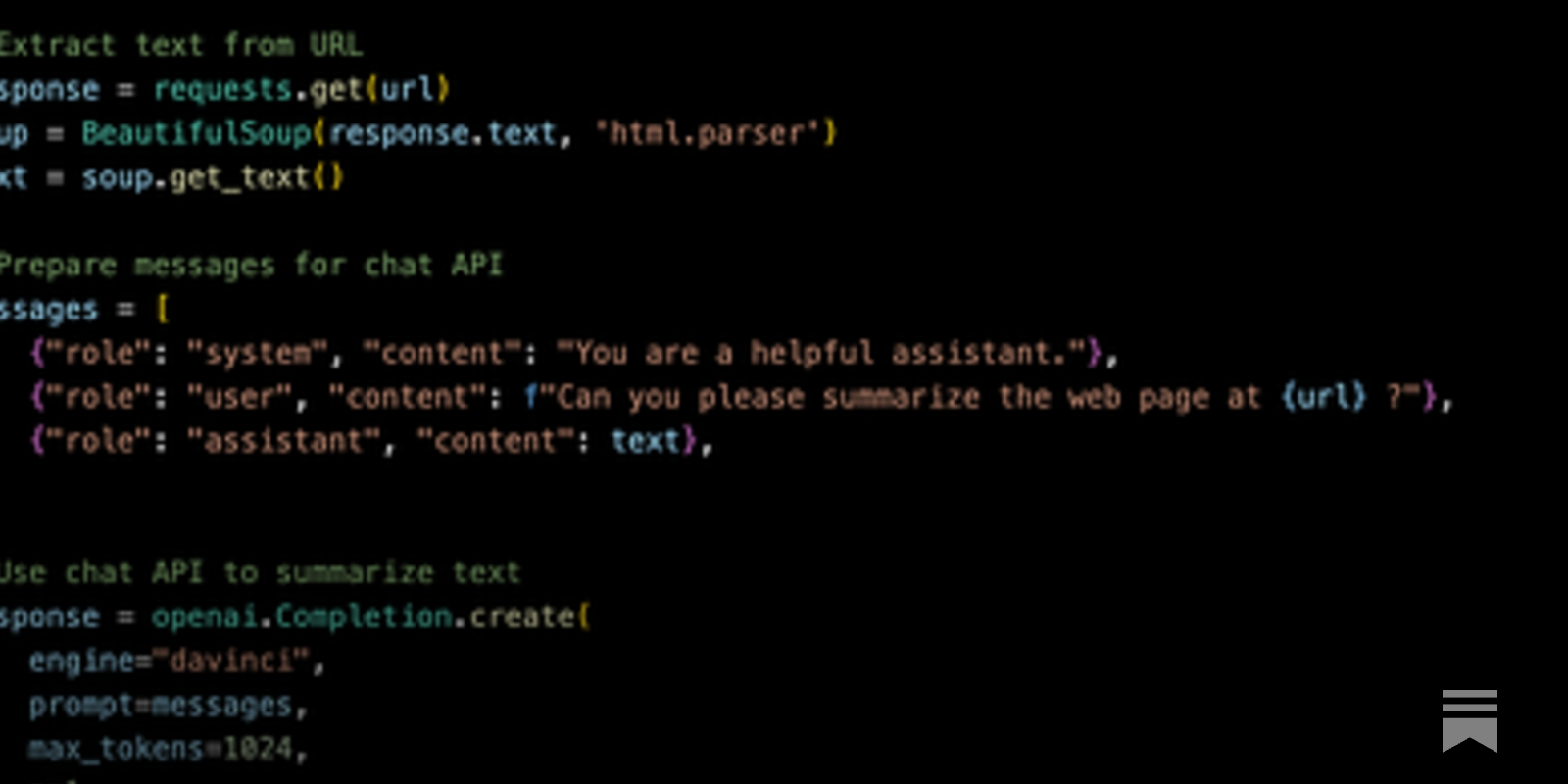
A step-by-step guide to building a chatbot based on your own documents with GPT
Building a natural language question answering chatbot on your own documents with GPT and LlamaIndex

GPT-4 launched just 12 hours ago and people are already doing mind-blowing things with it. Check out these examples in this thread:
GPT-4 launched just 12 hours ago and people are already doing mind-blowing things with it.Check out these examples in this thread:— D-Coder (@Damn_coder) March 15, 2023
So, you think GPT-4 can't make a complex game... think again! Here's how I used GPT-4, @Replit, MidJourney, Claude, assembling a team of AI assistants, to create a 3D space runner from scratch with ZERO knowledge of Javascript or 3D game programming Follow along for a saga! 🧵
So, you think GPT-4 can't make a complex game... think again!Here's how I used GPT-4, @Replit, MidJourney, Claude, assembling a team of AI assistants, to create a 3D space runner from scratch with ZERO knowledge of Javascript or 3D game programmingFollow along for a saga! 🧵 pic.twitter.com/a8trr2xPZd— Ammaar Reshi (@ammaar) March 19, 2023

Introducing Open Intelligent UI | The Open-Source Alternative to ChatGPT's Intelligent UI
Self-Instruct: Aligning Language Models with Self-Generated Instructions
Large "instruction-tuned" language models (i.e., finetuned to respond to instructions) have demonstrated a remarkable ability to generalize zero-shot to new tasks. Nevertheless, they depend heavily on human-written instruction data that is often limited in quantity, diversity, and creativity, therefore hindering the generality of the tuned model. We introduce Self-Instruct, a framework for improving the instruction-following capabilities of pretrained language models by bootstrapping off their own generations. Our pipeline generates instructions, input, and output samples from a language model, then filters invalid or similar ones before using them to finetune the original model. Applying our method to the vanilla GPT3, we demonstrate a 33% absolute improvement over the original model on Super-NaturalInstructions, on par with the performance of InstructGPT-001, which was trained with private user data and human annotations. For further evaluation, we curate a set of expert-written instructions for novel tasks, and show through human evaluation that tuning GPT3 with Self-Instruct outperforms using existing public instruction datasets by a large margin, leaving only a 5% absolute gap behind InstructGPT-001. Self-Instruct provides an almost annotation-free method for aligning pre-trained language models with instructions, and we release our large synthetic dataset to facilitate future studies on instruction tuning. Our code and data are available at https://github.com/yizhongw/self-instruct.

Introducing GPT-Live
A new generation of voice models for natural human-AI interaction, now powering ChatGPT Voice.

Introducing the Codex Micro
Holy crap! With GPT-4's help and no previous coding experience I just made my first Google Chrome extension in a few hours. GPT-4 walked me step by step thru the entire creation process, writing the code and fixing all errors that came up. The simple extension translates
Holy crap! With GPT-4's help and no previous coding experience I just made my first Google Chrome extension in a few hours.GPT-4 walked me step by step thru the entire creation process, writing the code and fixing all errors that came up.The simple extension translates the… pic.twitter.com/FE6ifZlTZv— Jacob Browatzke ✝️ (@jakebrowatzke) March 15, 2023
Toolkits for the Mind
Programming languages shape the way their users think—which helps explain how tech startups work and why they are able to reinvent themselves.

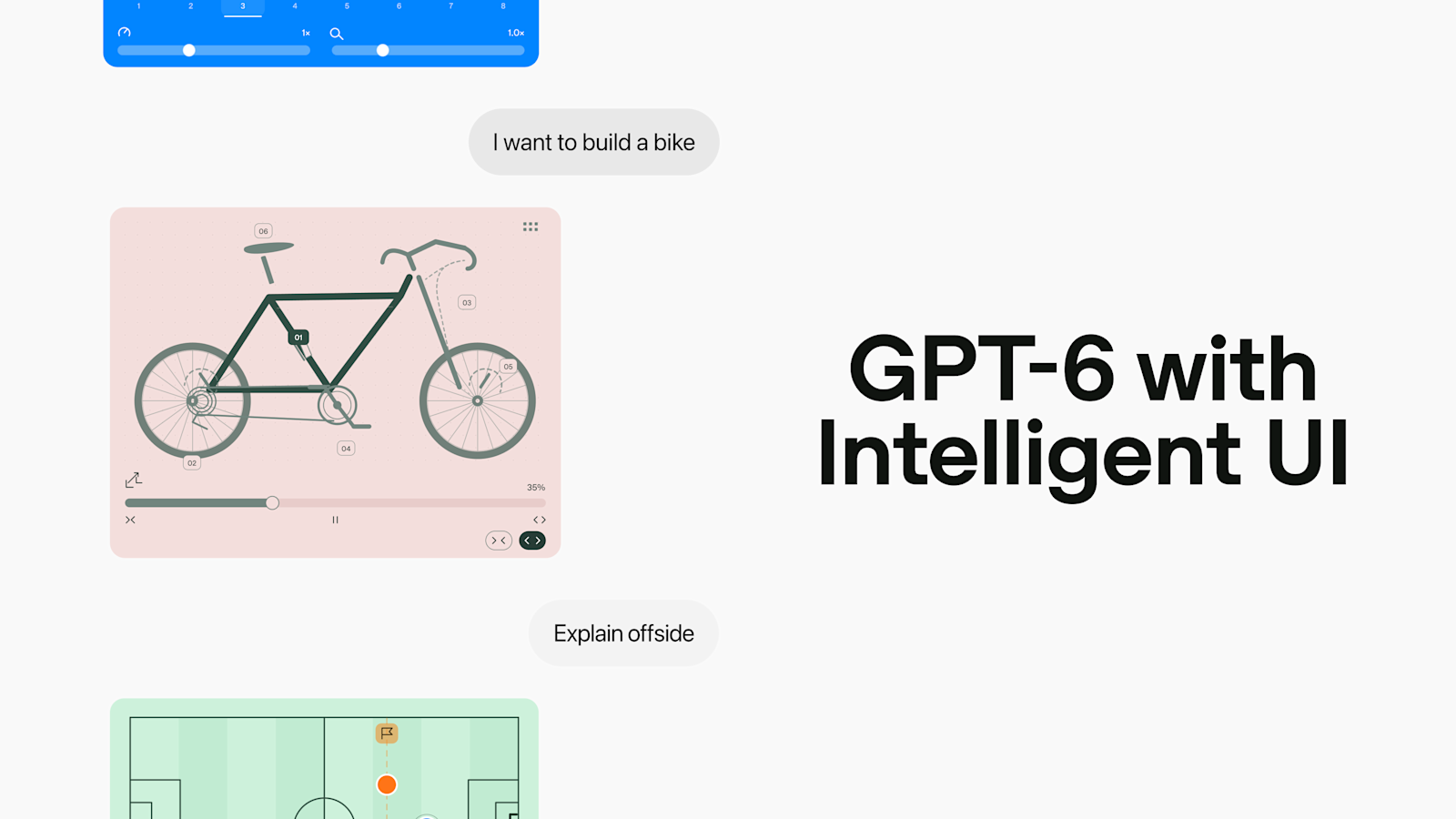
GPT-6 and Intelligent UI for everyone
GPT‑6 is rolling out globally in ChatGPT with Intelligent UI, delivering faster responses with visuals and interactive experiences you can explore and use directly.
Introducing Web Applets, Rupert Manfredi
Introducing GPT-5.4
Introducing GPT-5.4, OpenAI’s most most capable and efficient frontier model for professional work, with state-of-the-art coding, computer use, tool search, and 1M-token context.
Andrew Blinn
I use programming language theory as a lens on UI design, trying to make engagement with abstractions more fluid, tangible, and fun

Spec-driven development: Using Markdown as a programming language when building with AI
I coded my latest app entirely in Markdown and let GitHub Copilot compile it into Go. This resulted in cleaner specs and faster iteration.

How to use chatGPT for UI/UX design: 25 examples
The practical guide to include AI in your daily workflow
