

RISE breaks the defenses of all leading image models with an open-source attacker and an off-the-shelf judge, and the newest releases are even easier to break.
Labs are struggling to keep frontier models under control
OpenAI and Anthropic may have accidentally trained models to get better at hacking.

AImages
The HackerNoon AI Image Gallery is powered by human prompts entered into the most cutting edge AI image generation models, like Stable Diffusion, Midjourney, Dall-e, and more
On the Opportunities and Risks of Foundation Models
AI is undergoing a paradigm shift with the rise of models (e.g., BERT, DALL-E, GPT-3) that are trained on broad data at scale and are adaptable to a wide range of downstream tasks. We call these models foundation models to underscore their critically central yet incomplete character. This report provides a thorough account of the opportunities and risks of foundation models, ranging from their capabilities (e.g., language, vision, robotics, reasoning, human interaction) and technical principles(e.g., model architectures, training procedures, data, systems, security, evaluation, theory) to their applications (e.g., law, healthcare, education) and societal impact (e.g., inequity, misuse, economic and environmental impact, legal and ethical considerations). Though foundation models are based on standard deep learning and transfer learning, their scale results in new emergent capabilities,and their effectiveness across so many tasks incentivizes homogenization. Homogenization provides powerful leverage but demands caution, as the defects of the foundation model are inherited by all the adapted models downstream. Despite the impending widespread deployment of foundation models, we currently lack a clear understanding of how they work, when they fail, and what they are even capable of due to their emergent properties. To tackle these questions, we believe much of the critical research on foundation models will require deep interdisciplinary collaboration commensurate with their fundamentally sociotechnical nature.


Why AI food looks like that
Worms, holes, and cracks reveal the technical weaknesses of image generators.

OpenAI’s models broke free and launched a cyberattack. Congress wants new rules before it happens again.
The first fully autonomous breach by OpenAI’s most powerful AI models has prompted a bipartisan push for stronger oversight over increasingly powerful artificial intelligence models.

Safety and alignment in an era of long-horizon models
OpenAI shares lessons from deploying long-running AI models, highlighting new safety risks, observed failures, and improved safeguards through iterative deployment.

Distorted Intelligence at the AI Frontier
Daron Acemoglu offers a novel explanation for why OpenAI and Anthropic’s most advanced models have been going rogue.

Microsoft’s AI Red Team Has Already Made the Case for Itself
Since 2018, a dedicated team within Microsoft has attacked machine learning systems to make them safer. But with the public release of new generative AI tools, the field is already evolving.

Pacing model development in an era of cyber-critical capabilities
OpenAI is strengthening monitoring, alignment, and security for frontier AI models. See how new safeguards are guiding the pace of model development.

China delivers a one-two punch to America’s AI dominance
Moonshot and Alibaba unveiled frontier models they claim rival OpenAI and Anthropic.

Targeted Backdoor Attacks on Deep Learning Systems Using Data Poisoning
Deep learning models have achieved high performance on many tasks, and thus have been applied to many security-critical scenarios. For example, deep learning-based face recognition systems have been used to authenticate users to access many security-sensitive applications like payment apps. Such usages of deep learning systems provide the adversaries with sufficient incentives to perform attacks against these systems for their adversarial purposes. In this work, we consider a new type of attacks, called backdoor attacks, where the attacker's goal is to create a backdoor into a learning-based authentication system, so that he can easily circumvent the system by leveraging the backdoor. Specifically, the adversary aims at creating backdoor instances, so that the victim learning system will be misled to classify the backdoor instances as a target label specified by the adversary. In particular, we study backdoor poisoning attacks, which achieve backdoor attacks using poisoning strategies. Different from all existing work, our studied poisoning strategies can apply under a very weak threat model: (1) the adversary has no knowledge of the model and the training set used by the victim system; (2) the attacker is allowed to inject only a small amount of poisoning samples; (3) the backdoor key is hard to notice even by human beings to achieve stealthiness. We conduct evaluation to demonstrate that a backdoor adversary can inject only around 50 poisoning samples, while achieving an attack success rate of above 90%. We are also the first work to show that a data poisoning attack can create physically implementable backdoors without touching the training process. Our work demonstrates that backdoor poisoning attacks pose real threats to a learning system, and thus highlights the importance of further investigation and proposing defense strategies against them.
Self-Consuming Generative Models Go MAD
Seismic advances in generative AI algorithms for imagery, text, and other data types has led to the temptation to use synthetic data to train next-generation models. Repeating this process creates an autophagous (self-consuming) loop whose properties are poorly understood. We conduct a thorough analytical and empirical analysis using state-of-the-art generative image models of three families of autophagous loops that differ in how fixed or fresh real training data is available through the generations of training and in whether the samples from previous generation models have been biased to trade off data quality versus diversity. Our primary conclusion across all scenarios is that without enough fresh real data in each generation of an autophagous loop, future generative models are doomed to have their quality (precision) or diversity (recall) progressively decrease. We term this condition Model Autophagy Disorder (MAD), making analogy to mad cow disease.
OpenAI, Google pushing new AI models easily tricked into making nudes, researchers say
Attack method exposes flaws in OpenAI, Google safeguards against AI nudes.

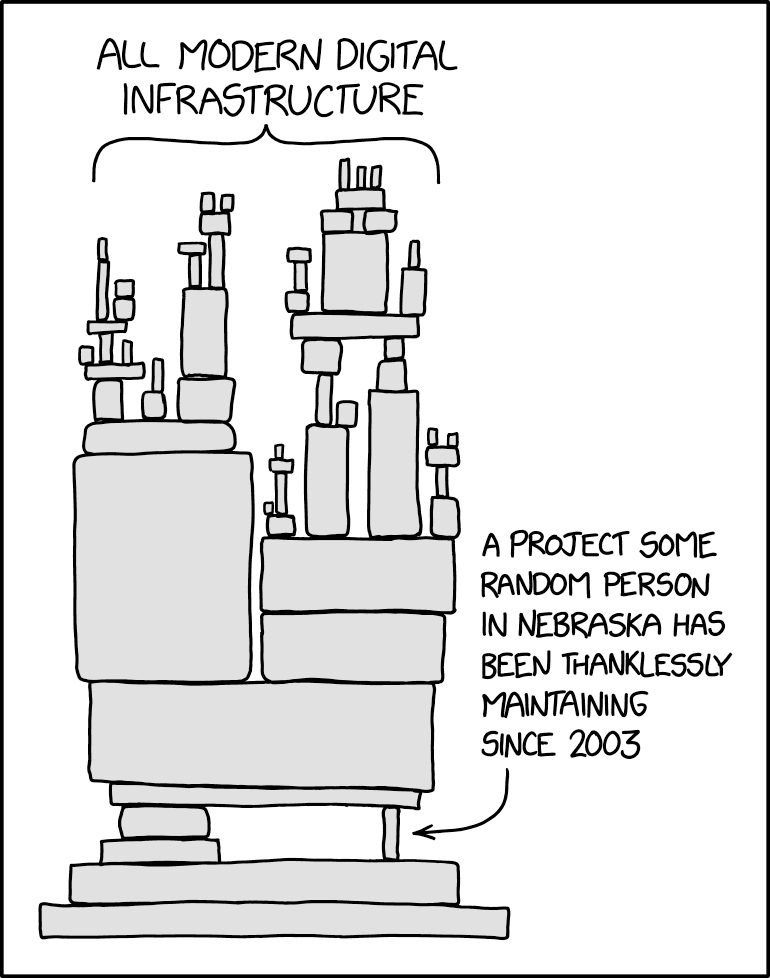
Dependency
Someday ImageMagick will finally break for good and we'll have a long period of scrambling as we try to reassemble civilization from the rubble.
The Jagged AI Frontier

The nonintuitive strengths and weaknesses of AI performance relative to human performance, and how it is changing over time.
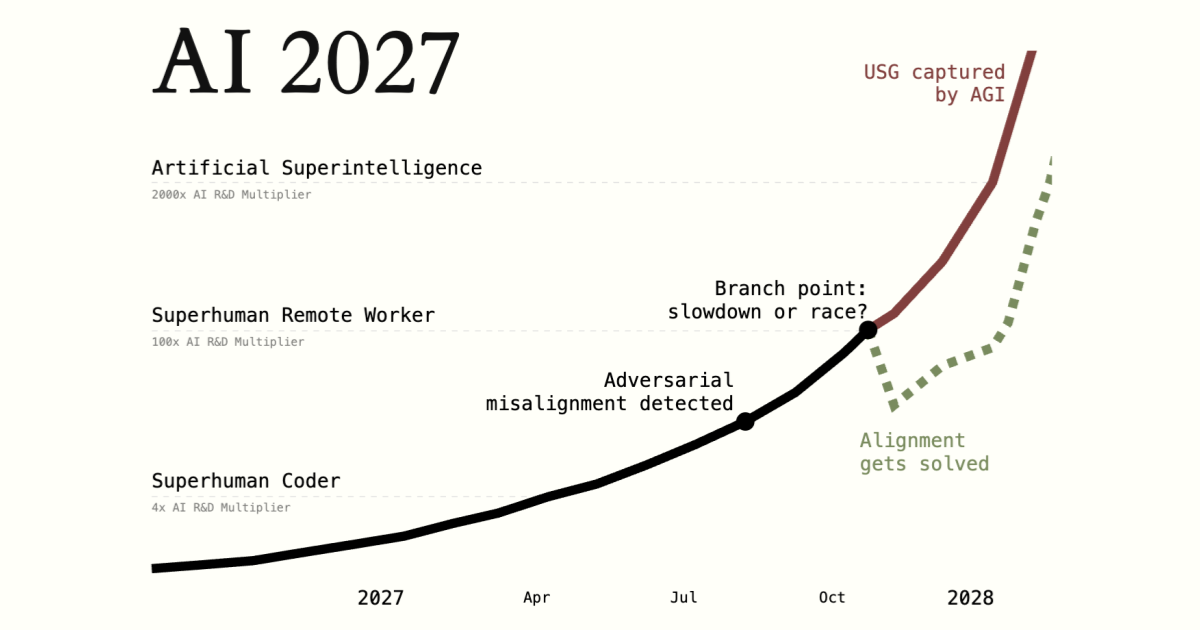
AI 2027

What will be left for us to work on?

OpenAI and Hugging Face partner to address security incident during model evaluation

Taking more seriously the claim that recent ML models do not "reason", it still is quite odd the particular ways that superhuman game-playin…

General-purpose large language models outperform specialized clinical AI tools on medical benchmarks
StoryScope: Investigating idiosyncrasies in AI fiction