


What cheap inference actually bought me, and why it took a year to learn how to spend it
Producing The Perfect Token
The unspoken inference quality gap and how numerics determine if the inference you're paying for is worth it.
Information Disclosure, Cognitive Biases, and Payday Borrowing
ABSTRACT Can psychology‐guided information disclosure induce borrowers to lower their use of high‐cost debt? In a field experiment at payday stores, we find that information that makes people think less narrowly (over time) about finance costs results in less borrowing. In particular, reinforcing the adding‐up dollar fees incurred when rolling over loans reduces the take‐up of future payday loans by 11% in the subsequent 4 months. Although we remain agnostic as to the overall sufficiency of better disclosure policy to “remedy” payday borrowing, we cast the 11% reduction in borrowing in light of the relative low cost of this policy.

Tightwads and spendthrifts: An interdisciplinary review
Consumers rely on a “pain of paying” to help deter their spending. While this is beneficial for some consumers, others experience levels of pain that create problems. “Tightwads” experience too much pain when considering spending and therefore spend less than they would ideally like to spend. By contrast, “spendthrifts” experience too little pain and therefore spend more than they would ideally like to spend. Neither are happy with how they handle money. In the decade since the tightwad‐spendthrift construct was introduced, much has been learned about what it is and is not (e.g., frugality, greed), what contextual factors are likely to reduce its importance, how it plays a role within romantic relationships, and when it might first emerge in childhood. This paper reviews the wide range of interdisciplinary research relevant to the tightwad‐spendthrift construct and proposes several directions for new research.

Inference characteristics of Llama · Cursor
A primer on inference math and an examination of the surprising costs of Llama.
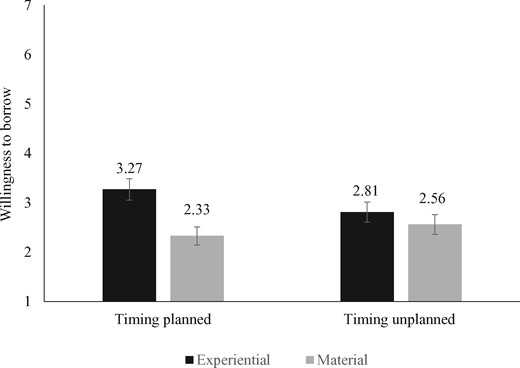
Context-Dependent Drivers of Discretionary Debt Decisions: Explaining Willingness to Borrow for Experiential Purchases
Abstract Mental accounting research suggests that consumers prefer borrowing for longer-lasting purchases in order to receive benefits from the purchases as they pay for them. In contrast, two sets of archival data and five lab studies show that consumers are more willing to borrow for experiential versus material purchases, even though experiential purchases tend to have a shorter physical duration. Further, framing the same purchase as more experiential than material increases willingness to borrow. This effect occurs because purchase timing is more important for experiential purchases—a function of consumers’ aversion to missing out on planned consumption. Thus, we moderate the proposed effect by varying whether the borrowing decision impacts planned consumption. Other differences between material and experiential purchases, such as scarcity or expected happiness, cannot similarly explain our results. Moreover, our conceptualization allows us to reconcile the apparent contradiction between the previous and current research by examining the relative impact of purchase-timing importance and payment-benefit duration matching in different contexts (i.e., “purchasing” and “source-of-funding” decisions).
What Would You Do with $500? Spending Responses to Gains, Losses, News, and Loans
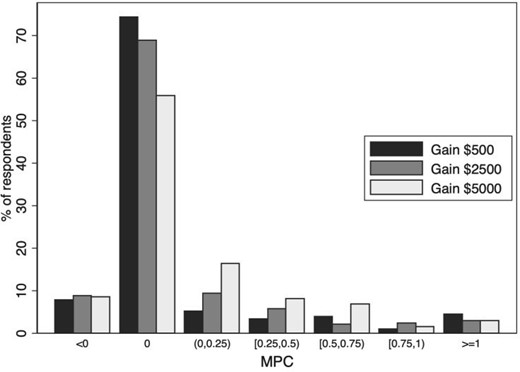
Abstract We use survey questions about spending in hypothetical scenarios to investigate features of propensities to consume that are useful for distinguishing between consumption theories. We find that (1) responses to unanticipated gains are vastly heterogeneous (either zero or substantially positive); (2) responses increase in the size of the gain, driven by the extensive margin of spending adjustments; (3) responses to losses are much larger and more widespread than responses to gains; and (4) even those with large responses to gains do not respond to news about future gains. These four findings suggest that limited access to disposable resources, and frictions in adjusting consumption, are important determinants of consumption behaviour. We also find that (5) households do not respond to the offer of a one-year interest-free loan, suggesting that this is not a consequence of short-term credit constraints; and (6) people do cut spending in response to news about future losses, suggesting that neither is this a consequence of myopia. A calibrated precautionary savings model with utility costs of changing consumption, and a sufficient fraction of low-wealth households, can account for these features of propensities to consume on both the extensive and intensive margins.
The Effects of Prior Spending on Future Spending Decisions: The Role of Acquisition Liabilities and Payments
Research in mental accounting shows that prior spending influences a consumer's decision to make a new spending decision (Heath and Soll 1996, Soman 2001). In particular, greater spending in a particular category reduces the likelihood of further spending in that category. In the present research, we decompose “spending” into two distinct episodes—the acquisition liability episode during which a purchase is made accompanied by a commitment to pay (e.g., using a credit card) and the payment episode during which the consumer's wealth actually gets depleted (e.g., paying the credit card bill). Using a controlled laboratory experiment and real world data from a group of consumers, we replicate earlier findings that prior spending influences a pending spending decision, but also show that the location of both the acquisition liability episode and the payment episode play a role. Our results contribute to an understanding of the dynamic mental accounting of acquisition liability and actual outflows.
Do Customers Learn from Experience? Evidence from Retail Banking
We study customers' adoption and subsequent switching decisions with regard to a menu of three-part tariff plans offered by a commercial bank. Using a rich panel data set covering 70,510 fee-based checking accounts over 30 months, before and after the introduction of the plans, we find that most customers adopt non-cost-minimizing plans, preferring plans with large monthly allowances and high fixed payments. Furthermore, after adoption, customers who exceed their allowances and consequently pay overage fees are more likely to switch to plans with larger allowances than customers who do not experience such fees. Notably, after switching, these overage-paying customers pay higher monthly payments than before. In contrast, switching customers who did not pay overage payments before switching pay less after switching. Our findings, unlike those of previous research on experience-based learning, suggest that the behavior of experienced customers does not converge to the predictions of neoclassical models. We propose that “overage aversion,” which is closely related to loss aversion and mental accounting, is the most plausible explanation for our findings. This paper was accepted by John List, behavioral economics.

Pain of Paying? — A Metaphor Gone Literal: Evidence from Neural and Behavioral Science
How do individuals consider the price of a good when making purchase decisions? Standard economic theories assume an analytical process: Individuals consider th

Introducing Sponsorware: How A Small Open Source Package Increased My Salary By $11k in Two Days
<p>After digging deep on SQLite during a pair programming session with a client/friend, I had an idea…</p> <p>About 45 minutes later, a proo...

In-Store Spending Dynamics: How Budgets Invert Relative-Spending Patterns
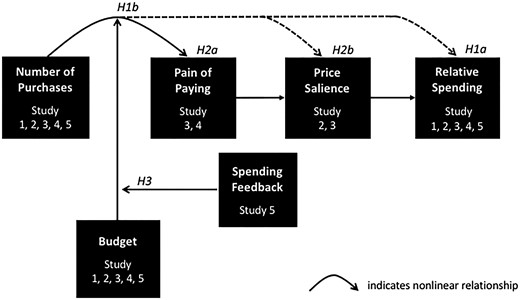
Abstract The authors conduct four controlled lab experiments and one field study in a brick-and-mortar grocery store to demonstrate that relative spending—the price of the purchased item relative to the mean price of the product category—evolves nonlinearly and distinctly for budget and nonbudget shoppers. While the relative spending of budget shoppers evolves in a concave manner, the relative spending of nonbudget shoppers evolves inversely in a convex manner. Thus, budget (nonbudget) shoppers spend relatively more (less) in the middle than at the beginning and toward the end of their shopping trip. Mediation analyses confirm that the pain of paying experienced while shopping drives price salience, which then drives relative spending. Moreover, manipulating shoppers’ pain of paying, by altering the opportunity costs associated with their spending or drawing shoppers’ attention to their spending via real-time spending feedback, is shown to influence these spending patterns. The research offers theoretical contributions to the in-store decision-making, budgeting, and pain-of-paying literature and has important implications for marketing and promotion strategies in retail and mobile technology environments, as it suggests when a shopper may be more sensitive to price-related factors.
The Buffett Formula: Going to Bed Smarter Than When You Woke Up
Learn how Warren Buffett and Charlie Munger turn curiosity into insight. Discover how interest-driven learning builds understanding and reveals hidden opportunities.

Double Mental Discounting: When a Single Price Promotion Feels Twice as Nice
This research finds that when a single gain has strong associations with multiple costs, consumers often mentally deduct that gain from perceived costs multiple times. For example, with some price promotions (e.g., spend $200 now and receive a $50 gift card to spend in the future), consumers mentally deduct the value of the price promotion from the cost of the first purchase when they receive the promotion, as well as from the cost of the second purchase when they use the promotion. Multiple mental deductions based on a single gain result in consumers' perceptions that their costs are lower than they actually are, which can trigger higher expenditures. This mental accounting phenomenon, referred to as “double mental discounting,” is driven by the extent to which gains feel associated, or coupled, with multiple purchases. This article also documents methods to decouple promotional gains from purchases, thus mitigating double mental discounting.

The UX of Learning
Think of the last time you ordered a book, booked a flight, or bought a car. How did you choose which book to read, where to go for vacation, or which car was best for you? You may have searched on…

Small Probabilistic Discounts Stimulate Spending: Pain of Paying in Price Promotions
AbstractWe find that small probabilistic price promotions effectively stimulate demand, even more so than comparable fixed price promotions (e.g., “1% chance it’s free” vs. “1% off,” respectively), because they more effectively reduce the pain of paying. In three field experiments at a grocer, we exogenously and endogenously manipulated the salience of pain of paying via elicitation timing (e.g., at entrance or checkout) and payment method (i.e., cash/debit cards or credit cards). This modulated the attractiveness of probabilistic discounts and their ability to stimulate spending. Shoppers paying with cash or debit cards, for example, spent 54% more if they received a 1% probabilistic discount than a 1% fixed discount (experiment 2). A fourth experiment showed that consumers’ sensitivity to pain of paying modulates the greater comparative efficacy of small probabilistic than fixed discounts. More broadly, the results elucidate a novel affective route through which price promotions stimulate demand––pain of paying.

The Hedonics of Debt
Psychologists and economists often discuss the “pain” of paying for our purchases. Four experiments examine how people evaluate prospective debt payments, analyzing how different features of a loan (down payment, final payment, duration, monthly payments) affect willingness to accept the loan. Akin to previous findings on physical pain, participants exhibited duration neglect and over-weighted final moments. However, participants also focused heavily on the monthly or average payment (unlike in retrospective studies of physical pain where only peak-end moments seem to count). In Experiment 2, participants’ willingness to accept the loan was not significantly diminished by making it more expensive through keeping the same monthly payment but extending the length of the loan by 40 percent (evincing duration neglect). Further, in Experiments 3 and 4, we show that participants increased their willingness to buy if loans were made longer and more expensive by adding smaller, less “painful” payments to the end.
