


Check out the project at https://library.groundmist.xyzCross-posted to https://baincapitalcrypto.com/atproto-for-local-first-distribution/ What if private data could be published effortlessly, without friction, fragmentation, or UI restrictions? I've been experimenting recently with connecting loc...
Exploring the AT Protocol as a legibility layer for local-first software | grjte
Check out the project at https://notebook.groundmist.xyzCross-posted to https://baincapitalcrypto.com/atproto-for-local-first-legibility/ Some people like vim and some people like emacs and some people like something else, and why not have our documents able to be edited in all of those programs? ...
atproto for local-first publishing
Exploring an effortless private to publishing pipeline for local-first software leveraging the AT Protocol’s global distribution.
Exploring interoperability & composability for local-first software | grjte
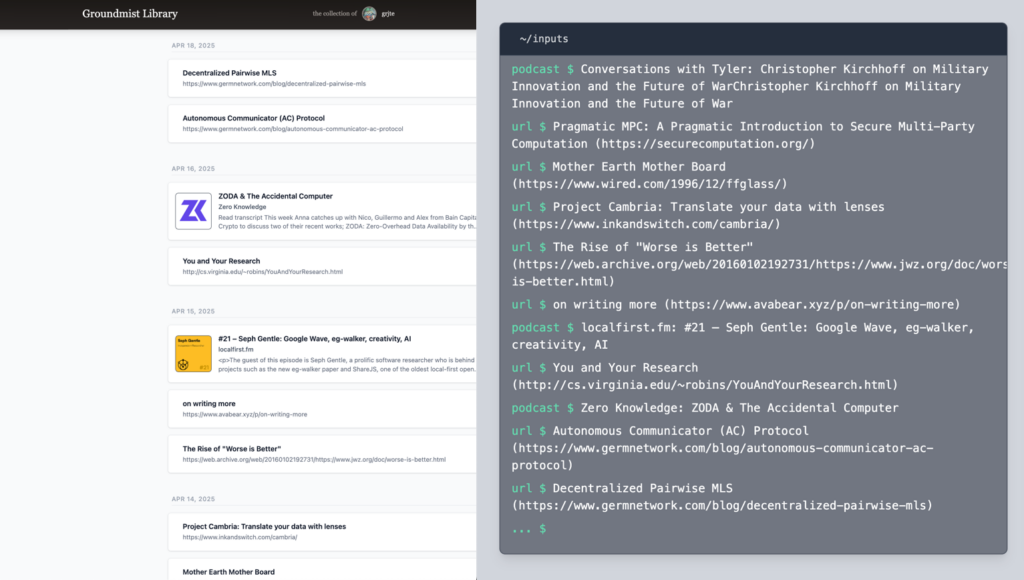
Check out the project at https://github.com/grjte/groundmist-syncCross-posted to https://baincapitalcrypto.com/atproto-for-local-first-interoperability/ This is the third exploration connecting local-first software with the AT Protocol (atproto). Previously, I explored how atproto can enable new fu...

A peer to peer community platform built on the AT Protocol
Drafts, private data, and obscurity.
The at:// protocol currently lacks any real means to have data which is both 'on-protocol', i.e. stored on your PDS in a way that you can guarantee access to...

Drafts, private data, and obscurity.
The at:// protocol currently lacks any real means to have data which is both 'on-protocol', i.e. stored on your PDS in a way that you can guarantee access to...
How do we talk about atproto to non-developers?
The beauty of AT Protocol is that all of your data from different apps is available on your PDS, your own folder on the internet containing your stuff as JSON. This means that you can switch which app you use to view that data, without losing anything. It also makes it very easy to make connections between data stored using different lexicons, or just display activity in one place. Sifa does a nice job of this on your profile page. For web developers, and people who understand webhosting, the concept is reasonably easy to understand. I know that any atproto app I join is going to store data in my PDS, any other people will be able to see it.

bnewbold.net
Bluesky released early documentation for the "AT Protocol" (atproto) a few weeks ago, and I've been noodling around with it. Technically, it strikes an appealing balance between rigid cryptographically signed content-addressable storage on the one hand, and familiar web-friendly schemas and integrations on the other. But at an ecosystem level, there are already a bunch of existing open social media projects. Does atproto bring anything interesting to the table? How might it fit in compared to other similar protocols?
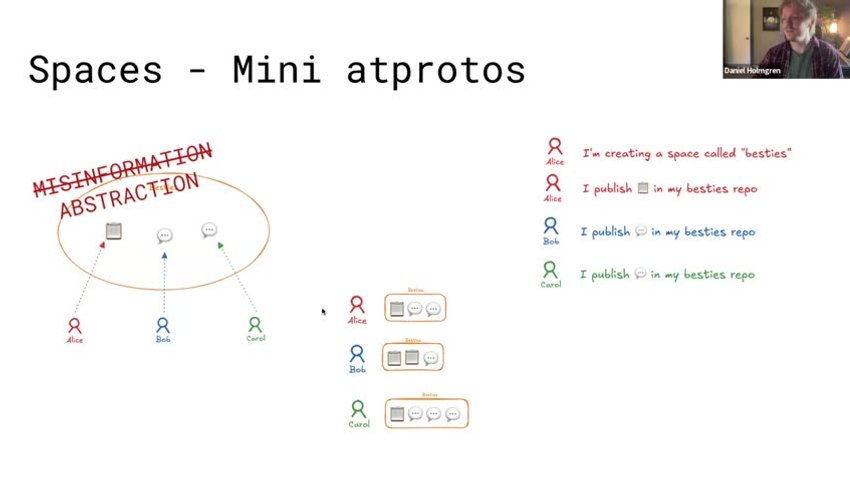
FediForum Talk: Introduction to Atproto Spaces
By Daniel Holmgren, head of protocol at Bluesky PBC. A technical overview of the recent extension of AT Protocol beyond public data to cover permissioned data and private group spaces.
Rashid Aziz: Extending ATproto for private data - ATProto Community
Jake Lazaroff — Building more resilient local-first software with atproto
Building More Resilient Local-First Software with atproto | jakelazaroff.com
atproto has the potential to become a rock-solid replacement for the most fragile part of any local-first app: the sync server.
I wrote up my talk at @localfirstconf.com as a blogpost The AT Protocol is a high-scale network by design. It works by codifying proven architectures into a protocol. If you've ever used kafka to connect some backend services, then you basically know how atproto works.

Starting from scale in the design of the AT Protocol
pfrazee.leaflet.pubblogged: Building on AT Protocol dbushell.com/2026/03/10/building-on-at-pro…

Building on AT Protocol
dbushell.comAnyway, this is mostly for my friends, but I kinda love the model of “broadcast on atproto, but transfer data privately off protocol”

Scoiattolo
So @iroh.computer is kinda magic. This turned out to be a huge project, and I'm still reducing the overall complexity, squashing bugs, and cleaning things up, but uh, the endpoint discovery works pretty seamlessly and I can view and download items from another users library in a pretty simple manner

