

"In science, if you know what you are doing, you should not be doing it. In engineering, if you do not know what you are doing, you should not be doing it. Of course, you seldom, if ever, see either pure state."
Immutable Skills
How knowledge redevelops at higher levels of abstraction, and why its still dependent on properties of the printing press
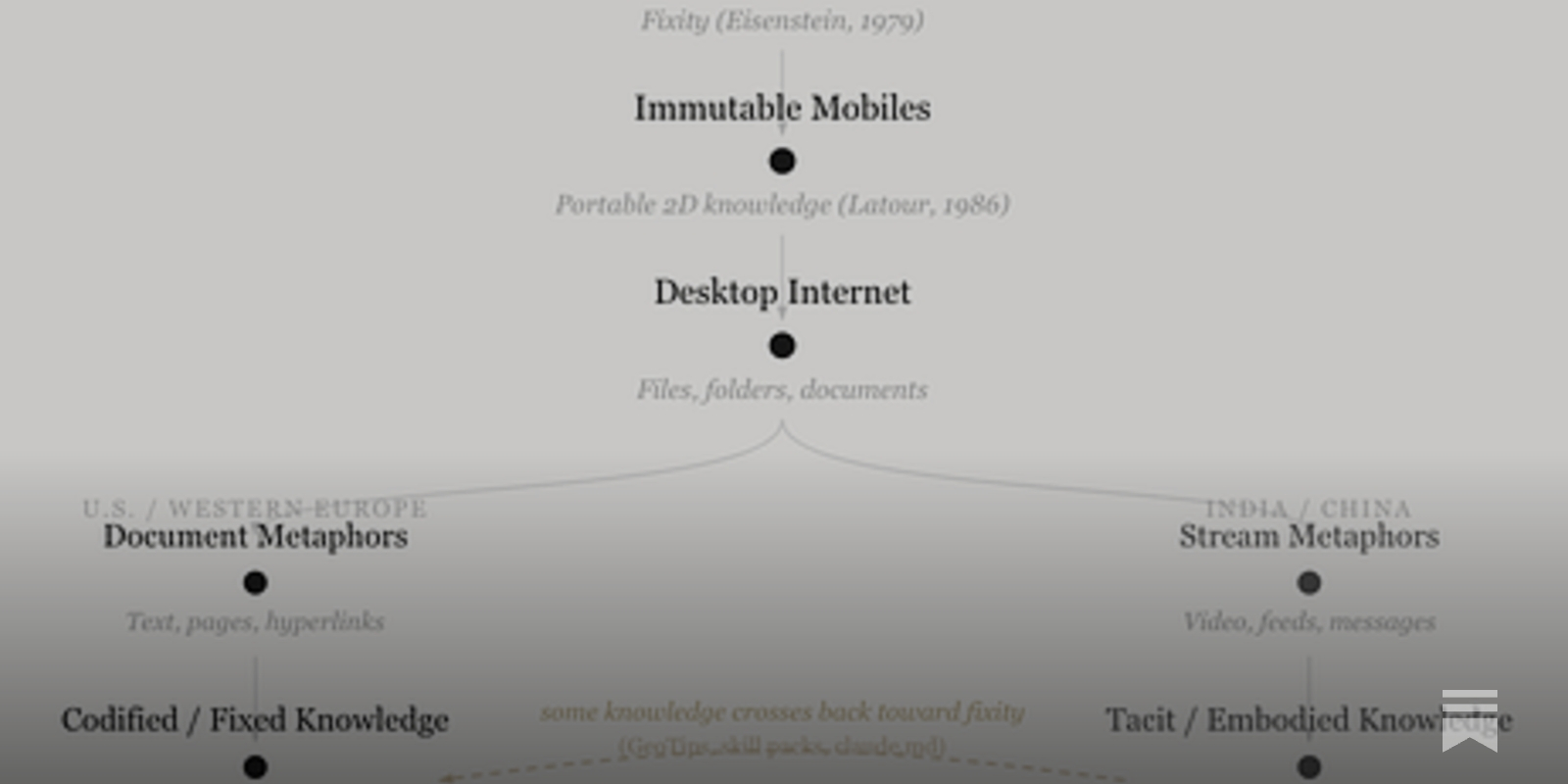
Do the Math | Using physics and estimation to assess energy, growth, options—by Tom Murphy
Few among us question actions done “in the name of science” when said actions are carried out by credible groups or individuals. It goes without saying that the acquisition and expansion of knowledge is highly valued. As long as the pursuit is not directly harmful to people, it generally gets a pass. But one level deeper, what is science itself done in the name of?
Explorable - Think Outside The Box - Research, Experiments, Psychology, Self-Help
"It is impossible to live without failing at something, unless you live so cautiously that you might as well not have lived at all - in which case, you fail by default." - J.K. Rowling
I don't know if I like working at higher levels of abstraction
AI tools push us to higher abstraction. I'm not sure I like what that costs us.
101 Things I Learned in Engineering School
In this unique primer, an experienced civil engineer and instructor presents the physics and fundamentals that underlie the many fields of engineering. Far from a dry, nuts-and-bolts exposition, however, 101 THINGS I LEARNED® IN ENGINEERING SCHOOL probes real-world examples to show how the engine...

Illusions of Understanding in the Sciences
Scientists seek to understand the causes of observed phenomena. Beliefs that they have succeeded are based on understanding that is rarely or possibly never complete, and varies in depth and quality. Most often scientists believe they understand more than they do, making their belief an illusion. This illusion then persists in explanations scientists provide in print, in talks, or in discussions. The illusion that a scientist has a valid and complete explanation tends to be magnified when the data are well described by mathematical and computer simulation models due to the precision of such models and their ability to predict well; prediction does not imply causality, but gives the illusion that it does. The first part of this essay supports the case for the universality of partial and incomplete levels of understanding by showing the difficulty of reaching a deep level of understanding for even a simple analysis and model that most scientists use and believe they understand: linear regression. The second part highlights some implications of the existence of many levels of understanding and explanation, and their use by scientists for design, testing, analysis, and theory development. It discusses the way that deduction and induction depend on the levels of understanding and the implications of the illusion that a scientist’s understanding is deep. It makes a case that the many incomplete levels of understanding affect, often unwittingly, the ways scientists design experiments, test theories, comprehend, communicate, and teach.

Works in Progress: The Long Journey to Doing Good Better
The more I learn, the more I realize how much I don’t know. — Albert Einstein

The future belongs to those who can refute AI, not just generate with AI
Why verification, not prompting, could shape the next decade of engineering

Alexander Lerchner, The Abstraction Fallacy: Why AI Can Simulate But Not Instantiate Consciousness - PhilPapers
Computational functionalism dominates current debates on AI consciousness. This is the hypothesis that subjective experience emerges entirely from abstract causal topology, regardless of the underlying physical substrate. We argue this view ...

On working machines
In part one, on thinking machines, I explored two facets of the philosophy of artificial intelligence: “intelligence”, and consciousness. That left an important topic to consider for this post: the...
Thinking Fast, Slow, Artificially: AI and Your Brain
AI can boost your decisions — or quietly undermine them. Wharton researchers introduce a new theory of cognition that every leader needs to understand.

The abstraction you didn't ask for
When I say 'generative AI isn't going away,' people hear 'and you have to like it.' You don't, and you might be right not to. But the is-ought divide here is real and we should all be preparing for both outcomes.
Alexander Lerchner, The Abstraction Fallacy: Why AI Can Simulate But Not Instantiate Consciousness - PhilArchive
Computational functionalism dominates current debates on AI consciousness. This is the hypothesis that subjective experience emerges entirely from abstract causal topology, regardless of the underlying physical substrate. We argue this view ...

The Abstraction Fallacy: Why AI Can Simulate But Not Instantiate Consciousness
Computational functionalism dominates current debates on AI consciousness. This is the hypothesis that subjective experience emerges entirely from abstract causal topology, regardless of the underlying physical substrate. We argue this view fundamentally mischaracterizes how physics relates to information. We call this mistake the Abstraction Fallacy. Tracing the causal origins of abstraction reveals that symbolic computation is not an intrinsic physical process. Instead, it is a mapmaker-dependent description. It requires an active, experiencing cognitive agent to alphabetize continuous physics into a finite set of meaningful states. Consequently, we do not need a complete, finalized theory of consciousness to assess AI sentience—a demand that simply pushes the question beyond near-term resolution and deepens the AI welfare trap. What we actually need is a rigorous ontology of computation. The framework proposed here explicitly separates simulation (behavioral mimicry driven by vehicle causality) from instantiation (intrinsic physical constitution driven by content causality). Establishing this ontological boundary shows why algorithmic symbol manipulation is structurally incapable of instantiating experience. Crucially, this argument does not rely on biological exclusivity. If an artificial system were ever conscious, it would be because of its specific physical constitution, never its syntactic architecture. Ultimately, this framework offers a physically grounded refutation of computational functionalism to resolve the current uncertainty surrounding AI consciousness.

Opinion | Can You Get Smarter? (Published 2015)
There is much that you can do to keep cognitively sharp.

Something I’ve been thinking about recently: A lot of useful discoveries come from “the process” - understanding a system, seeing its behavior, getting curious, playing with it, the surprising finds along the way. I’m concerned that by “abstracting” the process we’ll significantly harm that
