As with many areas of public interest, the common wisdom surrounding energy conservation consists of myths and legends, rules of thumb and superstitions. We're given guidelines as soundbites, catchy but insubstantial. We trust them blindly, not knowing whether our actions make any significant impact.
The critical role of second-order normative beliefs in predicting energy conservation
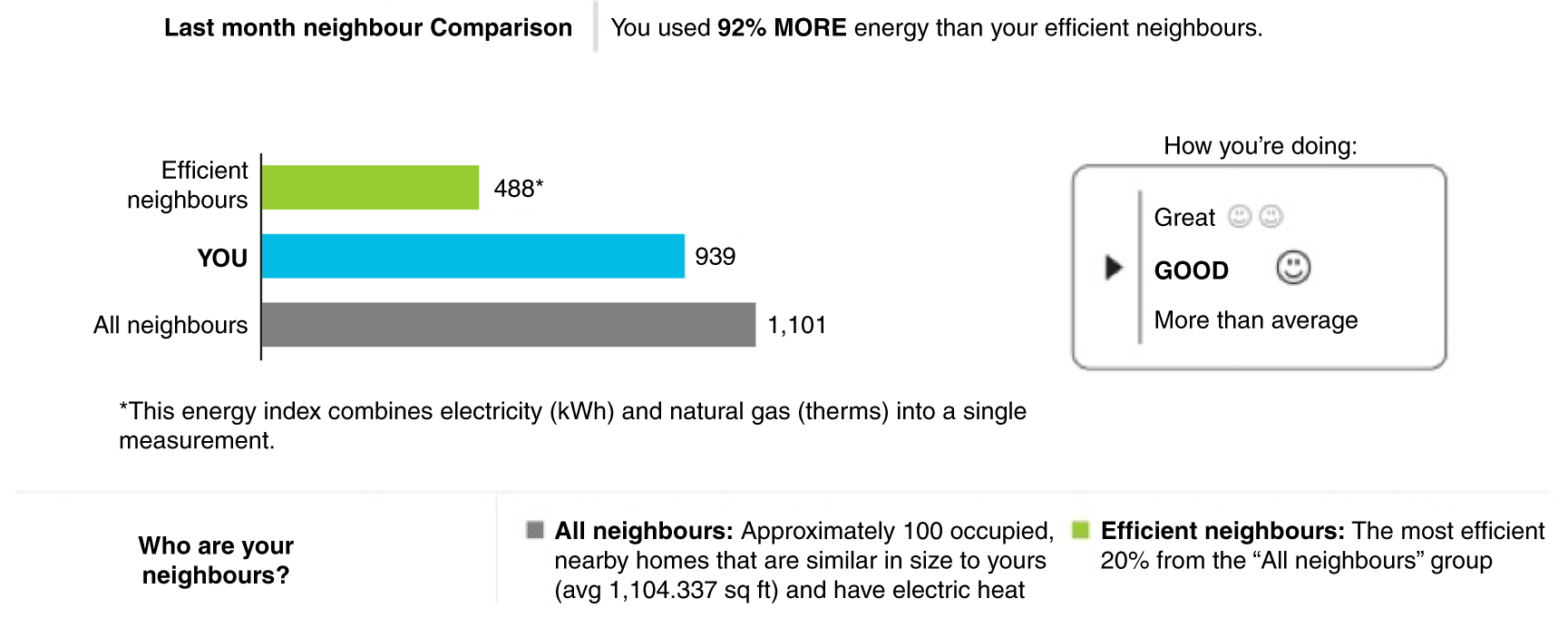
Sustaining large-scale public goods requires individuals to make environmentally friendly decisions today to benefit future generations1–6. Recent research suggests that second-order normative beliefs are more powerful predictors of behaviour than first-order personal beliefs7,8. We explored the role that second-order normative beliefs—the belief that community members think that saving energy helps the environment—play in curbing energy use. We first analysed a data set of 211 independent, randomized controlled trials conducted in 27 US states by Opower, a company that uses comparative information about energy consumption to reduce household energy usage (pooled N = 16,198,595). Building off the finding that the energy savings varied between 0.81% and 2.55% across states, we matched this energy use data with a survey that we conducted of over 2,000 individuals in those same states on their first-order personal and second-order normative beliefs. We found that second-order normative beliefs predicted energy savings but first-order personal beliefs did not. A subsequent pre-registered experiment provides causal evidence for the role of second-order normative beliefs in predicting energy conservation above first-order personal beliefs. Our results suggest that second-order normative beliefs play a critical role in promoting energy conservation and have important implications for policymakers concerned with curbing the detrimental consequences of climate change.
Oil and Gas=Peril and Poverty/ Solar and Wind=Prosperity and Protection
2026 has changed the psychological meaning of energy forever

What comes next with the energy shock?
The disruption to oil supply, oil prices and the world economy has been surprisingly manageable so far


Saul Griffith's commitment to showing how much individuals--and entire superpowers--can benefit from "energy literacy" — THE ALTERNATIVE
Continuing our week of blogs reckoning with the chastening IPCC report on climate change - but also trying to focus on concrete actions and motivating knowledge, rather than gnashing our teeth and rending our garments - we were alerted to the work of Australian-American inventor Saul Griffith. A
Breakthrough Energy | Home
Empowering innovators to build the future of energy
Ditch the niceties in AI prompts to save energy use, say researchers
A UN report warns of the rapid growth in AI energy consumption, but suggests users can improve efficiency by making prompts more concise

Overcoming Salience Bias: How Real-Time Feedback Fosters Resource Conservation
Inattention and imperfect information bias behavior toward the salient and immediately visible. This distortion creates costs for individuals, the organizations in which they work, and society at large. We show that an effective way to overcome this bias is by making the implications of one’s behavior salient in real time, while individuals can directly adapt. In a large-scale field experiment, we gave participants real-time feedback on the resource consumption of a daily, energy-intensive activity (showering). We find that real-time feedback reduced resource consumption for the target behavior by 22%. At the household level, this led to much larger conservation gains in absolute terms than conventional policy interventions that provide aggregate feedback on resource use. High baseline users displayed a larger conservation effect, in line with the notion that real-time feedback helps eliminate “slack” in resource use. The approach is cost effective, is technically applicable to the vast majority of households, and generated savings of 1.2 kWh per day and household, which exceeds the average energy use for lighting. The intervention also shows how digitalization in our everyday lives makes information available that can help individuals overcome salience bias and act more in line with their preferences. This paper was accepted by Uri Gneezy, behavioral economics.


A Reality Check on Our ‘Energy Transition’ | The Tyee
To our peril, there’s been no green revolution. Just green addition to rising fossil fuel use.

Bright Spots | Jan Rosenow | Substack
Jan Rosenow's newsletter on the energy transition. Oxford Professor. Energy policy advisor. Energy transition optimist. Cutting through the noise to show how the clean energy future is possible. Click to read Bright Spots, by Jan Rosenow, a Substack publication with thousands of subscribers.

Energy bills will rise ‘astronomically’ under One Nation, Coalition
New Victorian Energy Minister Jaclyn Symes says the opposition’s plan to cancel a huge power cable project and boost gas usage is designed to hoodwink voters.

Why it's time to dispel the myths about nuclear power
Thirty years has passed since events in Chernobyl, while Japan marks the fifth anniversary of the Fukushima disaster. We need more than ever to have a reasoned discussion on the issues

We’re Squandering LEDs’ Potential to Save Our Night Skies
Bad decisions have turned efficient technology into a driver of light pollution. There is a better way

Serenity and the Myth of "Getting Out the Signal" - Reactor
We want to believe that knowledge will change the world for the better, but it's not always that simple.

Climate solutions most likely to reach ‘positive tipping points’ revealed by scientists
Global shift towards clean electricity could trigger ‘cascade’ of progress, helping reduce air pollution, cut waste and revive oceans