


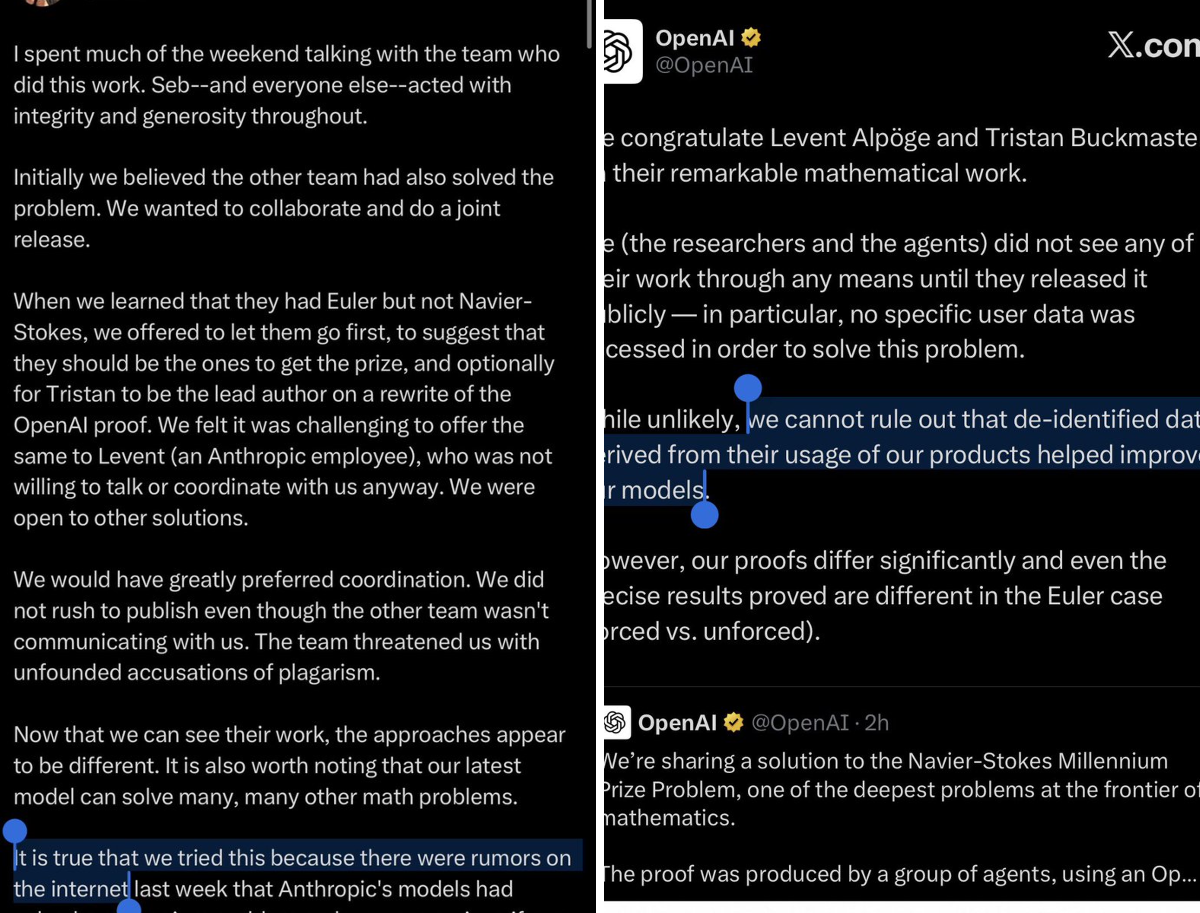
Obviously these results will be reported widely in other outlets, but I will note them here, in decreasing order of how “digested” the results currently are: Levent Alpöge, Tristan Buck…
Unforced Euler singularity, unforced Navier-Stokes singularity, and the Generalized Riemann Hypothesis
Obviously these results will be reported widely in other outlets, but I will note them here, in decreasing order of how “digested” the results currently are: Levent Alpöge, Tristan Buck…

tristanbuckmaster (@tristanbuckmaster@mastodon.social)
Today, Levent Alpöge and I have made public three results: finite-time blowup with smooth forcing for incompressible porous media, for Boussinesq, and for 3d incompressible Euler. https://cims.nyu.edu/~tristanb/statement.pdf https://cims.nyu.edu/~tristanb/euler.pdf https://cims.nyu.edu/~tristanb/ipm.pdf https://cims.nyu.edu/~tristanb/boussinesq.pdf https://github.com/tristanbuckmaster/fluid_lean
GitHub - openai/NavierStokesAndEuler at 8937a8f4cbc7abaab5e9e97d1cc7f5d2319d9538
Lean certificates accompanying Navier-Stokes and Euler results - openai/NavierStokesAndEuler
The Singularity is Here - David Perell
The Singularity is already here, and it began in Western Europe at the end of the 16th century.

Against The Singularity | TechCrunch
Ray Kurzweil's predictions of the Singularity annoy me sufficiently that I once sat down to write a TechCrunch column attacking them. A brief primer: Singularity theory argues that our exponential technological growth will, several decades hence, culminate in an unimaginable transcendence that redefines humanity, sentience, and/or reality. It is also known as the Rapture of the Nerds

In defense of astrophysics
This post https://x.com/CJHandmer/status/2122609626588061816 has been making the rounds on X. The post claims to use Claude Opus 5.5 to identify 872 major errors in published astrophysics papers, described at https://science.caseyhandmer.com/physics/
Why the Singularity won't be as big a deal as you might think
In this excerpt from mathematician and network scientist Samuel Arbesman's new book, The Half-Life of Facts: Why Everything We Know Has an Expiration

NIK on Twitter / X
>sam altman: "we tried this because there were rumor on the internet">rumor: math professor close to solving navier-stokes>the professor: using codex for a year>openai: has all his logs>checked every codex session tagged to N-S>found the most promising one>spun up 10,000… pic.twitter.com/RInlP88gmA— NIK (@ns123abc) September 8, 2026
AI Has Solved One of Math’s $1 Million Millennium Prize Problems | Quanta Magazine
Mathematicians at OpenAI showed that the Navier-Stokes equations, which describe how fluids flow, can sometimes “blow up.” But the massive result is not without controversy.

Claude has improved on a longstanding lower bound for the fraction of zeros of the Riemann zeta function that satisfy the Riemann hypothesis
An unreleased Claude model improved the lower bound for the fraction of zeroes of the Riemann zeta function that satisfy the hypothesis, raising it from 41.6% to 67.2%.
OpenAI solves Navier–Stokes, but research misconduct concerns remain | Olga Holtz posted on the topic | LinkedIn
OpenAI says its AI has solved a Millennium Prize Problem: Navier–Stokes. A human mathematician asks whether OpenAI committed research misconduct. As a mathematician working at the intersection of mathematics and AI, I find this truly messy while also potentially historic. Three things deserve attention. 1. The fine print IS the mathematics. The claimed construction starts with a three-dimensional incompressible fluid at rest. Under a smooth external force, its velocity becomes unbounded in finite time, even while its kinetic energy stays bounded. Crucially, the force itself remains smooth through the singularity. Forcing is explicitly permitted in Clay’s official breakdown alternatives C and D. Its presence does not disqualify the result. But this construction does not establish blow-up for unforced Navier–Stokes. That distinction matters. 2. This was a research system, not one clever prompt. OpenAI reports roughly 10,000 concurrent agents in the successful group and a result after about 88 hours. The Navier–Stokes effort used approximately 130 billion output tokens; Lean formalization and verification took another 17 hours. Human researchers redirected the effort and used tools to consolidate intermediate insights. The salient part here, as I already wrote earlier, is a new organization of mathematical discovery using an enormous amount of compute, not a faster chatbot. The published Lean formalization is important: there is something concrete for others to check. Let‘s see independent scrutiny of both the proof and whether the formal statement matches the intended theorem. 3. Proof verification is not provenance verification. The result follows the line of attack designed by Spanish mathematicians Diego Córdoba and Luis Martínez Zoroa, who appeared to be close to solving the problem themselves. Tristan Buckmaster has raised concerns about research priority and possible use of private Codex material (his statement is linked to the comment by Guillermo Núñez Ponasso below). Those concerns are not automatic proof of misconduct, yet: OpenAI recognizes Buckmaster and Levent Alpöge’s priority on forced Euler, a related but different problem. It denies accessing their unpublished work. But it also cannot rule out de-identified data from their OpenAI product usage helping improve its models, though it calls that unlikely. Is it though? That ‚leakage’ is quite possible, in my view. If correct, this is an extraordinary result. Let’s get independent verification. And let’s protect unpublished research — but exactly how to protect it from an AI lab if using its tools for this research? Recall that a verified theorem can settle a mathematical question. It cannot, by itself, settle scientific credit or establish that the discovery process was fair. Are you comfortable using an AI lab’s tools when that lab could also become your research competitor? https://lnkd.in/g4HzzUNp #AI #Mathematics #AIforScience #MillenniumProblems #NavierStokes | 54 comments on LinkedIn

No, AI hasn’t officially solved Navier–Stokes. Yet
PropAIganda, now with a Millennium Prize Problem
The Shape of Things to Come: A Singularity in All Four Quadrants – Integral Life
It seems clear is that we are seeing a general pattern of accelerated returns in at least four irreducible dimensions of our lives. It is a "singularity in all four quadrants" — Post-Humanism, Post-Scarcity, Post-Irony, and Post-Metaphysics. Let’s take a brief look at each of these dimensions.
More than five-twelfths of the zeros of $ζ$ are on the critical line
The second moment of the Riemann zeta-function twisted by a normalized Dirichlet polynomial with coefficients of the form $(μ\star Λ_1^{\star k_1} \star Λ_2^{\star k_2} \star \cdots...

Valerio Capraro on Twitter / X
BREAKING: OpenAI’s solution to Navier–Stokes does not match its Lean verification.The most important article to read today is not one of OpenAI’s 700 AI-generated math papers.It is this other paper, making a deep and worrying point:A Lean-verified proof does not… pic.twitter.com/bU7TQdv594— Valerio Capraro (@ValerioCapraro) October 8, 2026

Riemann Hypothesis may have been solved with the help of Claude. “what I saw during the course of progress so amazed me that I believe it is one dawn across science of something far greater.” alpo.ge/remark.pdf
