

A from-the-ground-up walkthrough of how modern LLMs work, from tokens to transformer blocks to the next-token loop
I Built an LLM From Scratch

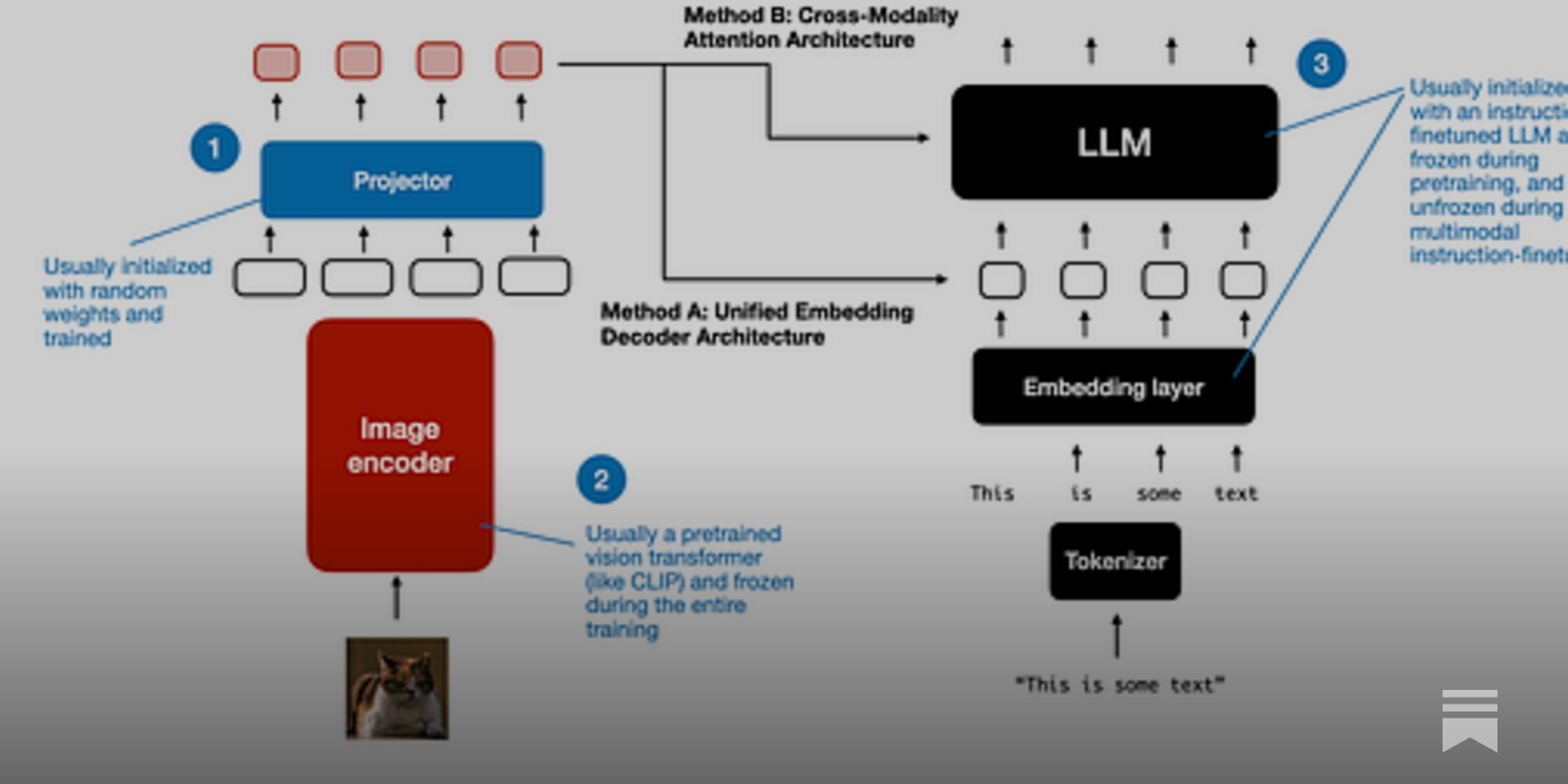
Understanding Multimodal LLMs
An introduction to the main techniques and latest models
The Ultimate Guide to Fine-Tuning LLMs from Basics to Breakthroughs: An Exhaustive Review of Technologies, Research, Best Practices, Applied Research Challenges and Opportunities (Version 1.0)
Dan Shipper 📧 on Twitter / X
this is true and is a big reason why you don’t need to be a highly technical researcher to use LLMs in surprising and novel ways https://t.co/TuxNzXzToU— Dan Shipper 📧 (@danshipper) July 27, 2025

LLMs are not like manufacturing machines - Ross Wintle
LLMs are not just machines. They are machine-building machines! This comes with way more responsibility. And understanding it may change how you use them.

Research – Inception
We are leveraging diffusion technology to develop a new generation of LLMs. Our dLLMs are much faster and more efficient than traditional autoregressive LLMs.

Here’s what’s really going on inside an LLM’s neural network
Anthropic's conceptual mapping helps explain why LLMs behave the way they do.

LLMs are a tool for thought
The oxygen from the air diffuses into your bloodstreams, is used for cellular respiration, and is transformed into carbon dioxide.
Build agents, not pipelines
There are only two ways to use LLMs in a computer program: as part of a pipeline, or as an agent. In other words, either you express the control flow of the program in code, or you give a LLM tools and allow it to manage the control flow itself1.

1/4 Do LLMs understand? "They understand in a way that’s very different from how humans understand," Dileep George, @dileeplearning.bsky.social, of Google DeepMind at the Simons Institute workshop on The Future of Language Models and Transformers. Video: simons.berkeley.edu/talks/dileep-george-google-de…
something that has come up fairly recently with LLMs - for coding, specifically - is that it’s become a lot easier to burn stupefying amounts of tokens on stuff very fast, with agents running 24/7 or managing more agents (see: Yegge’s Gas Town) even with low inference costs that adds up in a hurry

Jesse Felder
‘While some cling to the promise of an AI “revolution,” the cost of adoption is proving a stubborn bottleneck. These developments also suggest that the economics of replacing human labor with AI may be more complicated than some early forecasts originally implied.’ fortune.com/2026/05/22/microsoft-ai-cost-…
i can’t help but think we’re far from nailing memory systems this one here is extremely interesting. two LLMs at once, one just managing and surfacing memory for the other

Asa ⭔
I'm not a fan of the decoupled 'memory retrieval → task execution' loop, so my agent has a subconscious background thread that looks for relevant, unique memory context in its experiential database while it runs and injects it on top of the live context window.
LLM is a learned distribution p on sequences of tokens. If you just sample a bunch of text from p willy nilly and put it in the training data and train you just get back p. But if you sample a bunch of text from p and throw out whatever's bad and train on what's left then you learn p(x|x is not bad)


