The ChatGPT phrase “As of my last knowledge update” appears in several papers published by academic journals.
AI #169: New Knowledge
Even in a relatively quiet period, AI is out there creating new knowledge.
Elicit: AI for scientific research
Use AI to search, summarize, extract data from, and chat with over 125 million papers. Used by over 2 million researchers in academia and industry.

Elicit: AI for scientific research
Use AI to search, summarize, extract data from, and chat with over 125 million papers. Used by over 2 million researchers in academia and industry.
ChatGPT isn’t the only chatbot pulling answers from Elon Musk’s Grokipedia
Google’s Gemini, AI Mode, and AI Overviews, Perplexity, and Microsoft are starting to cite Musk’s Wikipedia knockoff.

Wikipedia:Signs of AI writing
This is a list of writing and formatting conventions typical of AI chatbots such as ChatGPT, with real examples taken from Wikipedia articles, drafts, comments, and other content. It is a field guide to help detect undisclosed AI-generated content on Wikipedia: while some of the signs may be broadly applicable, some may not apply in a non-Wikipedia context.[a] Not all text featuring these indicators is AI-generated, as the large language models that power AI chatbots are trained on human writing, including Wikipedia. Many elements of AI writing can be found in editorials, blogs, or fan fiction.
Jimmy Wales Says Wikipedia Could Use AI. Editors Call It the 'Antithesis of Wikipedia'
Wikipedia's founder said he used ChatGPT in the review process for an article and thought it could be helpful. Editors replied to point out it was full of mistakes.
AI and the Wisdom of Uncertainty
AI chatbots rarely say "I don't know," and neither, increasingly, do we. But we can cultivate our epistemic resilience.

The ChatGPT effect: In 3 years the AI chatbot has changed the way people look things up
ChatGPT has dramatically altered how people retrieve information, muscling aside Google search as the first stop on the hunt for answers.

The ChatGPT effect: In 3 years the AI chatbot has changed the way people look things up
ChatGPT has dramatically altered how people retrieve information, muscling aside Google search as the first stop on the hunt for answers.
AI, Learned Today
AI, Learned Today is a learning-in-public journal about how to use modern AI through my everyday use. It’s a place to share what I tried, what I noticed, and what I’m learning. Honest field notes from someone exploring the field of rapidly evolving AI tools.
Quotation errors in general science journals
Abstract. Due to the incremental nature of scientific discovery, scientific writing requires extensive referencing to the writings of others. The accuracy

Three Inverse Laws of AI - Susam Pal
Since the launch of ChatGPT in November 2022, generative artificial intelligence (AI) chatbot services have become increasingly sophisticated and popular. These systems are now embedded in search engines, software development tools as well as office software. For many people, they have quickly become part of everyday computing.
Ars Technica Pulls Article With AI Fabricated Quotes About AI Generated Article
A story about an AI generated article contained fabricated, AI generated quotes.

#predictingthefuture #newfutureofwork | Jaime Teevan
🌱 Prediction: Knowledge will outgrow publication. We’re already seeing academic publication start to buckle under AI, sometimes absurdly. I still publish research more or less the way Darwin did. I run a study, write it up, a few other scientists check it over, and the result gets filed away as a document with my name on the front. Faster than Darwin, with better figures, but the same basic shape. I predict that shape won’t last another decade. Academic authors are starting to slip hidden instructions into papers to flatter the AI that might review them. Reviewers are spending time checking whether citations exist or were hallucinated. Researchers asking AI to tell them about a paper instead of reading it directly. These are signs that the creation of new knowledge is outgrowing the articles that used to contain it. An academic paper serves many purposes at once. It makes an argument legible. It lets strangers check one's reasoning. It assigns credit and responsibility. It records who knew what and when. A paper was the only container we had for these different jobs, so it carried all of them together. With AI, they can be separated. My guess is that means the unit of publication will get smaller. Much of my research has focused on microproductivity, developing the idea that large accomplishments can be built from many small contributions. Publication will start to become a form of microproductivity. Instead of holding onto a result until it can be wrapped in a narrative large enough to justify a paper, researchers will publish it the moment it’s solid. Each finding, method, or negative result will be citable and carry its own provenance, so credit and reasoning travel with it. Reviewing will shrink to match, so claims get checked as they’re made instead of in one verdict at the end. But more than changing publication, the deeper change will be to how research itself is done. You may have heard the term “compound engineering,” where every bug fixed, evaluation written, workflow documented, or lesson learned becomes part of the system’s memory. I predict we’re about to see “compound science,” where every experiment, evaluation, insight, artifact, and learned capability becomes a reusable asset for future discovery. Findings will become evidence. Methods will become building blocks. Failed approaches will become constraints. For centuries, science has relied on humans to navigate an ever-growing body of knowledge. Soon that body of knowledge will help navigate itself. Scientists will spend less time searching for hypotheses and more time deciding which opportunities to pursue. AI systems will propose explanations, design experiments, run analyses, and explore many possibilities in parallel. Every discovery will become a part of the machinery that produces the next one. Papers ten years from now will look less like my current papers than my current papers look like Darwin’s. If they exist at all. #PredictingTheFuture #NewFutureOfWork

The Transformation of Documents: Repositories Are the New Unit of Knowledge Work
How will documents evolve when AI agents become ubiquitous? In a world of AI agents, does the repository become the source of truth—where humans declare intent, agents turn it into executable artif…

Artificial intelligence and illusions of understanding in scientific research
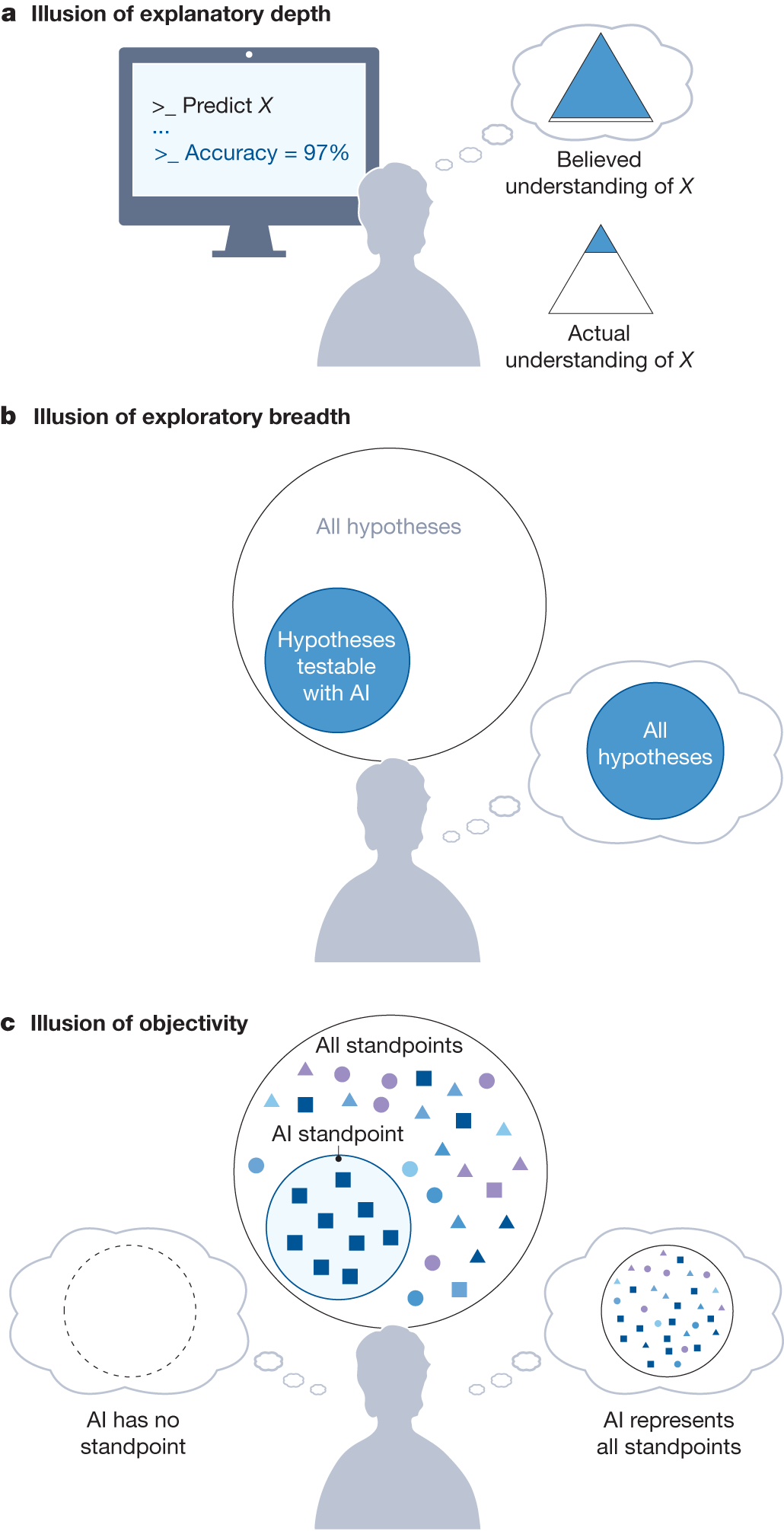
Scientists are enthusiastically imagining ways in which artificial intelligence (AI) tools might improve research. Why are AI tools so attractive and what are the risks of implementing them across the research pipeline? Here we develop a taxonomy of scientists’ visions for AI, observing that their appeal comes from promises to improve productivity and objectivity by overcoming human shortcomings. But proposed AI solutions can also exploit our cognitive limitations, making us vulnerable to illusions of understanding in which we believe we understand more about the world than we actually do. Such illusions obscure the scientific community’s ability to see the formation of scientific monocultures, in which some types of methods, questions and viewpoints come to dominate alternative approaches, making science less innovative and more vulnerable to errors. The proliferation of AI tools in science risks introducing a phase of scientific enquiry in which we produce more but understand less. By analysing the appeal of these tools, we provide a framework for advancing discussions of responsible knowledge production in the age of AI.