

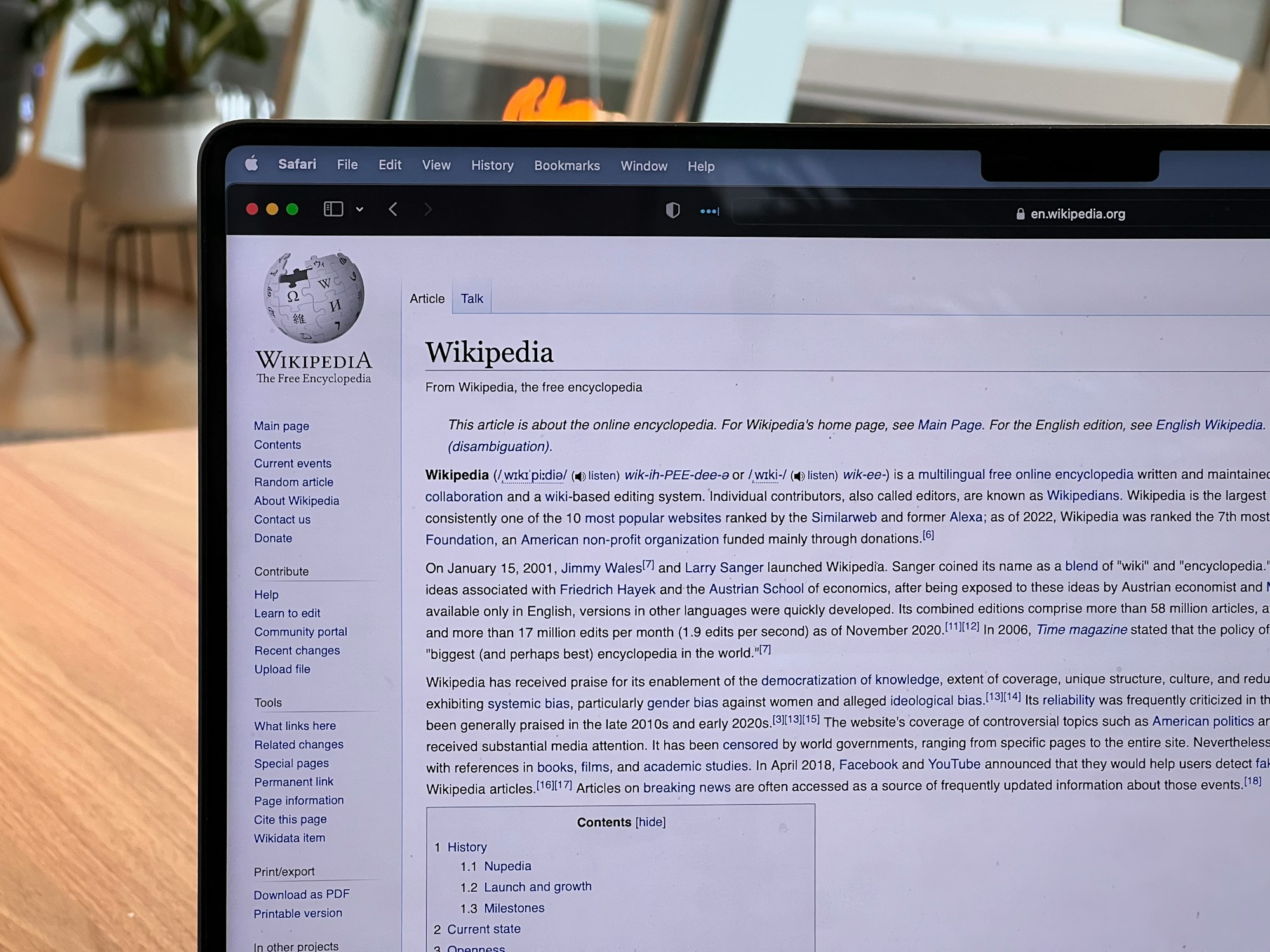
“With fewer visits to Wikipedia, fewer volunteers may grow and enrich the content, and fewer individual donors may support this work.”
How Wikipedia Will Survive in the Age of AI (With Wikipedia’s CTO Selena Deckelmann)
The Wikimedia Foundation’s chief technology and product officer explains how she helps manage one of the most visited sites in the world in the age of generative AI.
Millions of Volunteers Are Keeping the Internet Human. For Now.
We’re never going back to the human internet we had. But we can hope for a better internet than the AI-dominated one that is emerging, writes Sarah Gilbert.

What Americans See About AI Online
One month of web browsing data shows most respondents visited a search page with an AI-generated summary, but visits to in-depth content about AI were much rarer.

AI and the Collapse of the www
This paper studies market design for generative AI intermediation. AI answer systems can improve user experience while diverting visits that finance publisher content and generate source-level quality signals. I show that an AI platform that underinternalizes future content reproduction retains too little referral traffic and can make costly open-web information subcritical, even with truthful content, accurate answers, and rational users. The mechanism can be self-reinforcing: less source-level measurement weakens conventional search, inducing further AI reliance. Sustainable repair requires replacing displaced revenue and deleted measurement through visitor-replacement royalties, audited provenance, human-information audits, and keystone-topic compensation.

Our Approach to Artificial Intelligence
We are experimenting with using AI tools to extend our work as a small nonprofit, so that we can focus our time on reinforcing human connections, conversations, and communities that have eroded.

OKA – Disseminating free content on Wikipedia and open platforms through targeted funding
We are a non-profit organization dedicated to improving Wikipedia and other open platforms. We do so by providing monthly stipends to full-time contributors and translators. We leverage AI (Large Language Models) to automate most of the work.
Use of AI to Get News in U.S. Is Rare
Fewer than one in 10 Americans use artificial intelligence tools to get news and information.

Study Finds A Third of New Websites are AI-Generated
Researchers found the internet is becoming aggressively positive as AI-generated text floods the web.

Content Independence Day, one year on- building the business model for the agentic Internet
One year after declaring Content Independence Day, a dynamic market for monetized content has officially emerged. In this report, we examine how the rise of autonomous AI agents is upending traditional search referrals and detail the new infrastructure required to support a sustainable web economy.

Why AI Companies Are Buying—And Then Destroying—Old Books
We've long joked about delaying bedtime in order to read the entire internet, but the prospect of actually doing so doesn't sound as appealing as it used to. An ever-growing proportion of text online, we may sense, hasn't been written by humans, but generated by artificial intelligence.

Bad news for Google — new survey shows 55% of people are now using AI instead of search engines
More users are turning to AI search for personalized responses

The Impact of AI-Generated Text on the Internet
By mid-2025, roughly 35% of newly published websites were classified as AI-generated or AI-assisted.
The Paradox of Reuse in 2026: A Case of Quasi-Enclosure, or "Subsidized Club Goods that Sort of Look Like Public Goods"
How we can understand, and react to, the complicated impacts of AI systems on online communities and knowledge commons

The Paradox of Reuse in 2026: A Case of Quasi-Enclosure, or "Subsidized Club Goods that Sort of Look Like Public Goods"
How we can understand, and react to, the complicated impacts of AI systems on online communities and knowledge commons
Americans Turning to AI to Supplement Healthcare Visits
One in four Americans use AI for health information. Most do so to supplement care, but some are using AI in place of a provider visit when barriers arise.

Sure. AI companies have ALWAYS been training their models on Wikipedia content, which under the free and open access model is available to anyone — including AI companies. Agreements like these require AI companies to limit and offset the strain they place on Wikimedia infrastructure.

Club Announcement Spurs 🤦♂️
Hoping that @molly.wiki can help explain.
