

History of Successful Boycotts | Ethical Consumer
These examples of successful boycotts show the big an impact this campaign tactic can have.
Montgomery Bus Boycott
Sparked by the arrest of Rosa Parks on 1 December 1955, the Montgomery bus boycott was a 13-month mass protest that ended with the U.S. Supreme Court ruling that segregation on public buses is unconstitutional. The Montgomery Improvement Association (MIA) coordinated the boycott, and its president, Martin Luther King, Jr., became a prominent civil rights leader as international attention focused on Montgomery. The bus boycott demonstrated the potential for nonviolent mass protest to successfully challenge racial segregation and served as an example for other southern campaigns that followed. In Stride Toward Freedom, King’s 1958 memoir of the boycott, he declared the real meaning of the Montgomery bus boycott to be the power of a growing self-respect to animate the struggle for civil rights.
Civil Rights Era (1950–1963) - The Civil Rights Act of 1964: A Long Struggle for Freedom | Exhibitions - Library of Congress
The Brown decision fueled violent resistance during which Southern states evaded the law. The Montgomery bus boycott began a campaign of nonviolent civil disobedience to protest segregation that attracted national and international attention. Media coverage of the use of fire hoses and attack dogs against protesters and bombings and riots in Birmingham compelled Kennedy to act, sending a civil rights bill to Congress.
Consumer Boycotts | The Paper Pilot
The Paper Pilot's digital garden of thoughts on philosophy, politics, and sociology
"We Will Shoot Back": The Natchez Model and Paramilitary Organization in the Mississippi Freedom Movement
Between 1965 and 1979, economic boycotts were a principal form of insurgency for Black activists in Mississippi. After 1964, in several communities, the boycott of White-owned commerce became the primary tactic utilized by human rights forces to disrupt the system of segregation. These boycotts relied upon paramilitary organization to protect the activities and leadership of the Mississippi freedom movement and the Black community in general and to sanction anyone in the Black community who wished to violate the boycott. This paradigm of economic boycotts supported by paramilitary organization was first utilized in 1965 in Natchez. Natchez is a commercial center in southwest Mississippi. The combination of economic boycott with armed resistance posed an effective coercive campaign to pressure the local White power structure for concessions demanded by the movement. The insurgent model of Natchez was replicated throughout the state, particularly in Black communities of southwest Mississippi.
Resisting Racial Capitalism: An Antipolitical Theory of Refusal
An Antipolitical Theory of Refusal
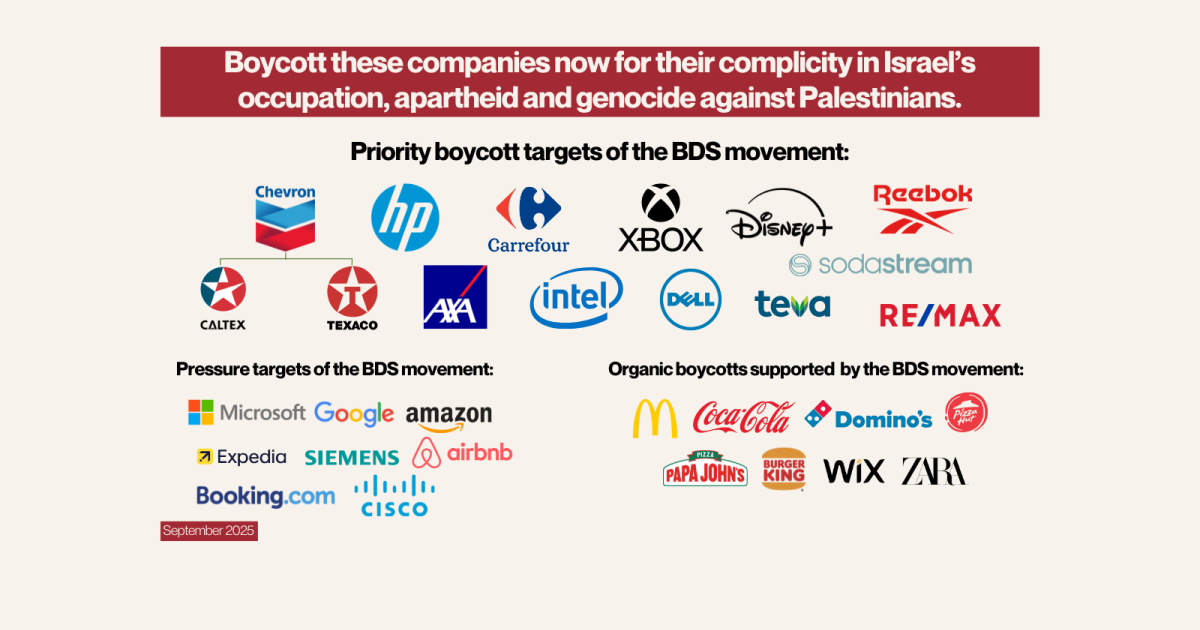
Guide to BDS Boycott & Pressure Corporate Priority Targeting
Ending the complicity of states, corporations, and institutions in Israel’s ongoing, live-streamed genocide against 2.3 million Palestinians in Gaza is the most effective form of solidarity with the Palestinian struggle to end the genocide and dismantle Israel’s 76-year-old regime of settler-colonialism and apartheid.
Boycott US products? New tariffs make people choose European products. Are we seeing a trend? | Tuta
With the growing movement to boycott US products and services, more people are choosing European alternatives. Let’s take a look at the best European products you can use.

Immigrants against the State: Yiddish and Italian Anarchism in America
From the 1880s through the 1940s, tens of thousands of first- and second-generation immigrants embraced the anarchist cause after arriving on American shores. Kenyon Zimmer explores why these migrants turned to anarchism, and how their adoption of its ideology shaped their identities, experiences, and actions. Zimmer focuses on Italians and Eastern European Jews in San Francisco, New York City, and Paterson, New Jersey. Tracing the movement's changing fortunes from the pre–World War I era through the Spanish Civil War, Zimmer argues that anarchists, opposed to both American and Old World nationalism, severed all attachments to their nations of origin but also resisted assimilation into their host society. Their radical cosmopolitan outlook and identity instead embraced diversity and extended solidarity across national, ethnic, and racial divides. Though ultimately unable to withstand the onslaught of Americanism and other nationalisms, the anarchist movement nonetheless provided a shining example of a transnational collective identity delinked from the nation-state and racial hierarchies.
Anti-War Protests of the 1960s-70s
The Vietnam anti-war movement was one of the most pervasive displays of opposition to the government policy in modern ti...

Black Marxism, Revised and Updated Third Edition by Cedric J Robinson | East Bay Booksellers
In this ambitious work, first published in 1983, Cedric Robinson demonstrates that efforts to understand Black people’s history of resistance solely through the prism of Marxist theory are incomplete and inaccurate.
Boycott The New York Times
For years The New York Times has relentlessly pushed anti-trans propaganda, playing a significant role in the escalating genocide against us. It's far past time for a call to action: anyone who cares about trans lives must boycott and divest the Times.

The Root – Black News, Opinions, Politics and Culture
Living for the City
In this nuanced and groundbreaking history, Donna Murch argues that the Black Panther Party (BPP) started with a study group. Drawing on oral history and unt...
Protests | The Paper Pilot
The Paper Pilot's digital garden of thoughts on philosophy, politics, and sociology
Assam Movement
The Assam Movement, also known as the Anti-Foreigners Agitation, was a popular uprising in Assam, India, from 1979 to 1985, that demanded the Government of India detect, disenfranchise and deport illegal aliens. Led by All Assam Students Union (AASU) and All Assam Gana Sangram Parishad (AAGSP) the movement defined a six-year period of sustained civil disobedience campaigns, political instability and widespread ethnic violence. The movement ended in 1985 with the Assam Accord.
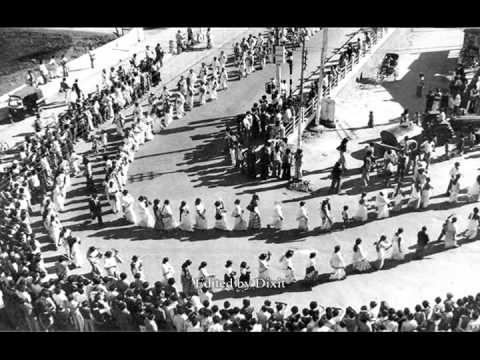
The Anti-Apartheid Movement began as the Boycott Movement, set up in 1959 to persuade shoppers to boycott goods from apartheid sources.