View Empirical Generalization Research Papers on Academia.edu for free.
Academia.edu - Find Research Papers, Topics, Researchers
Academia.edu is the platform to share, find, and explore 64 Million research papers. Join us to accelerate your research needs & academic interests.

Academia.edu - Find Research Papers, Topics, Researchers
Academia.edu is the platform to share, find, and explore 65 Million research papers. Join us to accelerate your research needs & academic interests.

The language of generalization.
Connected Papers | Find and explore academic papers
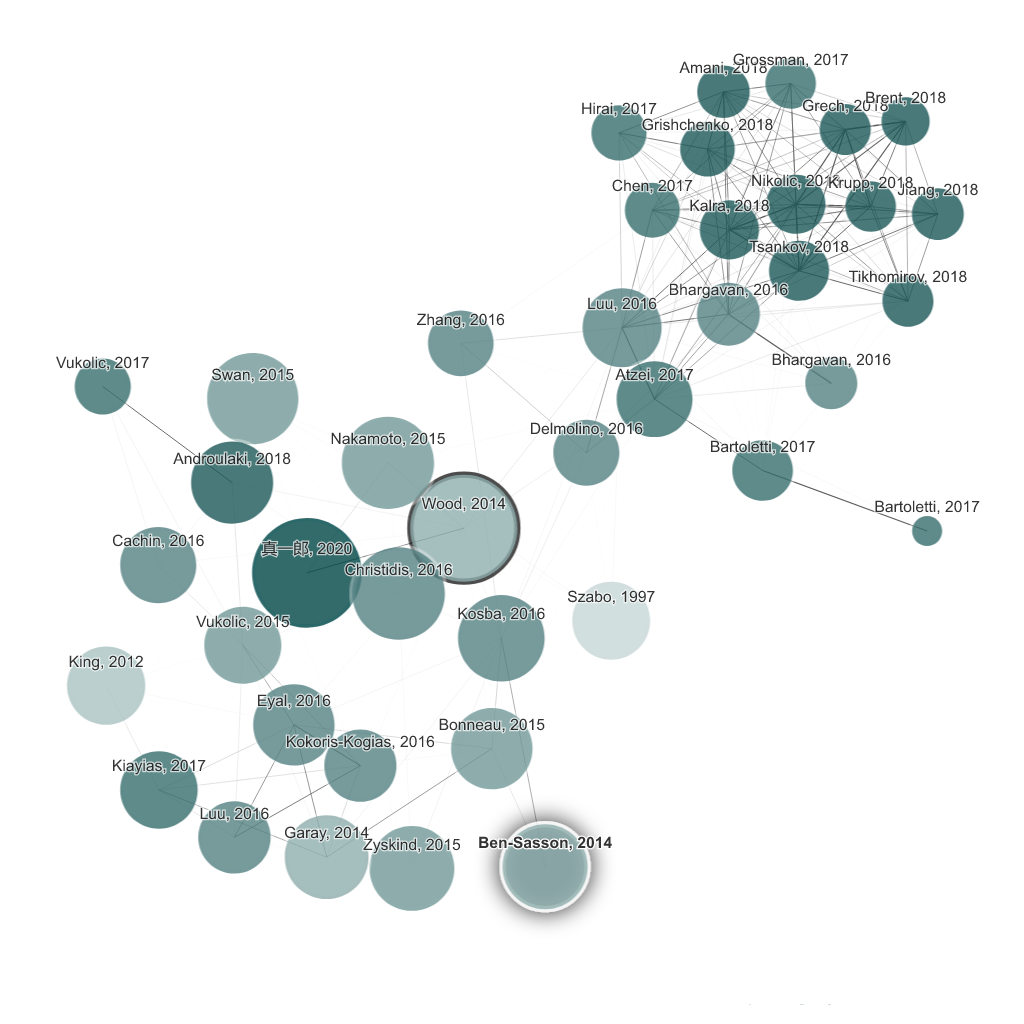
A unique, visual tool to help researchers and applied scientists find and explore papers relevant to their field of work.
Connected Papers | Find and explore academic papers
A unique, visual tool to help researchers and applied scientists find and explore papers relevant to their field of work.
A call for broadening the altmetrics tent to democratize science outreach
Common altmetrics indices are limited and biased in the social media that they cover. In this Perspective, we highlight how and why altmetrics should broaden its scope to provide more reliable metrics for scientific content and communication.
Paperstars
A better way to evaluate scientific papers. Methodological soundness and transparency, not citation counts.

The scientific enterprise is a human enterprise
An excerpt from my newly-defended PhD dissertation.

The new way we’ll do science
Papers should become human-readable views over a graph of data, tools, results, and certificates.

AI maps science papers to predict research trends two to three years ahead
The number of scientific papers is growing so rapidly that scientists are no longer able to keep track of all of them, even in their own research area. Researchers from the Karlsruhe Institute of Technology ...

Leiden Manifesto for Research Metrics
The Leiden Manifesto for Research Metrics (also known as the Leiden Manifesto) is a 22 April 2015 published comment in Nature that includes a list of "ten principles to guide research evaluation".[1] It was formulated by public policy professor Diana Hicks, scientometrics professor Paul Wouters, and their colleagues at the 19th International Conference on Science and Technology Indicators, held between 3–5 September 2014 in Leiden, The Netherlands.[2]
AI for Research | Scite
Scite searches 280M+ scholarly articles to give you citation-backed answers and show you how every claim is supported or disputed.
Augmenting Research Ideation with Data: An Empirical Investigation...
Recent advancements in large language models (LLMs) demonstrate strong potential for generating novel research ideas, yet such ideas often struggle with feasibility and effectiveness. In this...

papers-we-love/papers-we-love
Papers from the computer science community to read and discuss.
Reproducible research: methodological principles for transparent…
This Mooc proposes methodological principles for open and transparent science. It deals in a practical way with note-taking, computational documentation, replicability of analyses.