China is launching a comprehensive “credit score” system, and the more I learn about it, the more nightmarish it seems. China appears to be leveraging all the tools of the information age—electronic purchasing data, social networks, algorithmic sorting—to construct the ultimate tool of social control. It is, as one commentator put it, “authoritarianism, gamified.” Read this piece for the full flavor—it will make your head spin. If that and the little other reporting I’ve seen is accurate, the basics are this:
Uh-oh: Silicon Valley is building a Chinese-style social credit system - Fast Company
In China, scoring citizens’ behavior is official government policy. U.S. companies are increasingly doing something similar, outside the law.

In China, a Three-Digit Score Could Dictate Your Place in Society
China is taking the idea of a credit score to the extreme, using big data to track and rank what you do—your purchases, your pastimes, your mistakes.
China wants to give all of its citizens a score – and those who fall short will be denied basic privileges
The Communist Party wants to encourage good behaviour by marking all its people using online data. Those who fall short will be denied basic freedoms like loans or travel
China Turns Big Data into Big Brother
The country wants to assign citizens a score that determines their eligibility for everything from loans to education.
China’s plan to organize its society relies on ‘big data’ to rate everyone
The Communist Party wants to harness vast troves of online data to score people and companies on their behavior.

Chinese officials 'create 488m bogus social media posts a year'
Harvard researchers say leaked documents show bureaucrats fabricate positive posts to distract from criticism of government
China to bar people with bad 'social credit' from planes, trains
China said it will begin applying its so-called social credit system to flights and trains and stop people who have committed misdeeds from taking such transport for up to a year.

China Didn’t Make Americans Hate Data Centers
GOP lawmakers, tech investors, and even OpenAI have tied the anti-data-center movement in the US to Chinese interference. Experts say it’s much more complicated than that.


China’s online nationalist army
Nationalism on Chinese social media has grown hugely during Xi Jinping’s time as leader – and it is changing in a potentially explosive way. An army of ultra-patriotic social media personalities now attacks foreign governments and big companies - and sometimes calls for even harsher actions than Beijing takes.

Gauging the Strength of China’s Economy in Uncertain Times
An update on China’s recent economic performance and policy changes, focusing on aggregate credit as a measure to gauge policy stimulus.

China’s scary lesson to the world: Censoring the Internet works
China is confidently promoting its vision of “Internet Sovereignty.”

China
This blog post was published on November 20, 2019. It might be out of date, have broken images or links, or simply contain bad ideas and opinions that didn't stand the test of time. Please read generously!
Authoritarians Distract Rather than Debate - Marginal REVOLUTION
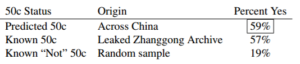
It’s long been known that the Chinese government hires people to support the government with fabricated posts on social media. In China these people are known as the “50c party”, so called because the posters were rumored to be paid 50 cents (5 jiao or about $.08) to write the posts. The precise nature and extent […]
How the Chinese Government Fabricates Social Media Posts for Strategic Distraction, Not Engaged Argument
The Chinese government has long been suspected of hiring as many as 2,000,000 people to surreptitiously insert huge numbers of pseudonymous and other deceptive writings into the stream of real social media posts, as if they were the genuine opinions of ordinary people. Many academics, and most journalists and activists, claim that these so-called "50c party" posts vociferously argue for the government's side in political and policy debates. As we show, this is also true of the vast majority of posts openly accused on social media of being 50c. Yet, almost no systematic empirical evidence exists for this claim, or, more importantly, for the Chinese regime's strategic objective in pursuing this activity. In the first large scale empirical analysis of this operation, we show how to identify the secretive authors of these posts, the posts written by them, and their content. We estimate that the government fabricates and posts about 448 million social media comments a year. In contrast to prior claims, we show that the Chinese regime's strategy is to avoid arguing with skeptics of the party and the government, and to not even discuss controversial issues. We show that the goal of this massive secretive operation is instead to distract the public and change the subject, as most of the these posts involve cheerleading for China, the revolutionary history of the Communist Party, or other symbols of the regime. We discuss how these results fit with what is known about the Chinese censorship program, and suggest how they may change our broader theoretical understanding of "common knowledge" and information control in authoritarian regimes. This paper is related to our articles in *Science,* "[Reverse-Engineering Censorship In China: Randomized Experimentation And Participant Observation](/publication/reverse-engineering-censorship-in-china-randomized-experimentation-and-participant-observation/)", and the *American Political Science Review,* "[How Censorship In China Allows Government Criticism But Silences Collective Expression](/publication/how-censorship-in-china-allows-government-criticism-but-silences-collective-expression/)". Replication data at the Harvard Dataverse: [https://doi.org/10.7910/DVN/QSZMPD](https://doi.org/10.7910/DVN/QSZMPD).