

Imagine a surveillance camera in a typical convenience store in the 1980s. That camera was big and expensive, and connected by a wire running through the wall to a VCR sitting in a back room. There have been significant advances in camera technology in the ensuing decades — in resolution, digitization, storage, and wireless transmission — and cameras have become cheaper and far more prevalent. Still, for all those advances, the social implications of being recorded have not changed: when we walk into a store, we generally expect that the presence of cameras won’t affect us. We expect that our movements will be recorded, and we might feel self-conscious if we notice a camera, especially if we’re doing anything that we feel might attract attention. But unless something dramatic occurs, we generally understand that the videos in which we appear are unlikely to be scrutinized or monitored. All that is about to change. Today’s capture-and-store video systems are starting to be augmented with active monitoring technology known variously as “video analytics,” “intelligent video analytics,” or “video content analysis.” The goal of this technology is to allow computers not just to record but also to understand the objects and actions that a camera is capturing. This can be used to alert the authorities when something or someone deemed “suspicious” is detected, or to collect detailed information about video subjects for security or marketing purposes. Behind all the dumb video camera “eyes” that record us will increasingly lie ever-smarter “brains” that will be monitoring us. As we will see, technologists are working on teaching computers to do that monitoring in remarkable ways across a broad variety of dimensions.
Gazing Back at the Surveillance Cameras That Watch Us (Published 2018)
These photographers explored the implications of a culture of pervasive monitoring.

Flock + AI-powered cameras - staffny
I think we all by now understand that AI (artificial intelligence) is not the solution when it comes to understanding humans. It often makes errors, and when yo...
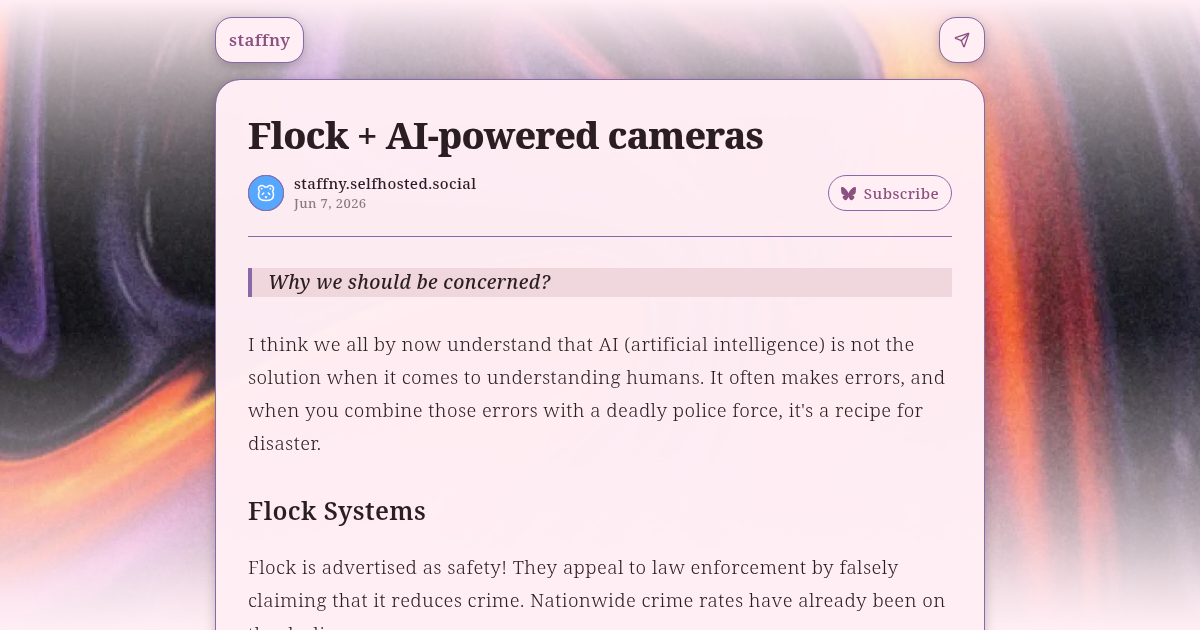
Virtual Reality Allows the Most Detailed, Intimate Digital Surveillance Yet
The kinds of behaviors virtual reality captures have long been a holy grail for data-monetizing companies.
‘Who is going to pay us when we’re replaced by robots?’ The Indian factory workers told to film themselves for AI
When workers had cameras attached to them, they found it funny at first. But novelty soon turned to concern

Tidying Up When We Have No Control over Our Digital Lives
Never-ending notifications. Pull-to-refresh rewards. There's no escape from surveillance capitalism.

We Need A Massive Surveillance Program (Idle Words)
I am a privacy activist who has been riding a variety of high horses about the dangers of permanent, ubiquitous data collection since 2012.
The Creepy New Wave of the Internet
As human behavior is tracked and merchandized on a massive scale, the Internet of Things creates the perfect conditions to bolster and expand the surveillance state.

yeah… this chip pays for the whole TV
How Google Discovered the Value of Surveillance | Hacker News
It took basically until now for the bloom to come off the rose. Think about that. For 20 years Google has been supposedly hiring the smartest guys in the room and all it took was free food, some ball pits and slides, contributing some tech to open source, and working on a handful of "moonshots" that haven't gone anywhere to keep the sheen of innovation going. And it worked. For 20 years.
Why Privacy Matters Even if You Have ‘Nothing to Hide’
What’s the problem with ubiquitous surveillance? Don’t think Orwell; think Kafka.

Why Privacy Matters Even if You Have ‘Nothing to Hide’
What’s the problem with ubiquitous surveillance? Don’t think Orwell; think Kafka.
Event Cameras: a New Way of Sensing - Davide Scaramuzza - ICCP 2024 Keynote
39C3 - AI Agent, AI Spy
216,000,000 Spy TVs | The LG Smart TV Problem
Surveillance and the Internet of Things | Hacker News
As Bruce says, the real issue now is not surveillance or even information, but power. Who gets to watch whom, and (of course) who watches the watchers?
Unloom
All the tools you love from screen recorders, without sacrificing privacy or ownership of your data