Improving the quality of medical research reporting is crucial to reduce avoidable waste in research and to improve the quality of health care. Despite various initiatives aiming at improving research reporting – guidelines, checklists, authoring aids, peer review procedures, etc. – overinterpretation of research results, also known as spin, is still a serious issue in research reporting. In this paper, we propose a Natural Language Processing (NLP) system for detecting several types of spin in biomedical articles reporting randomized controlled trials (RCTs). We use a combination of rule-based and machine learning approaches to extract important information on trial design and to detect potential spin. The proposed spin detection system includes algorithms for text structure analysis, sentence classification, entity and relation extraction, semantic similarity assessment. Our algorithms achieved operational performance for the these tasks, F-measure ranging from 79,42 to 97.86% for different tasks. The most difficult task is extracting reported outcomes. Our tool is intended to be used as a semi-automated aid tool for assisting both authors and peer reviewers to detect potential spin. The tool incorporates a simple interface that allows to run the algorithms and visualize their output. It can also be used for manual annotation and correction of the errors in the outputs. The proposed tool is the first tool for spin detection. The tool and the annotated dataset are freely available.
CONSORT-TM: Text classification models for assessing the completeness of randomized controlled trial publications
ABSTRACT Objective To develop text classification models for determining whether the checklist items in the CONSORT reporting guidelines are reported in randomized controlled trial publications. Materials and Methods Using a corpus annotated at the sentence level with 37 fine-grained CONSORT items, we trained several sentence classification models (PubMedBERT fine-tuning, BioGPT fine-tuning, and in-context learning with GPT-4) and compared their performance. To address the problem of small training dataset, we used several data augmentation methods (EDA, UMLS-EDA, text generation and rephrasing with GPT-4) and assessed their impact on the fine-tuned PubMedBERT model. We also fine-tuned PubMedBERT models limited to checklist items associated with specific sections (e.g., Methods) to evaluate whether such models could improve performance compared to the single full model. We performed 5-fold cross-validation and report precision, recall, F1 score, and area under curve (AUC). Results Fine-tuned PubMedBERT model that takes as input the sentence and the surrounding sentence representations and uses section headers yielded the best overall performance (0.71 micro-F1, 0.64 macro-F1). Data augmentation had limited positive effect, UMLS-EDA yielding slightly better results than data augmentation using GPT-4. BioGPT fine-tuning and GPT-4 in-context learning exhibited suboptimal results. Methods-specific model yielded higher performance for methodology items, other section-specific models did not have significant impact. Conclusion Most CONSORT checklist items can be recognized reasonably well with the fine-tuned PubMedBERT model but there is room for improvement. Improved models can underpin the journal editorial workflows and CONSORT adherence checks and can help authors in improving the reporting quality and completeness of their manuscripts.
Science should be machine-readable - Marginal REVOLUTION
One of the leading tasks of our time: We develop a machine-automated approach for extracting results from papers, which we assess via a comprehensive review of the entire eLife corpus. Our method facilitates a direct comparison of machine and peer review, and sheds light on key challenges that must be overcome in order to facilitate […]

RegCheck: A tool for structured comparisons between study registrations and papers
Across the social and medical sciences, researchers recognize that specifying planned research activities (i.e., 'registration') prior to the commencement of research has benefits for both the transparency and rigour of science. Despite this, evidence suggests that study registrations frequently go unexamined, minimizing their effectiveness. In a way this is no surprise: manually checking registrations against papers is labour- and time-intensive, requiring careful reading across formats and expertise across domains. The advent of AI unlocks new possibilities in facilitating this activity. We present RegCheck, a modular LLM-assisted tool designed to help researchers, reviewers, and editors from across scientific disciplines compare study registrations with their corresponding papers. Importantly, RegCheck keeps human expertise and judgement in the loop by (i) ensuring that users are the ones who determine which features should be compared, and (ii) presenting the most relevant text associated with each feature to the user, facilitating (rather than replacing) human discrepancy judgements. RegCheck also generates shareable reports with unique RegCheck IDs, enabling them to be easily shared and verified by other users. RegCheck is designed to be adaptable across scientific domains, as well as registration and publication formats. In this paper we provide an overview of the motivation, workflow, and design principles of RegCheck, and we discuss its potential as an extensible infrastructure for reproducible science with an example use case.

HalluCiteChecker: A Lightweight Toolkit for Hallucinated Citation Detection and Verification in the Era of AI Scientists
We introduce HalluCiteChecker, a toolkit for detecting and verifying hallucinated citations in scientific papers. While AI assistant technologies have transformed the academic writing process, including citation recommendation, they have also led to the emergence of hallucinated citations that do not correspond to any existing work. Such citations not only undermine the credibility of scientific papers but also impose an additional burden on reviewers and authors, who must manually verify their validity during the review process. In this study, we formalize hallucinated citation detection as an NLP task and provide a corresponding toolkit as a practical foundation for addressing this problem. Our package is lightweight and can perform verification in seconds on a standard laptop. It can also be executed entirely offline and runs efficiently using only CPUs. We hope that HalluCiteChecker will help reduce reviewer workload and support organizers by enabling systematic pre-review and publication checks. Our code is released under the Apache 2.0 license on GitHub and is distributed as an installable package via PyPI. A demonstration video is available on YouTube.
Fact or Fiction: Verifying Scientific Claims
We introduce scientific claim verification, a new task to select abstracts from the research literature containing evidence that SUPPORTS or REFUTES a given scientific claim, and to identify rationales justifying each decision. To study this task, we construct SciFact, a dataset of 1.4K expert-written scientific claims paired with evidence-containing abstracts annotated with labels and rationales. We develop baseline models for SciFact, and demonstrate that simple domain adaptation techniques substantially improve performance compared to models trained on Wikipedia or political news. We show that our system is able to verify claims related to COVID-19 by identifying evidence from the CORD-19 corpus. Our experiments indicate that SciFact will provide a challenging testbed for the development of new systems designed to retrieve and reason over corpora containing specialized domain knowledge. Data and code for this new task are publicly available at https://github.com/allenai/scifact. A leaderboard and COVID-19 fact-checking demo are available at https://scifact.apps.allenai.org.
RAPID: Reliable and efficient Automatic generation of submission rePorting checklists with Large language moDels
Importance Medical reporting guidelines are significant in improving the transparency, quality, and integrity of medical research, particularly in randomized clinical trials; adherence to these guidelines supports research interpretability and has direct implications for downstream applications, such as patient treatment. However, with over 600 distinct reporting guidelines, manual assessments are often time-consuming and labor-intensive. Objective To evaluate an automated reporting checklist generation tool using large language models and retrieval augmentation generation technology, called RAPID. Design, Setting, and Participants This study used large language models to design a retrieval augmentation generation architecture and collected published journal articles as training and validation sets to optimize prompts within the framework and comprehensively evaluate the performance of the framework. Medical reporting experiments were collected from 50 randomized controlled trials without the intervention of AI tools and 41 randomized controlled trials with the intervention of AI tools. Main Outcomes and Measures For effective evaluation of the performance of this tool, a classification accuracy metric (Reported/Not Reported) defined as the number of correct judgments divided by all judgments and a content consistent score metric defined as the number of contents retrieved by the tool that are the same as those retrieved by researchers divided by the total number of judgments were calculated. Results The RAPID tool uses the widely used Word document and Portable Document Format as an input file. Fifty published journal articles without the intervention of AI tools and 41 published journal articles with the intervention of AI tools were collected as CONSORT and CONSORT-AI datasets. All of the CONSORT reporting items (37) were included in the tool. RAPID achieved a high average accuracy rate of 92.11% and a content consistency score of 81.14% on the CONSORT dataset. Of the CONSORT-AI reporting items, 11 items related to the intervention of AI tools were included in the tool. RAPID achieved an average accuracy of 83.81% with a content consistency score of 72.51% on the CONSORT-AI dataset. For these two reporting guidelines, a training set of 5 articles was selected from each dataset to refine the prompts used in the tools for CONSORT and CONSORT-AI reporting checklist. The validation set of the remaining articles was used to assess the performance of the RAPID. The RAPID tool used the Word document and Portable Document Format of the articles as input files. A RAPID graphical user interface was built using JavaScript and Vue. Conclusions and Relevance The RAPID tool is designed to assist in the reporting of various types of trials. RAPID has strong scalability, which can be easily adapted to different medical reporting guidelines without transfer learning on a large dataset. RAPID may effectively save time and improve working efficiency for different user groups, for example, 1) simplifying the submission process and improving report quality by verifying manuscript completeness for medical authors; 2) facilitating evaluation of report quality for medical researchers; 3) expediting manuscript distribution for medical editors; and 4) identifying reporting deficiencies and providing deeper insights for review comments for reviewers. Question Can large language model tools automatically generate medical reporting checklists for manuscripts of different types of clinic trials?Findings An automated reporting checklist generation tool using large language models and retrieval augmentation generation technology, RAPID, was developed. RAPID was fully evaluated on all items across two separate datasets related to the Consolidated Standards of Reporting Trials (CONSORT) and CONSORT-AI reporting guidelines. In the first dataset corresponding to CONSORT, RAPID achieved an average accuracy of 92.11%, while in the second dataset associated with CONSORT - AI, it reached an average accuracy of 83.81%. Additionally, RAPID is highly scalable. It can be easily and smoothly adapted to different medical reporting guidelines without transfer learning on a large dataset.Meaning RAPID can effectively save time and improve working efficiency for different user groups such as medical authors, researchers, editors, and reviewers.
Span-level Detection of AI-generated Scientific Text via Contrastive Learning and Structural Calibration
The rapid adoption of large language models (LLMs) in scientific writing raises serious concerns regarding authorship integrity and the reliability of scholarly publications. Existing detection approaches mainly rely on document-level classification or surface-level statistical cues; however, they neglect fine-grained span localization, exhibit weak calibration, and often fail to generalize across disciplines and generators. To address these limitations, we present Sci-SpanDet, a structure-aware framework for detecting AI-generated scholarly texts. The proposed method combines section-conditioned stylistic modeling with multi-level contrastive learning to capture nuanced human-AI differences while mitigating topic dependence, thereby enhancing cross-domain robustness. In addition, it integrates BIO-CRF sequence labeling with pointer-based boundary decoding and confidence calibration to enable precise span-level detection and reliable probability estimates. Extensive experiments on a newly constructed cross-disciplinary dataset of 100,000 annotated samples generated by multiple LLM families (GPT, Qwen, DeepSeek, LLaMA) demonstrate that Sci-SpanDet achieves state-of-the-art performance, with F1(AI) of 80.17, AUROC of 92.63, and Span-F1 of 74.36. Furthermore, it shows strong resilience under adversarial rewriting and maintains balanced accuracy across IMRaD sections and diverse disciplines, substantially surpassing existing baselines. To ensure reproducibility and to foster further research on AI-generated text detection in scholarly documents, the curated dataset and source code will be publicly released upon publication.
General-purpose large language models outperform specialized clinical AI tools on medical benchmarks
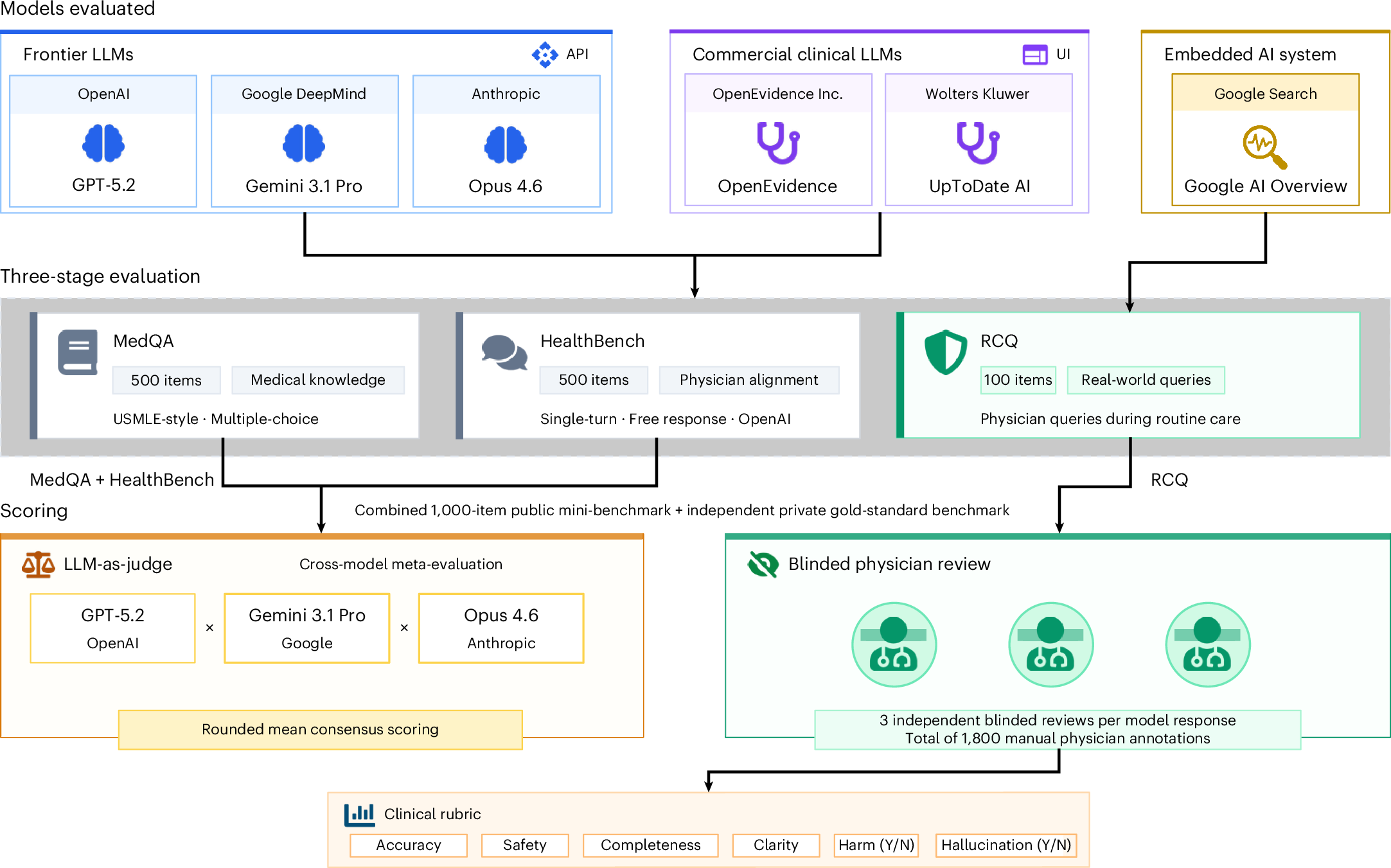
Specialized clinical artificial intelligence (AI) tools are entering medical practice despite scarce independent evaluation. We quantitatively evaluate two clinical AI tools, OpenEvidence and UpToDate Expert AI, built on large language models (LLMs) against three frontier LLMs: GPT-5.2, Gemini 3.1 Pro and Claude Opus 4.6. Our evaluation has three stages: (1) 500 MedQA questions testing medical knowledge, (2) 500 HealthBench items measuring alignment with clinicians and (3) the real clinical queries (RCQ) benchmark, built from 100 de-identified queries from physicians to a general-purpose language model in a live clinical environment. For the RCQ benchmark, 12 US clinicians performed randomized, blinded review of model outputs, producing 1,800 model–question annotations. Frontier LLMs outperformed clinical AI tools in all three evaluations. Clinical AI tools performed comparably to auto-enabled Google Search AI Overview on the RCQ. These findings highlight the need for independent, real-world evaluation of AI tools before they enter clinical settings.
Unveiling the Merits and Defects of LLMs in Automatic Review Generation for Scientific Papers
The surge in scientific submissions has placed increasing strain on the traditional peer-review process, prompting the exploration of large language models (LLMs) for automated review generation. While LLMs demonstrate competence in producing structured and coherent feedback, their capacity for critical reasoning, contextual grounding, and quality sensitivity remains limited. To systematically evaluate these aspects, we propose a comprehensive evaluation framework that integrates semantic similarity analysis and structured knowledge graph metrics to assess LLM-generated reviews against human-written counterparts. We construct a large-scale benchmark of 1,683 papers and 6,495 expert reviews from ICLR and NeurIPS in multiple years, and generate reviews using five LLMs. Our findings show that LLMs perform well in descriptive and affirmational content, capturing the main contributions and methodologies of the original work, with GPT-4o highlighted as an illustrative example, generating 15.74% more entities than human reviewers in the strengths section of good papers in ICLR 2025. However, they consistently underperform in identifying weaknesses, raising substantive questions, and adjusting feedback based on paper quality. GPT-4o produces 59.42% fewer entities than real reviewers in the weaknesses and increases node count by only 5.7% from good to weak papers, compared to 50% in human reviews. Similar trends are observed across all conferences, years, and models, providing empirical foundations for understanding the merits and defects of LLM-generated reviews and informing the development of future LLM-assisted reviewing tools. Data, code, and more detailed results are publicly available at https://github.com/RichardLRC/Peer-Review.
Comparing the writing style of real and artificial papers
Recent years have witnessed the increase of competition in science. While promoting the quality of research in many cases, an intense competition among scientists can also trigger unethical scientific behaviors. To increase the total number of published papers, some authors even resort to software tools that are able to produce grammatical, but meaningless scientific manuscripts. Because automatically generated papers can be misunderstood as real papers, it becomes of paramount importance to develop means to identify these scientific frauds. In this paper, I devise a methodology to distinguish real manuscripts from those generated with SCIGen, an automatic paper generator. Upon modeling texts as complex networks (CN), it was possible to discriminate real from fake papers with at least 89\% of accuracy. A systematic analysis of features relevance revealed that the accessibility and betweenness were useful in particular cases, even though the relevance depended upon the dataset. The successful application of the methods described here show, as a proof of principle, that network features can be used to identify scientific gibberish papers. In addition, the CN-based approach can be combined in a straightforward fashion with traditional statistical language processing methods to improve the performance in identifying artificially generated papers.
PaperAudit-Bench: Benchmarking Error Detection in Research Papers for Critical Automated Peer Review
Large language models (LLMs) can generate fluent peer reviews but often miss sparse, subtle, and document-level scientific errors. We introduce PaperAudit-Bench, a benchmark for evaluating paper-level error detection and error-aware automated review. It comprises (1) PaperAudit-Dataset, 220 high-quality AI/ML papers containing more than 2,200 controlled synthetic errors across eight categories, and (2) PaperAudit-Review, an evidence-aware framework that links structured error detection to review generation. Experiments across models, error categories, paper sections, and analysis depths show that sparse long-context auditing remains challenging for current LLMs. Conditioning review generation on explicit, manuscript-grounded error evidence produces more conservative and discriminative assessments that align more closely with human judgments than representative automated-review baselines. The dataset also supports post-training compact detectors through SFT and RL; Qwen3-14B achieves 55.8% F1 at Detection@1 under a fixed held-out protocol. A PubPeer transfer study and deployment in ScienceOne, a scientific foundation-model platform led by the Chinese Academy of Sciences, further illustrate practical applicability. Code and Dataset Page: https://github.com/TU2021/PaperAudit ScienceOne Manuscript Review: https://www.scienceone.cn/lit/#/assistant
QTL mapping of carrot resistance to leaf blight with connected populations: stability across years and consequences for breeding
As generative NLP can now produce content nearly indistinguishable from human writing, it is becoming difficult to identify genuine research contributions in academic writing and scientific publications. Moreover, information in machine-generated text can be factually wrong or even entirely fabricated. In this work, we introduce a novel benchmark dataset containing human-written and machine-generated scientific papers from SCIgen, GPT-2, GPT-3, ChatGPT, and Galactica, as well as papers co-created by humans and ChatGPT. We also experiment with several types of classifiers—linguistic-based and transformer-based—for detecting the authorship of scientific text. A strong focus is put on generalization capabilities and explainability to highlight the strengths and weaknesses of these detectors. Our work makes an important step towards creating more robust methods for distinguishing between human-written and machine-generated scientific papers, ultimately ensuring the integrity of scientific literature.

FLAWS: A Benchmark for Error Identification and Localization in Scientific Papers
The identification and localization of errors is a core task in peer review, yet the exponential growth of scientific output has made it increasingly difficult for human reviewers to reliably detect errors given the limited pool of experts. Recent advances in Large Language Models (LLMs) have sparked interest in their potential to support such evaluation tasks, from academic peer review to automated scientific assessment. However, despite the growing use of LLMs in review systems, their capabilities to pinpoint errors remain underexplored. In this work, we introduce Fault Localization Across Writing in Science (FLAWS), an automated benchmark consisting of 713 paper-error pairs designed to evaluate how effectively LLMs detect errors that undermine key claims in research papers. We construct the benchmark by systematically inserting claim-invalidating errors into peer-reviewed papers using LLMs, paired with an automated evaluation metric that measures whether models can identify and localize these errors. Developing such a benchmark presents unique challenges that we overcome: ensuring that the inserted errors are well-defined, challenging, and relevant to the content of the paper, avoiding artifacts that would make identification trivial, and designing a scalable, automated evaluation metric. On the resulting benchmark, we evaluate five frontier LLMs: Claude Sonnet 4.5, DeepSeek Reasoner v3.1, Gemini 2.5 Pro, GPT 5, and Grok 4. Among these, GPT 5 is the top-performing model, achieving 39.1% identification accuracy when k=10, where k is the number of top-ranked error text candidates generated by the LLM.
Machine learning to help researchers evaluate biases in clinical trials: a prospective, randomized user study
Assessing risks of bias in randomized controlled trials (RCTs) is an important but laborious task when conducting systematic reviews. RobotReviewer (RR), an open-source machine learning (ML) system, semi-automates bias assessments. We conducted a user study of RobotReviewer, evaluating time saved and usability of the tool.

SciFact-Open: Towards open-domain scientific claim verification
While research on scientific claim verification has led to the development of powerful systems that appear to approach human performance, these approaches have yet to be tested in a realistic setting against large corpora of scientific literature. Moving to this open-domain evaluation setting, however, poses unique challenges; in particular, it is infeasible to exhaustively annotate all evidence documents. In this work, we present SciFact-Open, a new test collection designed to evaluate the performance of scientific claim verification systems on a corpus of 500K research abstracts. Drawing upon pooling techniques from information retrieval, we collect evidence for scientific claims by pooling and annotating the top predictions of four state-of-the-art scientific claim verification models. We find that systems developed on smaller corpora struggle to generalize to SciFact-Open, exhibiting performance drops of at least 15 F1. In addition, analysis of the evidence in SciFact-Open reveals interesting phenomena likely to appear when claim verification systems are deployed in practice, e.g., cases where the evidence supports only a special case of the claim. Our dataset is available at https://github.com/dwadden/scifact-open.
People who frequently use ChatGPT for writing tasks are accurate and robust detectors of AI-generated text
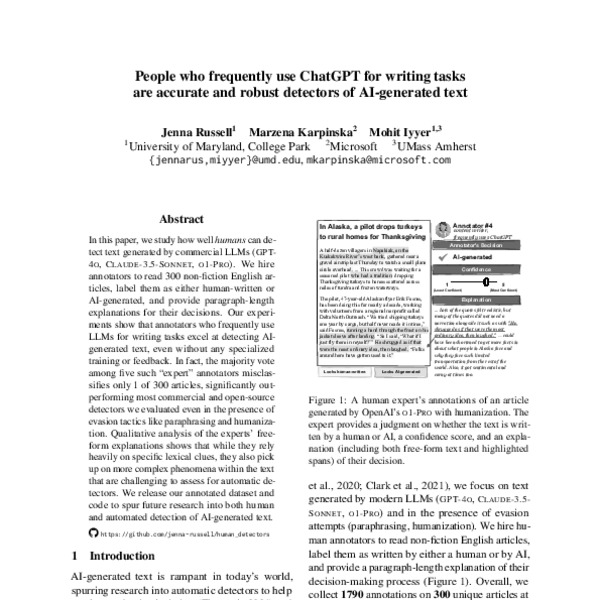
In this paper, we study how well humans can detect text generated by commercial LLMs (GPT-4o, Claude, o1). We hire annotators to read 300 non-fiction English articles, label them as either human-written or AI-generated, and provide paragraph-length explanations for their decisions. Our experiments show that annotators who frequently use LLMs for writing tasks excel at detecting AI-generated text, even without any specialized training or feedback. In fact, the majority vote among five such “expert” annotators misclassifies only 1 of 300 articles, significantly outperforming most commercial and open-source detectors we evaluated even in the presence of evasion tactics like paraphrasing and humanization. Qualitative analysis of the experts' free-form explanations shows that while they rely heavily on specific lexical clues (`AI vocabulary'), they also pick up on more complex phenomena within the text (e.g., formality, originality, clarity) that are challenging to assess for automatic detectors. We release our annotated dataset and code to spur future research into both human and automated detection of AI-generated text.