Explore stories of successful people who have harnessed their ADHD superpowers to achieve greatness.
ADHD and the Alexander Technique
Some people with ADHD have reported benefits in applying some of the ideas from my materials. What could be going on here? My interest in Alexander Technique’s potential relevance to ADHD arose because quite a few people with ADHD who have engaged with my materials have reported improvement in

How the hypercuriosity of ADHD may have helped humans thrive | Aeon Essays
ADHD isn’t merely a dysfunction. It’s best understood as an impulsive motivational drive for novel information

How the hypercuriosity of ADHD may have helped humans thrive | Aeon Essays
ADHD isn’t merely a dysfunction. It’s best understood as an impulsive motivational drive for novel information

Geniuses with Autism & Asperger's | Hidden Talents ABA
Discover 15 inspiring figures with Autism or Asperger's, showcasing their contributions and resilience throughout history.

ADHD and giftedness: a neurocognitive consideration of twice exceptionality
Current models of cognition and behavioral diagnosis emphasize categorical classification over continuous considerations of function and promote the "differential diagnosis" of various conditions according to observational criteria. However, an overemphasis on a purely behavioral, categorical approach to understanding human function fails to address the comorbidity of different disorders and does not include a consideration of overlapping levels of function, from "pathological" through "normal," to "gifted" or exceptional. The frequent co-occurrence of "gifted" and "pathological" function is thus difficult to understand from a corticocentric and purely behavioral and observational point of view. This article reviews "giftedness" in relation to the diagnosis of attention-deficit hyperactivity disorder, coexistence of which is termed "twice exceptional." It additionally considers problems in assessing these functions using current neuropsychological tests and methodologies that are presumably based upon a corticocentric model of cognition.
ADHD and Entrepreneurship: Unlocking the Potential of Those Who Break the Mold
Having symptoms related to the hyperactive-impulsive presentation of ADHD can spur innovativeness, proactiveness and risk-taking.

Stories of Hope: The richest man in the world has autism - The Behavior Exchange
Our new monthly blog series, Stories of Hope, can help! This month you’ll read about the journey of a famous person who, despite ASD, is arguably one of the most influential people in the world. Hint: You might own one of his cars!

Entrepreneurship and ADHD: Fast Brain, Fast Company?
Entrepreneurship and ADHD are connected in research — and the anecdotal success of businesses ranging from JetBlue to Kinko’s and beyond. Here, entreprene…

Nobody Has a Personality Anymore
My generation is obsessed with treating every trait as a symptom of a disorder: You’re not shy, you’re autistic; you’re not forgetful, you’ve got ADHD, writes Freya India.
From gifted to high potential and twice exceptional: A state-of-the-art meta-review
Despite the abundant literature on intelligence and high potential individuals, there is still a lack of international consensus on the terminology and clinical characteristics associated to this population. It has been argued that unstandardized use of diagnosis tools and research methods make comparisons and interpretations of scientific and epidemiological evidence difficult in this field. If multiple cognitive and psychological models have attempted to explain the mechanisms underlying high potentiality, there is a need to confront new scientific evidence with the old, to uproot a global understanding of what constitutes the neurocognitive profile of high-potential in gifted individuals. Another particularly relevant aspect of applied research on high potentiality concerns the challenges faced by individuals referred to as "twice exceptional" in the field of education and in their socio-affective life. Some individuals have demonstrated high forms of intelligence together with learning, affective or neurodevelopmental disorders posing the question as to whether compensating or exacerbating psycho-cognitive mechanisms might underlie their observed behavior. Elucidating same will prove relevant to questions concerning the possible need for differential diagnosis tools, specialized educational and clinical support. A meta-review of the latest findings from neuroscience to developmental psychology, might help in the conception and reviewing of intervention strategies.
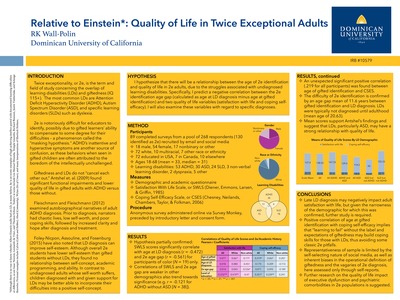
Relative to Einstein: Quality of Life in Twice Exceptional Adults
Twice exceptionality, or 2e, is the recently-coined term for the intersection of learning disabilities (LDs) and giftedness in an individual. Typically, these learning disabilities encompass ADHD, ASD, and/or specific learning disorders such as dyslexia. Because giftedness may obscure or compensate for a student’s academic struggles, and because institutional fixation on disability may overshadow intelligence, twice exceptionality is often missed by teachers and other authority figures in a child’s life. Given the ongoing difficulties of screening for twice exceptionality, it is likely that many 2e students have gone unidentified throughout most of their academic careers, without receiving the accommodations that would most benefit their studies. Furthermore, 2e adults whose schooling predated widespread awareness of twice exceptionality are more likely to have been diagnosed later in life. The twin prongs of identification and intervention for 2e youth make up the bulk of studies in the field. Today’s 2e youth are better-identified, better-studied, and better-supported than any previous generation, but 2e adults remain an understudied population. In addition to the difficulties and contradictions inherent in twice exceptionality, late identification and lack of support are likely to have negatively impacted twice exceptional adults, both in and out of the classroom. The present study will examine the ability of 2e adults to effectively cope with stressors in their lives, as well as their current level of life satisfaction. Approximately fifty or more 2e adults will be recruited through email and social media, and via the disability department of a small liberal arts university. Participants will be asked about their diagnostic histories and their experiences with higher education, and will then complete the Satisfaction With Life Scale (Diener, E., Emmons, R. A., Larsen, R. J., & Griffin, S., 1985) and Coping Self-Efficacy Scale (Chesney, M.A., Neilands, T.B., Chambers, D.B., Taylor, J.M., & Folkman, S., 2006). Data will be collected and analyzed in March and April 2017. We hypothesize that there will be a relationship between the age of identification as twice exceptional and adult quality of life, operationalized by Satisfaction with Life and Coping Self-Efficacy. Additionally, we will explore the relationships between specific diagnoses and these variables, as well as factors of race and gender. This study will provide information on an underserved and understudied group, and we hope it will provide a deeper understanding of the needs and strengths of this population.
The Missed Neurodiversity: advocate for recognition and resources for gifted individuals - BC Association of Clinical Counsellors
Note: This article includes additional questions and answers and supplementary resources from the Member Profile interview with Debbie Clelland, RCC, published in the Fall 2021 issue of BCACC’s Insights magazine. “When […]
Hyperactive–impulsive ADHD traits predict higher curiosity in adults: evidence from a cross-sectional study
Attention-deficit/hyperactivity disorder (ADHD) is typically framed in terms of difficulties with sustained attention, behavioral regulation, and impulse control, yet growing work suggests that some associated traits may also relate to potentially adaptive tendencies. Curiosity has been highlighted in qualitative research as one such trait that can function as both a strength and a challenge for adults with ADHD, but quantitative evidence examining its relationship to ADHD traits remains limited. This study examined whether ADHD traits are associated with individual differences in trait curiosity in adults.
Lived experience of twice-exceptional adults
How educational programs can support the development of gifts and/or exceptional talents and the challenges faced by Autistic twice-exceptional students.

Twice exceptional (2e) | Education | Research Starters | EBSCO Research
<p>Twice exceptional (2e) refers to individuals, particularly students, who exhibit both exceptional abilities and disabilities. These learners may show outstanding talent in areas such as academics, creativity, or leadership while simultaneously facing challenges in areas such as reading, attention, or social interaction. Identifying twice exceptional individuals can be complex, as their strengths may obscure their weaknesses, or the focus may be disproportionately on one aspect of their abilities. This duality often leads to under-recognition, with many 2e students navigating educational systems without appropriate support.</p> <p>The concept of twice exceptionality gained prominence in the late 20th century as educators began to understand that high intelligence does not always equate to high performance across all areas. These individuals may struggle with neurobiological conditions like dyslexia, ADHD, or autism spectrum disorder, which can complicate their learning experiences. Traits such as perfectionism, sensory sensitivities, and uneven development further illustrate the unique challenges faced by twice exceptional learners. It is essential for educators and caregivers to recognize and nurture both the strengths and needs of these individuals to foster an inclusive and supportive learning environment.</p>