The effects of welfare cuts in Denmark.
The Curb-Cut Effect (SSIR)
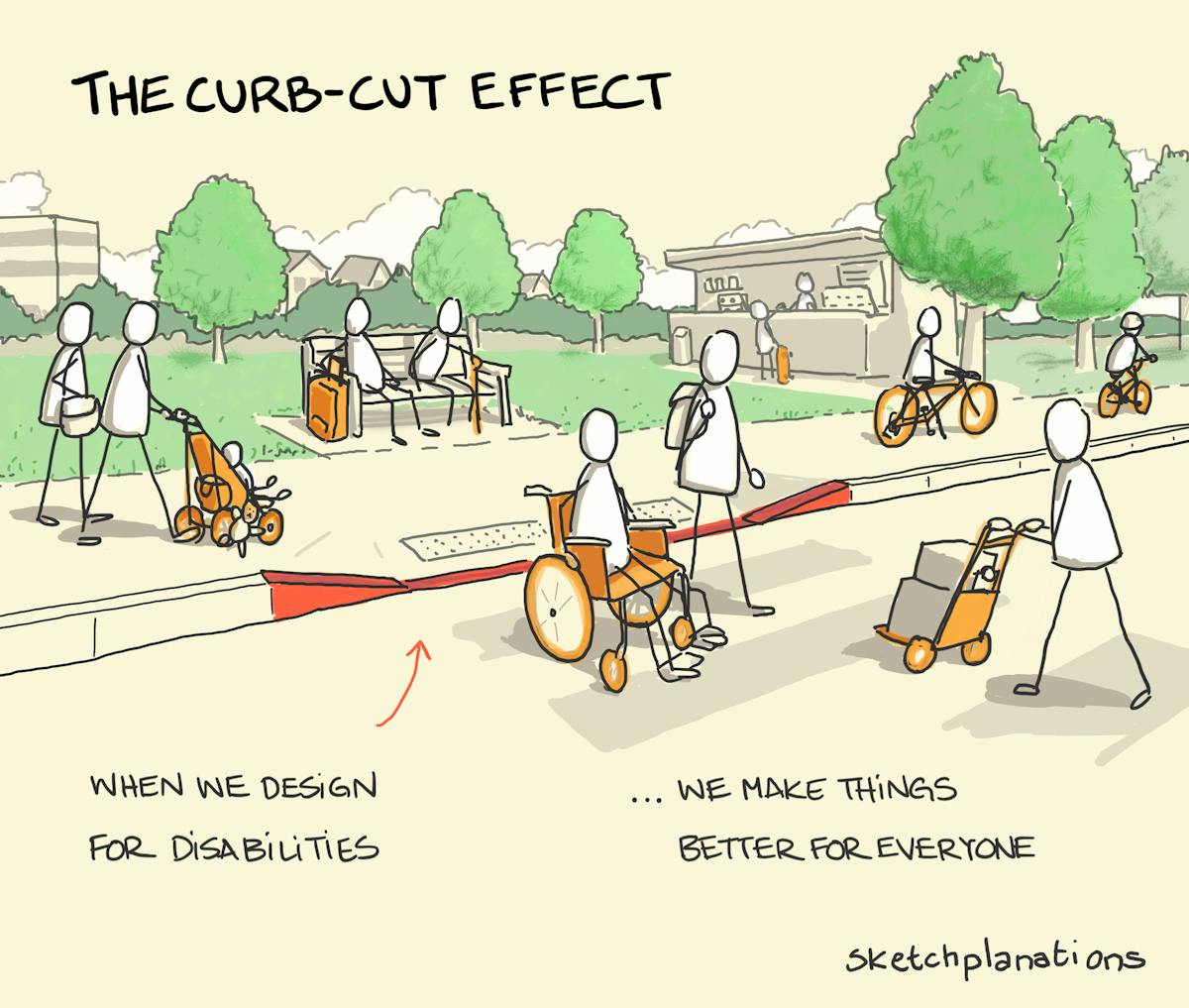
Laws and programs designed to benefit vulnerable groups, such as the disabled or people of color, often end up benefiting all of society. <meta property=

Wage Compression Drives Nordic Income Equality
Income inequality in the Nordic countries — Denmark, Finland, Norway, and Sweden — is substantially lower than in the United States or the United Kingdom despite similar levels of per capita income. The Gini coefficient for disposable income in Nordic countries averages 0.27, compared to 0.39 in the US and 0.36 in the UK. In Income Equality in the Nordic Countries: Myths, Facts, and Lessons (NBER Working Paper 33444), Magne Mogstad, Kjell G. Salvanes, and Gaute Torsvik analyze the underlying source of these disparities. They employ detailed microeconomic data and statistical decomposition techniques and consider distributional statistics on income, wages, working hours, education, and skills across these countries.

The Paradox of Redistribution and Strategies of Equality: Welfare State Institutions, Inequality, and Poverty in the Western Countries
Debates on how to reduce poverty and inequality have focused on two controversial questions: Should social policies be targeted to low-income groups or be universal? Should benefits be equal for all or earnings-related? Traditional arguments in favor of targeting and flat-rate benefits, focusing on the distribution of the money actually transferred, neglect three policy-relevant considerations: (1) The size of redistributive budgets is not fixed but reflects the structure of welfare state institutions. (2) A trade-off exists between the degree of low-income targeting and the size of redistributive budgets. (3) Outcomes of market-based distribution are often more unequal than those of earnings-related social insurance programs. We argue that social insurance institutions are of central importance for redistributive outcomes. Using new data, our comparative analyses of the effects of different institutional types of welfare states on poverty and inequality indicate that institutional differences lead to unexpected outcomes and generate the paradox of redistribution: The more we target benefits at the poor and the more concerned we are with creating equality via equal public transfers to all, the less likely we are to reduce poverty and inequality.
Children’s Rights and Online Age Assurance Systems
Abstract Age assurance is a way to prevent children accessing content, products or services that are potentially harmful to them, ranging from gambling services or alcohol or tobacco or, increasingly, certain products and services online. Now that children’s lives are mediated by digital technologies, policymakers are deliberating over the legal, technical and practical challenges. These have been little examined from the perspective of children’s rights. By combining legal and social research methods, this article examines the legal requirements for age assurance in Europe, assesses compliance by companies and reveals the consequences for family life. In law and practice, we show that age assurance is often ineffective in protecting children from online risk of harm. Further, as currently implemented it risks children’s other rights – to non-discrimination, privacy, to be heard, and their civil rights and freedoms, and remedy. We identify promising directions for the use of age assurance in child online protection, focusing on European policy, regulators and civil society actors.

Higher Wages for Early Care and Education Workers Builds a Stronger System
Higher wages for early care and education workers in California is critical to expanding affordable child care.

ICE Has Placed a Record 600 Immigrant Kids in Federal Shelters This Year — ProPublica
Under a zero tolerance policy, the first Trump administration separated immigrant children from their families at the U.S.-Mexico border. New data suggests separations are happening all over the country, often after little more than a traffic stop.

AI tool will lead to more child refugees being treated as adults, charity warns
‘Racist bias’ overestimating ages in Home Office’s facial-recognition software will lead to solo children being housed with adults, says Human Rights Network

Additional evidence on the effects of banning the purchase of sex on cases of rape in Sweden
I discuss (Ciacci J Popul Econ 37:37 2024) and provide additional results of a regression discontinuity in time model showing that the result that the ban affected cases of rape is not robust.

A 2024 Review of Child Care and Early Learning in the United States
Updated data on child care and early learning in the United States illustrate the urgent need for holistic public policymaking and robust investments that support young children, families, and early educators.

Cash Works. Place and Amount Matter.
Two excellent new reports from our friends at the Economic Security Project make a strong case for direct cash — and reveal why rural, county-level research matters. Right on Time argues that cash is particularly effective during major transitions: * having a child * losing a job * leaving foster care or incarceration

Comment on “Banning the purchase of sex increases cases of rape: evidence from Sweden”
Journal of Population Economics -
The End of Children
Birth rates are crashing around the world. Should we be worried?

Michaël Zemmour : « La protection sociale n'est pas responsable du déficit »
Le récit selon lequel le système social fait déraper les comptes publics est faux, rappelle l’économiste. Cet argument, répété par Bruno Le Maire avant l’exame…

After aid: Thoughts on a localised humanitarian system (part 1)
You have probably read 100+ articles on this topic — USAID shutdown, funding cuts from several EU governments and the UK. An…

Kill Chain
On the automated bureaucratic machinery that killed 175 children

The curb-cut effect
The curb-cut effect illustrates how when we design to benefit disadvantaged or vulnerable groups we end up helping society as a whole. Angela Glover Blackwell explains how campaigning by students with disabilities in Berkeley in the early 1970s led to adding curb cuts to the Berkeley sidewalks to make access easier for those in wheelchairs. Yet it wasn't just people in wheelchairs that it helped. Curb cuts also made life easier for people pushing children in strollers, people using trolleys for deliveries, people pulling a suitcase, those wheeling bikes or on skateboards, and it also helps save lives by guiding people to cross at safe locations. Another example is adding closed captioning to TV that helps anyone watch in a noisy bar, a waiting room, or watching an airline safety video. Or a classic example of universal design in the OXO Good Grips range originally made to be comfortable for holding a peeler even if you have arthritis. It's also a useful analogy for "how laws and programs designed to benefit vulnerable groups, such as the disabled or people of color, often end up benefiting all," (PolicyLink) whether that be increasing broadband access, improving public transport or taking cuts out of curbs. Here's a short, fun video of Gary Karp explaining the curb-cut effect. Thanks to my patron Quintin Balsdon for sharing it with me.