During a federal election there is a large amount of information being distributed, much of it online, which is seeking to influence your vote. Some of this may be disinformation, or false information.
What is electoral misinformation?
Advice on engaging with campaign material, and guidance on who to contact if you're unsure.
Election Disinformation in Different Languages is a Big Problem in the U.S.
And it’s driving a wedge between voters in non-English communities Mis- and disinformation about elections predate the endless scroll of modern social media services. [1] Yet easy access to online information channels and amplification tools enable false narratives to spread at a massive scale. When false narratives are combined with data voids and unique cultural […]
How Technology Is Shaping Modern Politics
Discover how technology is reshaping politics, from digital campaigns to AI, and the challenges of misinformation and election security.
Deep Storytelling: Collective Sensemaking and Layers of Meaning in U.S. Elections
Misinformation and disinformation about elections remain pressing concerns for researchers, policymakers, and the public. Critics, however, argue that fears surrounding these issues are exaggerated due to a lack of evidence of impact. This debate highlights the challenges inherent in assessing the impacts of misinformation, as the drivers of false and misleading content often exist in the context of a specific claim. To address this issue, we examined false and misleading information surrounding the 2020 and 2022 U.S. national elections, focusing on the contextual features of online conversations that fueled various rumors. We developed two qualitative codebooks, creating the second after realizing that the first, which labeled individual tweets, failed to capture broader rumoring dynamics. By integrating multi-layered qualitative coding with thematic analysis and quantitative visualizations, we show how influencers, political elites, and audiences collaboratively told deep stories from 2020 through 2022. As these stories were told, audiences interpreted events in 2022 through the lens of the 2020 story, guided by influencers' cues, leading to an evolution in storytelling style between the two election cycles. This ongoing performance was tailored to align with the incentive structures, affordances, and attention economy of social media. We combine deep stories with theories of collective sensemaking and rumoring, creating a framework to better assess the contextual features surrounding false and misleading information.

In Texas, AI-generated political ads are blurring the line between real and fake - Poynter
Experts say increasingly realistic campaign ads could make it harder for voters to distinguish authentic messages from fabricated ones
The small effects of political advertising are small regardless of context, message, sender, or receiver: Evidence from 59 real-time randomized experiments
Campaign persuasion operates with notable consistency across political parties, message tone, and information environment., Evidence across social science indicates that average effects of persuasive messages are small. One commonly offered explanation for these small effects is heterogeneity: Persuasion may only work well in specific circumstances. To evaluate heterogeneity, we repeated an experiment weekly in real time using 2016 U.S. presidential election campaign advertisements. We tested 49 political advertisements in 59 unique experiments on 34,000 people. We investigate heterogeneous effects by sender (candidates or groups), receiver (subject partisanship), content (attack or promotional), and context (battleground versus non-battleground, primary versus general election, and early versus late). We find small average effects on candidate favorability and vote. These small effects, however, do not mask substantial heterogeneity even where theory from political science suggests that we should find it. During the primary and general election, in battleground states, for Democrats, Republicans, and Independents, effects are similarly small. Heterogeneity with large offsetting effects is not the source of small average effects.

The Minimal Persuasive Effects of Campaign Contact in General Elections: Evidence from 49 Field Experiments
Significant theories of democratic accountability hinge on how political campaigns affect Americans’ candidate choices. We argue that the best estimate of the effects of campaign contact and advertising on Americans’ candidates choices in general elections is zero. First, a systematic meta-analysis of 40 field experiments estimates an average effect of zero in general elections. Second, we present nine original field experiments that increase the statistical evidence in the literature about the persuasive effects of personal contact tenfold. These experiments’ average effect is also zero. In both existing and our original experiments, persuasive effects only appear to emerge in two rare circumstances. First, when candidates take unusually unpopular positions and campaigns invest unusually heavily in identifying persuadable voters. Second, when campaigns contact voters long before election day and measure effects immediately—although this early persuasion decays. These findings contribute to ongoing debates about how political elites influence citizens’ judgments.

Recent Utah, Texas incidents fuel rumors and political narratives undermining trust in election integrity
A CIP Election Rumor Rundown
The Liar’s Dividend: Can Politicians Claim Misinformation to Evade Accountability?
This study addresses the phenomenon of misinformation about misinformation, or politicians "crying wolf"' over fake news. Strategic and false claims that stories are fake news or deepfakes may benefit politicians by helping them maintain support after a scandal. We posit that this benefit, known as the "liar's dividend," may be achieved through two politician strategies: by invoking informational uncertainty or by encouraging oppositional rallying of core supporters. We administer five survey experiments to over 15,000 American adults detailing hypothetical politician responses to stories describing real politician scandals. We find that claims of misinformation representing both strategies raise politician support across partisan subgroups. These strategies are effective against text-based reports of scandals, but are largely ineffective against video evidence and do not reduce general trust in media. Finally, these false claims produce greater dividends for politicians than alternative responses to scandal, such as remaining silent or apologizing.
Exposing Cross-Platform Coordinated Inauthentic Activity in the Run-Up to the 2024 U.S. Election
Coordinated information operations remain a persistent challenge on social media, despite platform efforts to curb them. While previous research has primarily f

Verifying information about elections
We can help you check the facts behind election information you receive.
Election Rumor Rundown for October 13: Emerging rumors around voting machines and ‘ballot dumping’
DHS reports misconstrue vulnerabilities as having been exploited, “Ballot Dumping” in Valley Center misleadingly suggest mass voter fraud, and prediction markets already advertising election bettin…

Dialogues on Democracy: Belief-Tailored AI Conversations Reduce Inaccurate Election Denial Beliefs
Elections, while central to democratic functioning, have become increasingly threatened by beliefs about election fraud. Artificial intelligence (AI) provides a novel opportunity to address such false beliefs through dynamic conversation and debunking. Through two experiments (N = 1,802 Republicans from Lucid who endorsed election fraud claims), we examined the use of AI to fact-check 2020 election conspiracies prior to the 2024 US Presidential election. We tested the effects of two treatments (an information-tailored and values-tailored AI dialogue) in which AI fact-checked their claims and tailored arguments to the specific election conspiracy that the participant themselves articulated. Both treatment conditions, when compared to a control dialogue and a simple statement that the conspiracy was incorrect, reduced confidence in their election conspiracy claims. There was no significant difference between information-tailored and values-tailored feedback. Promisingly, participants with the strongest baseline denialism experienced the largest decreases in denialism beliefs. These studies highlight the potential of AI-driven interventions to address election misinformation.

Home - LogiVote
Complete Solutions for a Campaign Management System and for Digital or Online Voting

Why Are American Presidential Election Campaign Polls so Variable When Votes Are so Predictable?
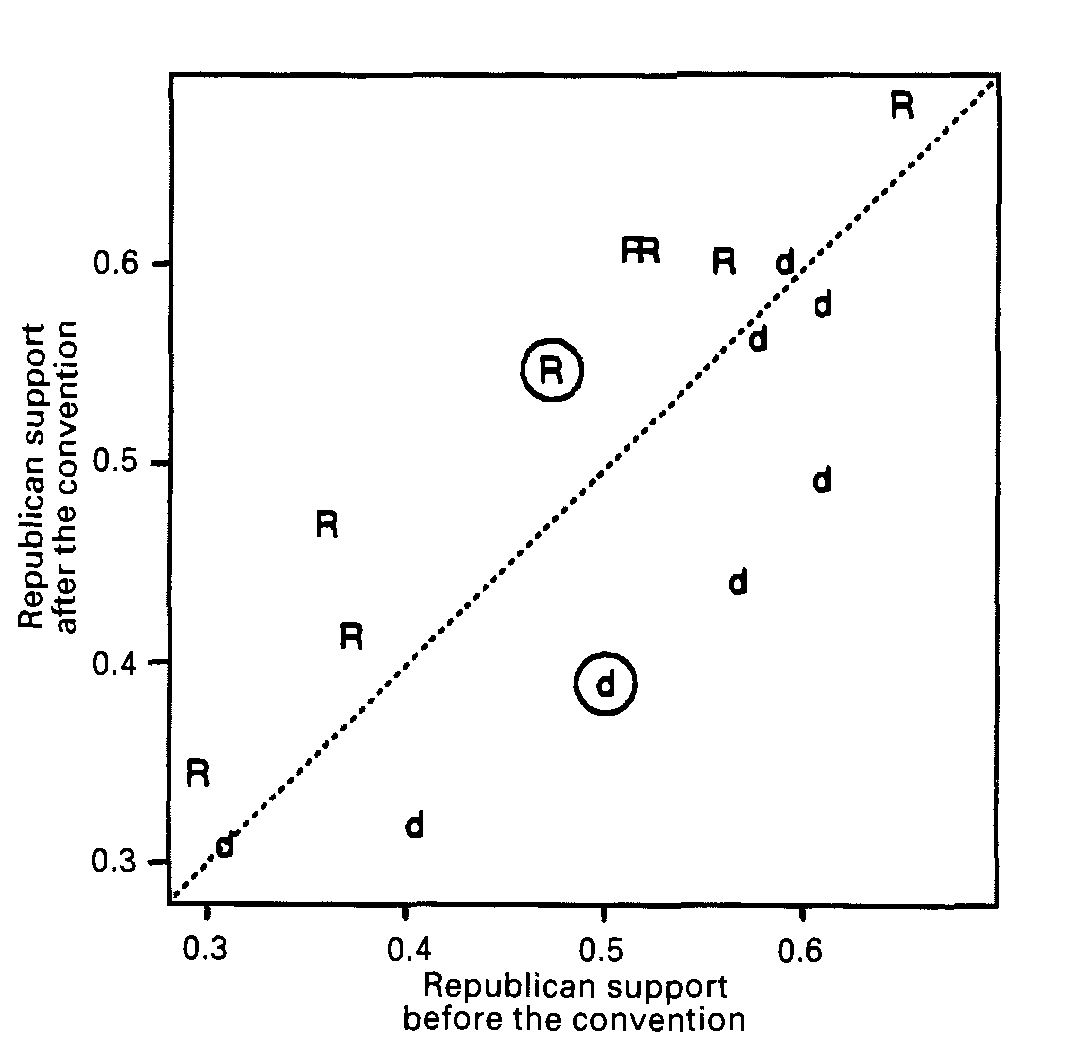
As most political scientists know, the outcome of the U.S. Presidential election can be predicted within a few percentage points (in the popular vote), based on information available months before the election. Thus, the general election campaign for president seems irrelevant to the outcome (except in very close elections), despite all the media coverage of campaign strategy. However, it is also well known that the pre-election opinion polls can vary wildly over the campaign, and this variation is generally attributed to events in the campaign. How can campaign events affect people's opinions on whom they plan to vote for, and yet not affect the outcome of the election? For that matter, why do voters consistently increase their support for a candidate during his nominating convention, even though the conventions are almost entirely predictable events whose effects can be rationally forecast? In this exploratory study, we consider several intuitively appealing, but ultimately wrong, resolutions to this puzzle, and discuss our current understanding of what causes opinion polls to fluctuate and yet reach a predictable outcome. Our evidence is based on graphical presentation and analysis of over 67,000 individual-level responses from forty-nine commercial polls during the 1988 campaign and many other aggregate poll results from the 1952–1992 campaigns. We show that responses to pollsters during the campaign are not generally informed or even, in a sense we describe, "rational." In contrast, voters decide which candidate to eventually support based on their enlightened preferences, as formed by the information they have learned during the campaign, as well as basic political cues such as ideology and party identification. We cannot prove this conclusion, but we do show that it is consistent with the aggregate forecasts and individual-level opinion poll responses. Based on the enlightened preferences hypothesis, we conclude that the news media have an important effect on the outcome of Presidential elections–-not due to misleading advertisements, sound bites, or spin doctors, but rather by conveying candidates' positions on important issues. Winner of the Pi Sigma Alpha Awardfor the best paper at the previous year's meetings of the Midwest Political Science Association. Replication data at the Harvard Dataverse: [https://doi.org/10.7910/DVN/I7GIKD](https://doi.org/10.7910/DVN/I7GIKD).
Facts and Myths about Misperceptions
Misperceptions threaten to warp mass opinion and public policy on controversial issues in politics, science, and health. What explains the prevalence and persistence of these false and unsupported beliefs, which seem to be genuinely held by many people? Though limits on cognitive resources and attention play an important role, many of the most destructive misperceptions arise in domains where individuals have weak incentives to hold accurate beliefs and strong directional motivations to endorse beliefs that are consistent with a group identity such as partisanship. These tendencies are often exploited by elites who frequently create and amplify misperceptions to influence elections and public policy. Though evidence is lacking for claims of a “post-truth” era, changes in the speed with which false information travels and the extent to which it can find receptive audiences require new approaches to counter misinformation. Reducing the propagation and influence of false claims will require further efforts to inoculate people in advance of exposure (for example, media literacy), debunk false claims that are already salient or widespread (for example, fact-checking), reduce the prevalence of low-quality information (for example, changing social media algorithms), and discourage elites from promoting false information (for example, strengthening reputational sanctions).