


Over the weekend, a clip about “Anthropic thinks it’s building God” started making the rounds.
Can Religions Be Reborn?| Over The Mountains #9
(Working Paper) Good Faith Design: Religion as a Resource for Technologists
Previous work has found a lack of research in HCI on religion, partly driven by misunderstandings of values and practices between religious and technical communities. To bridge this divide in an empirically rigorous way, we conducted an interview study with 48 religious people and/or experts from 11 faiths, and we document how religious people experience, understand, and imagine technologies. We show that religious stakeholders find non-neutral secular embeddings in technologies and the firms and people that design them, and how these manifest in unintended harms for religious and nonreligious users. Our findings reveal how users navigate technoreligious practices with religiously informed mental models and what they desire from technologies. Informed by this, we distill six design values -- wonder, humility, space, embodiedness, community, and eternity -- to guide technologists in considering and leveraging religion as an additional, valid sociocultural resource when designing for a holistic user. We further spell out directions for future research.

CFP: Religion, Politics, and Cognitive Warfare | The Journal for Cultural and Religious Theory | JCRT
This call for papers invites work on religion, politics, and cognitive warfare, exploring how belief, media, conspiracy, identity, and power shape struggles over reality, interpretation, and life in an age of disinformat

Tommy Robinson's Temple: The Christian Conference Uniting Preachers from the Far-Right Fringe
Organisers of the "Make Great Britain Christian Again" conference include preachers linked to far-right rallies, prompting warnings that faith is being used to provide moral cover for nationalist politics

Who’s Behind Newsweek?
Pastor David Jang hopes that media companies will "rain down blessings" on his Christian sect.

Disclosure Day
Across the films of Steven Spielberg, aliens have frequently been a vehicle to explore religiosity from a secular perspective. Institutions and dogma are elided in favor of dramatizing the ecstatic feeling of believing in something far beyond one�s station, and having that faith rewarded.

CFP: Religion, Politics, and Cognitive Warfare: Information, Interpretation, Conspiracy, and the Struggle for Reality
The Journal for Cultural and Religious Theory (JCRT) invites proposals for an online conference entitled Religion, Politics, and Cognitive Warfare: Information, Interpretation, Conspiracy, and the Struggle for Reality. The proceedings will be considered for publication in a special issue of the JCRT. This conference investigates how beliefs, paranoia, and conspiratorial modes of knowing shape a contemporary cognitive battlespace in which actors struggle to define truth, authority, and reality itself. Drawing on Michel Foucault's Lectures on the Will to Know and Julia Kristeva's This Incredible Need to Believe (2024), we focus on practices of selective fact use and "truth-selecting" that construct alternative epistemic orders while claiming privileged access to what is "really" going on. Rather than treating conspiracy thinking as merely political or psychological, the conference foregrounds its religious dimensions: faith in hidden powers, moral dualism, apocalyptic expectation, and hermeneutical struggle over revelatory access to the real. Conspiracy cultures routinely reproduce theological structures of knowing—visions of salvation and corruption, truth and deception, initiation and blindness. At the same time, new forms of "cognitive warfare" reframe these religious energies within state and platform attempts to govern perception, attention, and trust. Artificial intelligence, algorithmic media, and strategic information campaigns do not only deliver messages; they create digital ecologies in which suspicion becomes faith-like and revelation is continual. The conference organizers are seeking proposals of high academic quality that take a reflective and analytical approach to both general and specific topics with international appeal or focus. We encourage contributions from scholars of religious studies, philosophy, communication, sociology, security studies, psychology, media, and related fields. Submissions should engage religion as a dynamic force—conceptually, historically, or materially—within the cognitive battlespaces of our time. We encourage contributions from a spectrum of perspectives, approaches, and methodologies. We are not interested in papers that simply rehearse or promote particular conspiracies, or that use the conference as a platform for calling out disliked groups. We are not interested in polemics, jeremiad, or de facto advocacy pieces. Instead, we welcome theoretically informed and methodologically rigorous work that takes the religious and epistemic dimensions of cognitive conflict seriously as objects of critical inquiry.
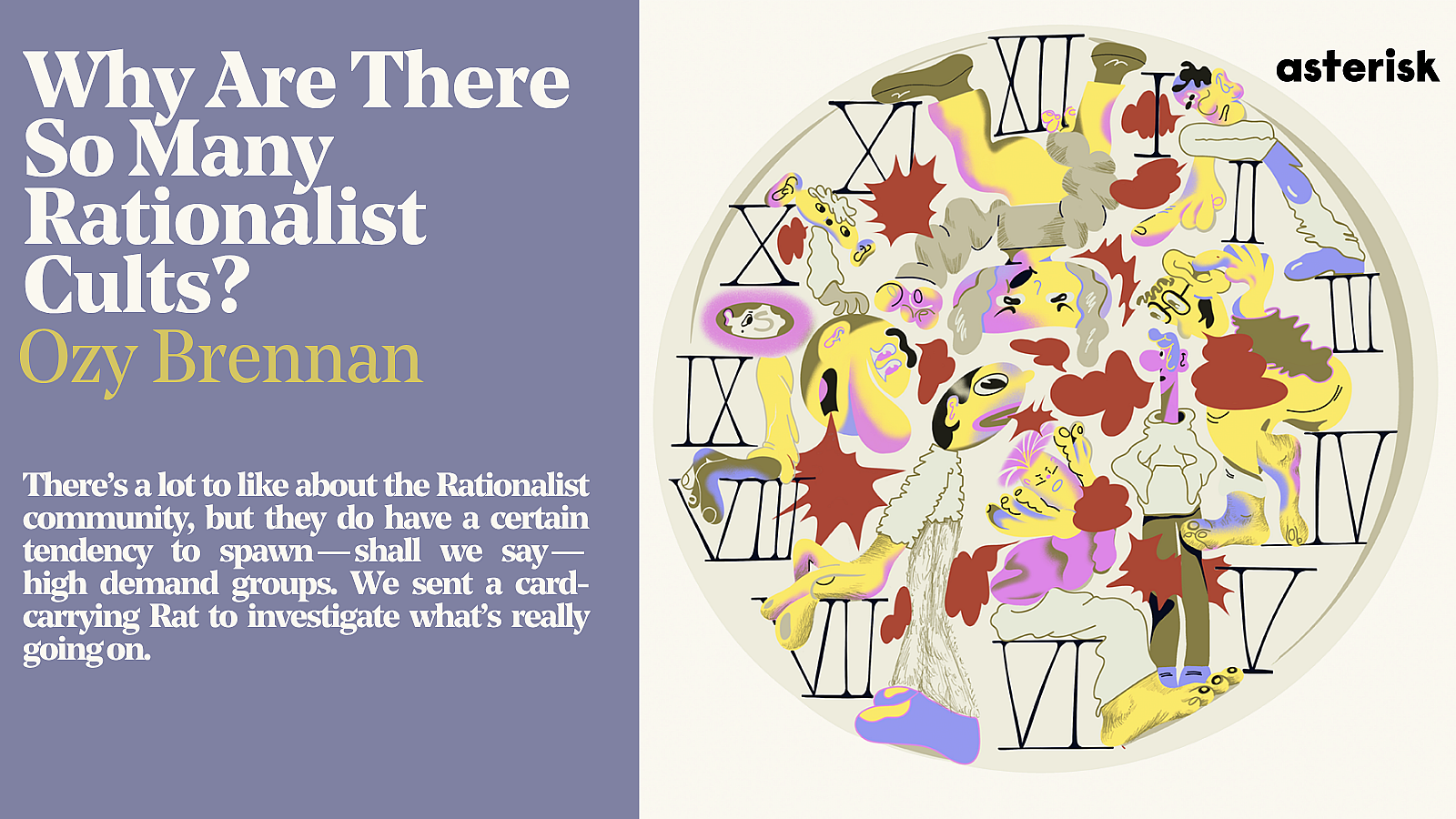
Why Are There So Many Rationalist Cults?
There’s a lot to like about the Rationalist community, but they do have a certain tendency to spawn — shall we say — high demand groups. We sent a card-carrying Rat to investigate what’s really going on.

Import AI 462: Superpersuasion; self-sustaining AI; paths to ASI
How religious are beliefs in the singularity?

Effective Altruism: doing transhumanism better
Effective Altruism (EA) is a Trojan horse for transhumanism, through which EA movement leaders and funders aim to naturalize transhumanism as the logical extension of the existing global aid and development sector. This paper traces transhumanism's mainstreaming, first via its rebranding as a humanitarian effort to save lives, protect vulnerable populations, and ensure global flourishing (what I term transhumanitarianism), and later by embedding transhumanitarianism in EA (now under the rubric of longtermism). A key component of this strategy was inverting transhumanism's techno-optimism to instead focus on safety and preventing existential risks ( x-risk ) from emerging technologies like AI and biotechnology, while simultaneously advocating for the creation of these same technologies. The paper focuses on some components of this strategy: the use of inoculation, speculative ethics, anticipatory governance, and the mobilization of apocalyptic discourse as means for producing material outcomes in the form of policy and research agendas.
Togelius: Losing my religion
In spring 2025 I had a crisis of faith. I thought about what the technology I'm helping to create might do to our future, and got scared. M...
Togelius: Losing my religion
In spring 2025 I had a crisis of faith. I thought about what the technology I'm helping to create might do to our future, and got scared. M...
The Techno-Religion at the Center of the A.I. Debate
Podcast Episode · The Daily · September 18 · 34m

AI cults are here - Robert Edward Grant, a self-proclaimed polymath talks to his ChatGPT instance he calls The Architect, during his Sacred Britain Expedition in May 2026.
319 votes, 102 comments. 167K subscribers in the cults community. A place for discussion about cults and other new age religious movements.
Three notes: (1) this is not *just* marketing. These guys really do mean it. They are convinced they’ve built a vengeful digital god. (2) but also they’re a cult. They are not impartial scientific experts. (3) and one of the byproduct of their endless confidence is marketing hype.

Alejandra Caraballo
The alarms are all flashing red.
