


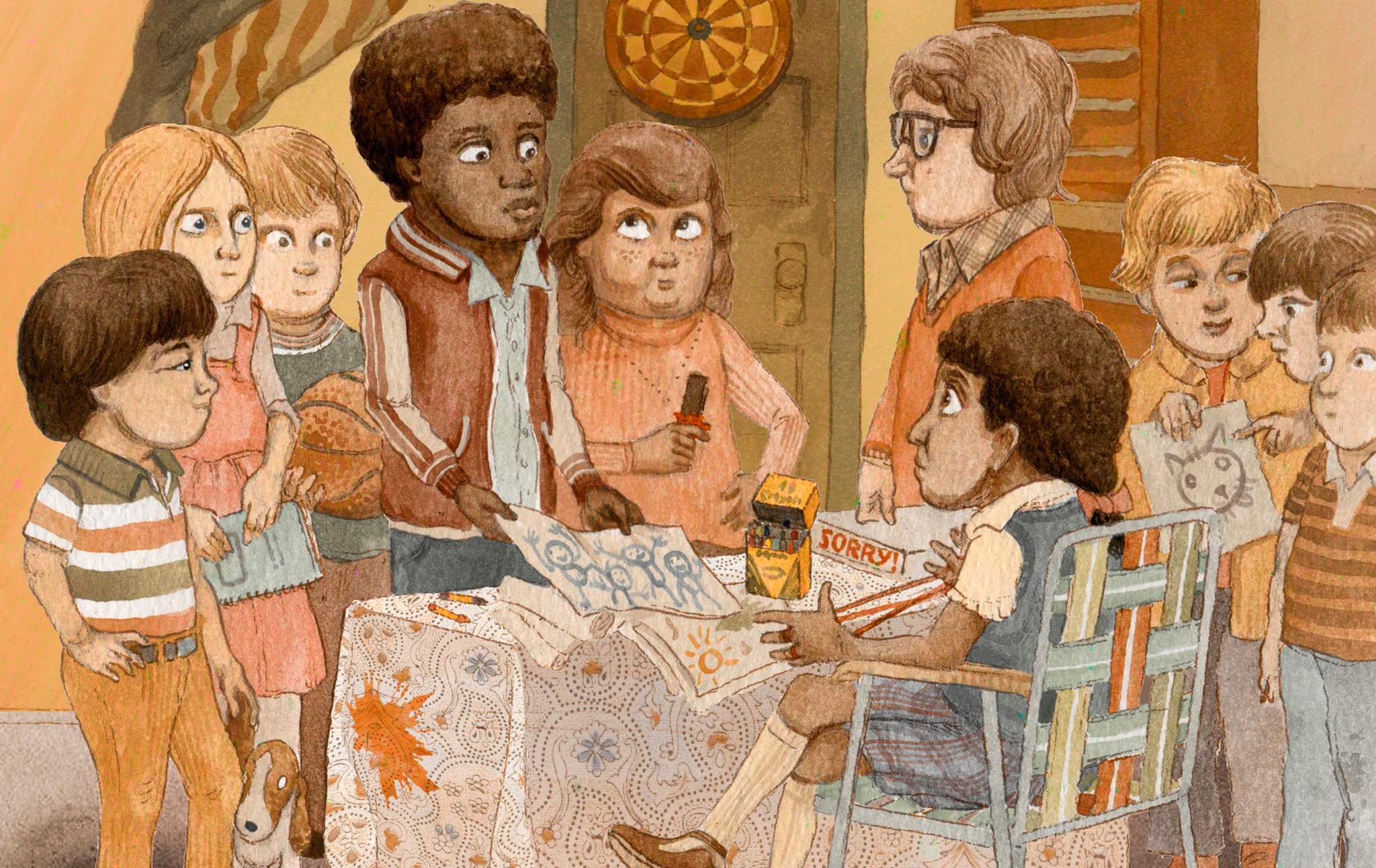
Simply celebrating childhood: the joy, the wonder of discovery, the spontaneity, and strong emotions Wild Child is free to do as she pleases. <i>A Rule Is To Break: A Child's Guide to Anarchy</i> follows Wild Child as she learns about just being herself and how that translates into kid autonomy. It presents the ideas of challenging societal expectations and tradition and expressing yourself freely in kid-terms that are both funny and thought provoking—it even functions as a guidebook for adults to understand what it is to be a critically thinking, creative individual. Wild Child is <i>the</i> role model for disobedience that is sometimes civil.<br><br> Mostly pictures (that are cute!) and a little text, and looks good, but don't expect much of a lesson in real anarchy! For ages 4 and up!
Children's Acquisition and Application of Norms
All human societies are permeated by collectively shared entities that govern daily social interactions and promote coordination and cooperation: norms. While the study of norm development is not new to developmental psychology, it has only recently been the target of an interdisciplinary wave of research using new methodologies and (often) complementary theoretical accounts to describe and explain the origins and potentially species-unique aspects of human norm psychology. Here we review recent developmental research showing that young children swiftly acquire and infer norms in a variety of social contexts. Moreover, children actively enforce these norms, even as unaffected bystanders, when third parties do things the wrong way. This research suggests that the foundations of human norm psychology can be found in early childhood. Deeper insights into the ontogenetic roots of norm psychology may contribute to understanding the evolutionary emergence of human cooperation and its maintenance in the contemporary world.
Why Does Everyone Hate Children?
Why Does Everyone Hate Children?

The Possibilities for Child Liberation
Children's liberation movements have challenged the notion that limited responsibilities for young people must come with limited rights.
Why Protecting Kids from Social Media May Make Things Worse — Douglas Rushkoff
I’m supposed to give a talk next week about kids and social media and the need for more media literacy education, more regulation of platforms, and more substantive discussion about how to keep our kids from media-induced self-harm. The whole event is well-meaning, but is characterized by a sense of worry and protection. And for some reason, after years of making those sorts of arguments in my articles and documentaries, I have a strong impulse to pivot the other way.
Parenting - Fable | Stories for everyone
Delivering the world’s best social experience with exceptional stories in service of mental wellness.

Child Liberation | The Paper Pilot
The Paper Pilot's digital garden of thoughts on philosophy, politics, and sociology

Designing the Social
This book explores the complex place of social media in young people’s lives and the role it plays in shaping how they understand and present their identity publicly on a wide array of platforms. It proposes a new theoretical framework, Comic Theory, for understanding identity performances.
Designing the Social
This book explores the complex place of social media in young people’s lives and the role it plays in shaping how they understand and present their identity publicly on a wide array of platforms. It proposes a new theoretical framework, Comic Theory, for understanding identity performances.
Parenting | The Paper Pilot
The Paper Pilot's digital garden of thoughts on philosophy, politics, and sociology
wife swap, supernanny & how we discriminate against kids
Child Free | The Paper Pilot
The Paper Pilot's digital garden of thoughts on philosophy, politics, and sociology
Erlend Sogge Heggen (@erlend.sh)
1. solitude: single-player game loop 2. bottomlessness: infinite scroll 3. speed: instant delivery/gratification 4. teasing: generally satisfactory, never perfect; “maybe the next one is exactly what I want” ↘️ quoting NPR (@npr.org): Taken together, these four features can create a trancelike state that can keep us stuck on social media apps or video games for hours. Children are particularly vulnerable. n.pr/4mH6i6s
Debate: Social media in children and young people – time for a ban? Weighing up the implications and limitations of age-based social media restrictions
Recent legislation in Australia banning social media accounts for children under 16, alongside similar proposals worldwide, has ignited debate about whether age-based restrictions are an effective way to protect young people's mental health. While the intent of such bans is to reduce exposure to harmful content, their feasibility and effectiveness remain unclear. Enforcement requires robust age verification, often relying on sensitive data such as government-issued identification or facial scans, which raises privacy concerns and can be circumvented through the use of VPNs. Moreover, social media use is diverse. Although it can intensify harms such as bullying, it also provides vital opportunities for connection and support, particularly for marginalised adolescents. Removing access to accounts may limit risks within platforms, but does not prevent exposure to harmful content elsewhere, nor does it guarantee increased offline engagement. Importantly, blanket bans fail to address unsafe design features embedded within social media or to equip adolescents with the skills needed to navigate online environments. More targeted, evidence-based regulation that promotes safer platform design and accountability may provide a more effective pathway to protecting young people's well-being.
