
Weight space editing changes a neural network’s knowledge, behaviour and alignment through direct modification of its weights. Model-mediated weight space manipulation, also known as weight space...
Sparks of Weight-Space Programming: LLMs can natively read & write neural network weights
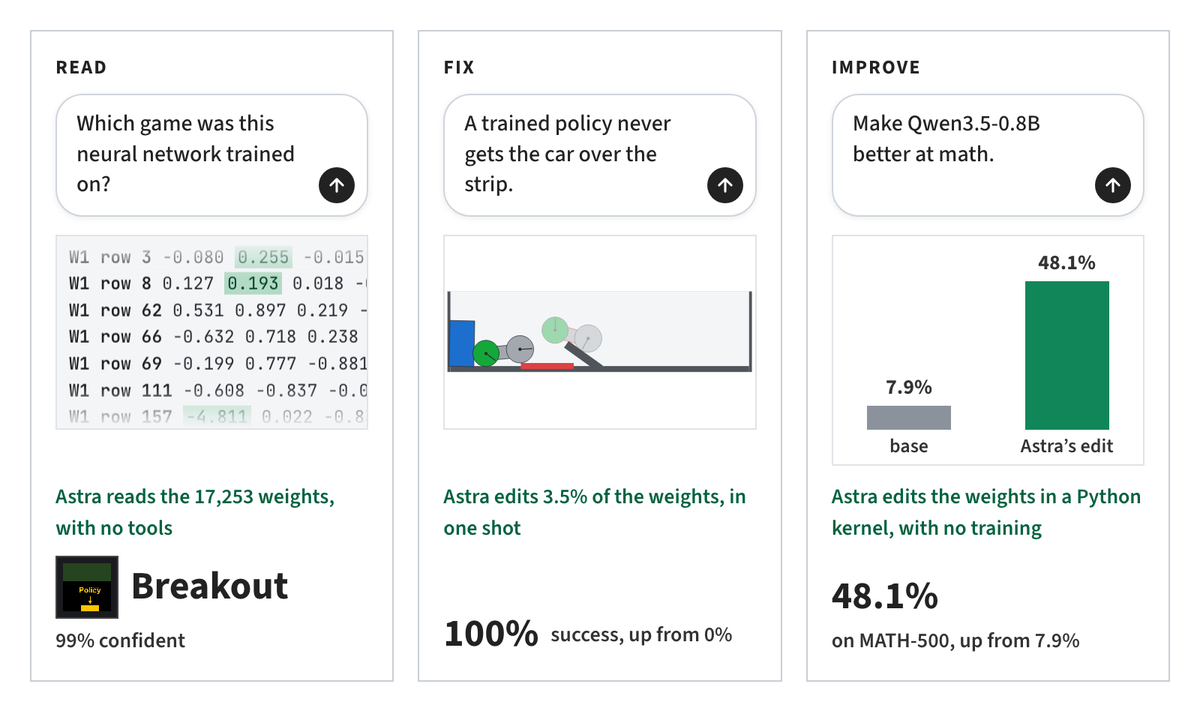
We find that frontier LLMs are surprisingly good at natively reading and writing neural network weights, using a variety of recent tools and algorithms or even via direct weight editing.
Sparks of Weight-Space Programming: LLMs can natively read & write neural network weights
We find that frontier LLMs are surprisingly good at natively reading and writing neural network weights, using a variety of recent tools and algorithms or even via direct weight editing.
Qwen 3.8 27B on my laptop can interpret model weights, too
Yesterday’s hot paper was Sparks of Weight-Space Programming: LLMs can natively read & write neural network weights by Rikiya Takehi, Jayden Teoh, Alex Zhang, and Omar Khattab. The paper found …
Alex Krentsel on Twitter / X
i've reproduced the results from the MIT blog post today on weight-space programming. but one additional result i have to add: this is a new, step-change emerging capability that's appeared in just the latest set of models. pic.twitter.com/EhMsQaaOkL— Alex Krentsel (@AlexKrentsel) November 2, 2026

Meta-Weight-Net: Learning an Explicit Mapping For Sample Weighting
Current deep neural networks(DNNs) can easily overfit to biased training data with corrupted labels or class imbalance. Sample re-weighting strategy is commonly used to alleviate this issue by designing a weighting function mapping from training loss to sample weight, and then iterating between weight recalculating and classifier updating. Current approaches, however, need manually pre-specify the weighting function as well as its additional hyper-parameters. It makes them fairly hard to be generally applied in practice due to the significant variation of proper weighting schemes relying on the investigated problem and training data. To address this issue, we propose a method capable of adaptively learning an explicit weighting function directly from data. The weighting function is an MLP with one hidden layer, constituting a universal approximator to almost any continuous functions, making the method able to fit a wide range of weighting function forms including those assumed in conventional research. Guided by a small amount of unbiased meta-data, the parameters of the weighting function can be finely updated simultaneously with the learning process of the classifiers. Synthetic and real experiments substantiate the capability of our method for achieving proper weighting functions in class imbalance and noisy label cases, fully complying with the common settings in traditional methods, and more complicated scenarios beyond conventional cases. This naturally leads to its better accuracy than other state-of-the-art methods.
Sparks of Weight-Space Programming: LLMs can natively read & write neural network weights
We find that frontier LLMs are surprisingly good at natively reading and writing neural network weights much like code, sometimes with tools such as a Python kernel and sometimes from the raw weights alone.
MatinKhajavi/Weight-Space-Programming
Replication of 'Sparks of Weight-Space Programming' (Takehi et al., 2026)
How Open Weights Are Changing the AI Race | Serverless Guru
Open Weight models: what they are, why you should care, and how the work of the open-source fine-tuning community around those models is reshaping daily life, both for developers and for everyday AI users.

Weight-space programming for auditing clinical decision networks
Machine learning models in radiotherapy are commissioned by testing them on cases with known answers, which may not reveal a shortcut that the test cases share with the training data. Frontier language models have recently been reported to read and write the raw weights of small neural networks, an ability called weight-space programming. The purpose of this study was to determine whether such a model, given only a clinical protocol and a network's weights, can audit and repair the network. Networks with 433 to 4,801 parameters were trained to screen head-and-neck planning requests against four rules. Flaws were planted through the training data: confounds that hid each rule, a 3 Gy shift in the cord threshold, and a hidden trigger. Claude Opus 5.5 audited each network blind, without tools, data or code execution, and every claim and repair was tested on about 420,000 requests. The language model named the broken rule in 16 of 18 flawed networks (95% CI 67% to 97%), including all 15 with a confound or a threshold shift. It repaired each of the 16 by changing a median of 3 parameters. Fine-tuning on protocol-labeled requests also repaired every network, but changed nearly every parameter. Each confound and shift it found was visible in single units, and a simple statistic chosen for each flaw type found the same flaws. It cleared 2 of 5 healthy networks without being forced and found 1 of 3 triggers. Testing against the protocol detected every flaw, and black-box testing found the confounds and the shift faster. The results indicate that, in small networks, weight-space programming can locate and repair flaws that silence an input or shift a threshold, but cannot yet certify that a network is correct.

Inkling: Our Open-Weights Model
Our first open-weights model: multimodal, Mixture-of-Experts, with controllable reasoning effort. Available to fine-tune on Tinker.

Rikiya Takehi on Twitter / X
We asked GPT-6 Astra to edit Qwen3.5-0.8B weights to improve math.It directly changed only 0.016% of weights, fixing 0.8B's reasoning loops & improving math up to 6x and even instruction following 3x, without gradients or training.We call this Weight-Space Programming:… pic.twitter.com/DwTwzXzSbE— Rikiya Takehi (@rikiyatakehi) November 2, 2026

Representer Point Selection for Explaining Deep Neural Networks
We propose to explain the predictions of a deep neural network, by pointing to the set of what we call representer points in the training set, for a given test point prediction. Specifically, we show that we can decompose the pre-activation prediction of a neural network into a linear combination of activations of training points, with the weights corresponding to what we call representer values, which thus capture the importance of that training point on the learned parameters of the network. But it provides a deeper understanding of the network than simply training point influence: with positive representer values corresponding to excitatory training points, and negative values corresponding to inhibitory points, which as we show provides considerably more insight. Our method is also much more scalable, allowing for real-time feedback in a manner not feasible with influence functions.
Weight-Space Programming for Medical Imaging: Do We Still Need Training Data?
Can a large language model (LLM) write the parameters of a medical image classifier from medical knowledge alone, without any training data? Such classifiers normally require labelled images, which are costly and often unavailable. We investigate this question through weight-space programming (WSP), in which an LLM writes or adapts the weights and biases of a neural network directly, without optimisation on training data. Claude Opus 5.5 and GPT-6 Astra each generate the parameters of a small LeNet-style CNN in a single reply, without tool use and without access to any image. We compare these networks against zero-shot MedSigLIP and against the same architecture trained on labels using the Adam optimiser, across 7 classification tasks in four modalities: chest X-ray, breast ultrasound and abdominal CT (all from MedMNIST), and pelvic MRI (SynthUterus). The LLM-written networks perform above chance on all six MedMNIST tasks, with a mean test AUC of 0.719 for Opus and 0.711 for Astra. Both models outperform MedSigLIP on 5 of 6 tasks while using more than 10,000 times fewer parameters. However, the same network trained with Adam on only 256 labelled images achieves a higher AUC on every MedMNIST task (mean AUC 0.828). On SynthUterus, Opus attains an AUC of 0.764, whereas Astra falls below chance (AUC 0.136) owing to a systematic error. These results show that LLMs can write functional medical classifiers, but that they do not yet replace training data. We release the protocol, logs and all generated weights at https://github.com/MaximilianLindholz/weight-space-programming-medical.
Weight-Space-Programmed Qwen3.5-0.8B - a Hugging Face Space by ML-Intern-lab
This app lets you type a math problem and (optionally) set a token limit. It then runs both the original Qwen3.5‑0.8B model and its weight‑edited version, showing the two generated answers side‑by‑...
Beyond Model Collapse: Scaling Up with Synthesized Data Requires...
Large Language Models (LLM) are increasingly trained on data generated by other LLM, either because generated text and images become part of the pre-training corpus, or because synthetized data is...
Natural emergent misalignment from reward hacking
We show for the first time that realistic AI training processes can accidentally produce misaligned models.