


Researchers from MIT introduce SwarmWorld, an environment where initially homogeneous language-model agents spontaneously self-organize and collectively evolve functional technologies through...
[Keynote 04] AgentSociety: Exploring Large Language Model Agents for Piloting Social Experiments
PoliSim@CHI 2026
Large Language Models are rapidly evolving from text generators into reasoning systems that can act as autonomous agents. When placed in social contexts, these agents display emergent behaviors such as forming coalitions, spreading information, and making collective decisions.
Why agent swarms could be the next “scaling law”
An OpenAI researcher called it “the most ‘feel the AGI’ moment that I had since reasoning models.”

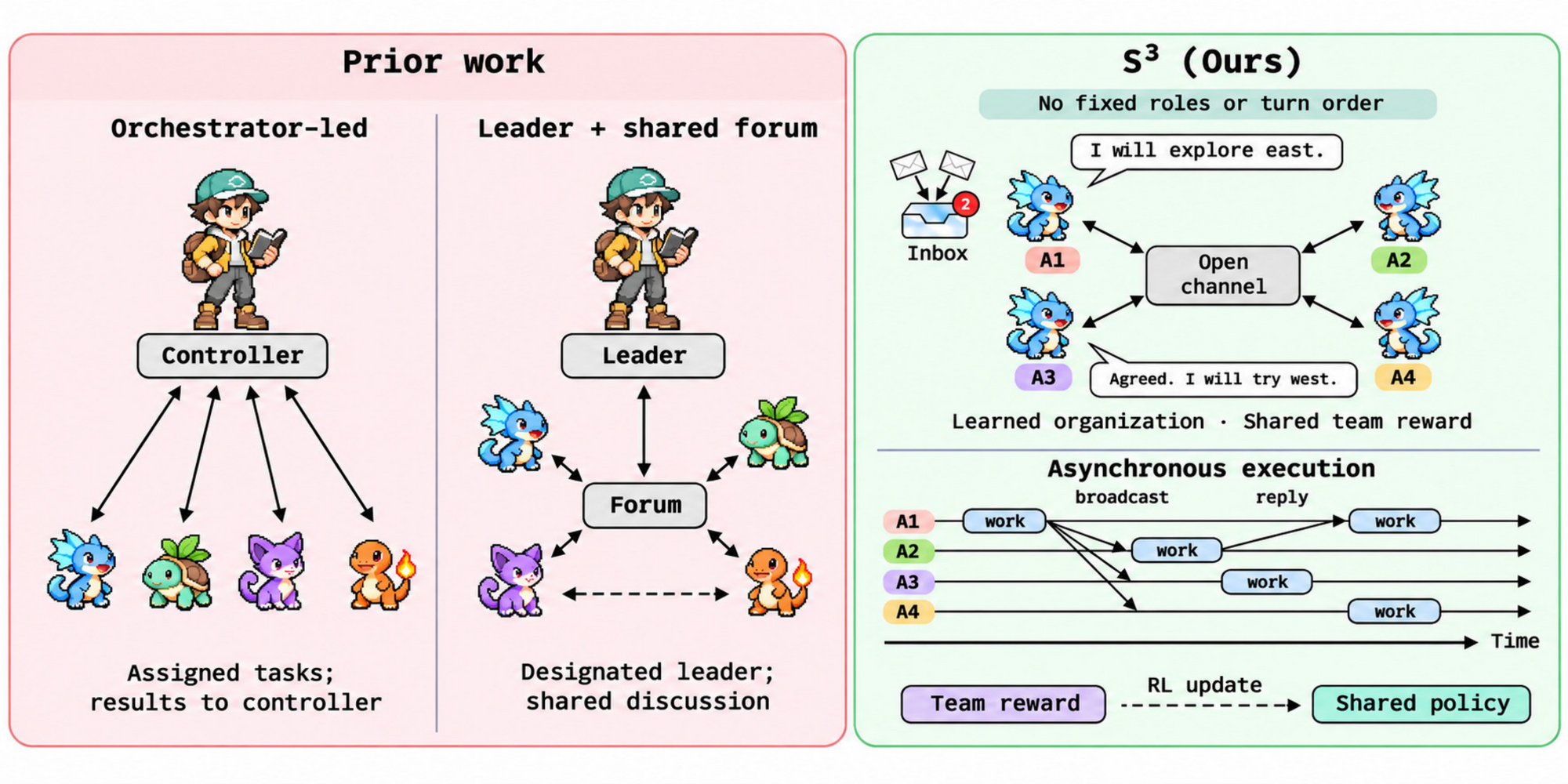
s³: Simple Scaling of Swarms
Asynchronous, role-free LLM swarms learn emergent coordination with one shared reward, beat best-of-N, and scale past their training size.
Social physics in the age of artificial intelligence
Artificial intelligence (AI) systems are rapidly becoming more capable, autonomous, and deeply embedded in social life. As humans increasingly interact, cooperate, and compete with AI, we move from purely human societies to hybrid human-AI societies whose collective dynamics cannot be captured by existing behavioural models alone. Drawing on evolutionary game theory, cultural evolution, and Large Language Models (LLMs) powered simulations, we argue that these developments open a new research agenda for social physics centred on the co-evolution of humans and machines. We outline six key research directions. First, modelling the evolutionary dynamics of social behaviours (e.g. cooperation, fairness, trust) in hybrid human-AI populations. Second, understanding machine culture: how AI systems generate, mediate, and select cultural traits. Third, analysing the co-evolution of language and behaviour when LLMs frame and participate in decisions. Fourth, studying the evolution of AI delegation: how responsibilities and control are negotiated between humans and machines. Fifth, formalising and comparing the distinct epistemic pipelines that generate human and AI behaviour. Sixth, modelling the co-evolution of AI development and regulation in a strategic ecosystem of firms, users, and institutions. Together, these directions define a programme for using social physics to anticipate and steer the societal impact of advanced AI.

The Evolutionary Ecology of Software: Constraints, Innovation, and the AI Disruption
This chapter investigates the evolutionary ecology of software, focusing on the symbiotic relationship between software and innovation. An interplay between constraints, tinkering, and frequency-dependent selection drives the complex evolutionary trajectories of these socio-technological systems. Our approach integrates agent-based modeling and case studies, drawing on complex network analysis and evolutionary theory to explore how software evolves under the competing forces of novelty generation and imitation. By examining the evolution of programming languages and their impact on developer practices, we illustrate how technological artifacts co-evolve with and shape societal norms, cultural dynamics, and human interactions. This ecological perspective also informs our analysis of the emerging role of AI-driven development tools in software evolution. While large language models (LLMs) provide unprecedented access to information, their widespread adoption introduces new evolutionary pressures that may contribute to cultural stagnation, much like the decline of diversity in past software ecosystems. Understanding the evolutionary pressures introduced by AI-mediated software production is critical for anticipating broader patterns of cultural change, technological adaptation, and the future of software innovation.
Swarm Intelligence: From Natural to Artificial Systems
Abstract. Social insects--ants, bees, termites, and wasps--can be viewed as powerful problem-solving systems with sophisticated collective intelligence. Co
Stanford AO — Building the autonomous organization
Stanford AO is building the autonomous organization — an incubator at Stanford OpenLab for agent swarms, DAOs, AI villages, and related experiments.
Konrad Hinsen's blog
The advent of AI agents based on large language models (LLMs) has put the idea of automating the intellectual and cognitive work of researchers on the table. A lively, sometimes even heated discussion is already going on. A frequently missing piece in this debate is the question why we, individually and as a society, actually do science. I will examine this question first, and then consider what it implies for introducing automation into science.
Emergent social conventions and collective bias in LLM populations
Social conventions are the backbone of social coordination, shaping how individuals form a group. As growing populations of artificial intelligence (AI) agents communicate through natural language, a fundamental question is whether they can bootstrap the foundations of a society. Here, we present experimental results that demonstrate the spontaneous emergence of universally adopted social conventions in decentralized populations of large language model (LLM) agents. We then show how strong collective biases can emerge during this process, even when agents exhibit no bias individually. Last, we examine how committed minority groups of adversarial LLM agents can drive social change by imposing alternative social conventions on the larger population. Our results show that AI systems can autonomously develop social conventions without explicit programming and have implications for designing AI systems that align, and remain aligned, with human values and societal goals. , Groups of AI agents can develop social conventions, generate societal bias, and undergo critical mass dynamics in norm adoption.

Swarm Intelligence
Here is a possible world 50 years in the future, one I think is more likely than the scenario most people expect, which is one huge AI in the sky.

OpenAI Releases Swarm: An Experimental AI Framework for Building, Orchestrating, and Deploying Multi-Agent Systems

EMERGENCE WORLD: A Laboratory for Evaluating Long-horizon Agent Autonomy — Emergence AI
Most evaluations of AI agents look like exams: a discrete task, a clean environment, a score in minutes or hours. Emergence World is built for the opposite question—what happens when you let agents run continuously, in a shared environment with real-world signals, for weeks. It is a research platfor

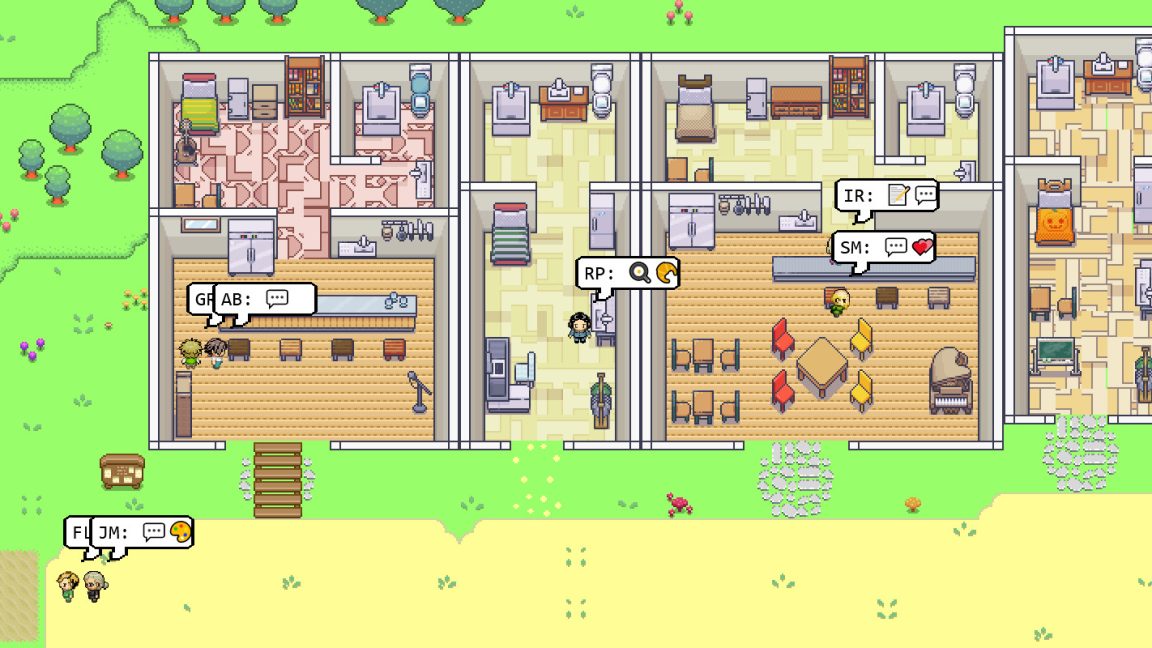
Surprising things happen when you put 25 AI agents together in an RPG town
Researchers study emergent AI behaviors in a sandbox world inspired by The Sims.
Agent swarms and the new model economics · Cursor
We compared old and new agent swarms building SQLite from scratch and found that better coordination delivers similar quality at a fraction of the cost.

Emergent Coordinated Behaviors in Networked LLM Agents: Modeling the Strategic Dynamics of Info Ops