


The Altmetric Explorer looks beyond citation analysis by tracking all the online attention to published research in one intuitive platform.
A call for broadening the altmetrics tent to democratize science outreach
Common altmetrics indices are limited and biased in the social media that they cover. In this Perspective, we highlight how and why altmetrics should broaden its scope to provide more reliable metrics for scientific content and communication.
In an era where research evaluation methods are evolving, the Research Contribution Claim Network makes trustworthy tracking of non-traditional research output easy!
In this whitepaper, Patrick Hochstenbach (Ghent University Library), Thomas van Himbergen (SURF), Laurents Sesink (SURF) and Herbert Van de Sompel (DANS) introduce the...
Researchers | alphaXiv
Browse researcher profiles on alphaXiv: publications, citation metrics, research areas, and the papers behind them.

The Research Nexus vision for a more connected scholarly community
Crossref envisions “a rich and reusable open network of relationships connecting research organizations, people, things, and actions; a scholarly record that the global community can build on forever, for the benefit of society”. This Research Nexus expands on the importance of research objects being persistently and uniquely identified. The scholarly community has an established practice of connecting things such as citations to others’ work and it is increasingly critical to identify relationships beyond citations, bringing together published work, unpublished work, institutions, individuals, and identifying the actions that they take e.g., funding, publishing, creating, modifying, citing, and sharing. The Research Nexus brings together metadata and relationships to build a joined-up picture of the scholarly ecosystem and helps everyone identify these relationships and how they change through time. This vision is possible if all parts of the scholarly ecosystem (and beyond) work together, including various scholarly infrastructure organizations.

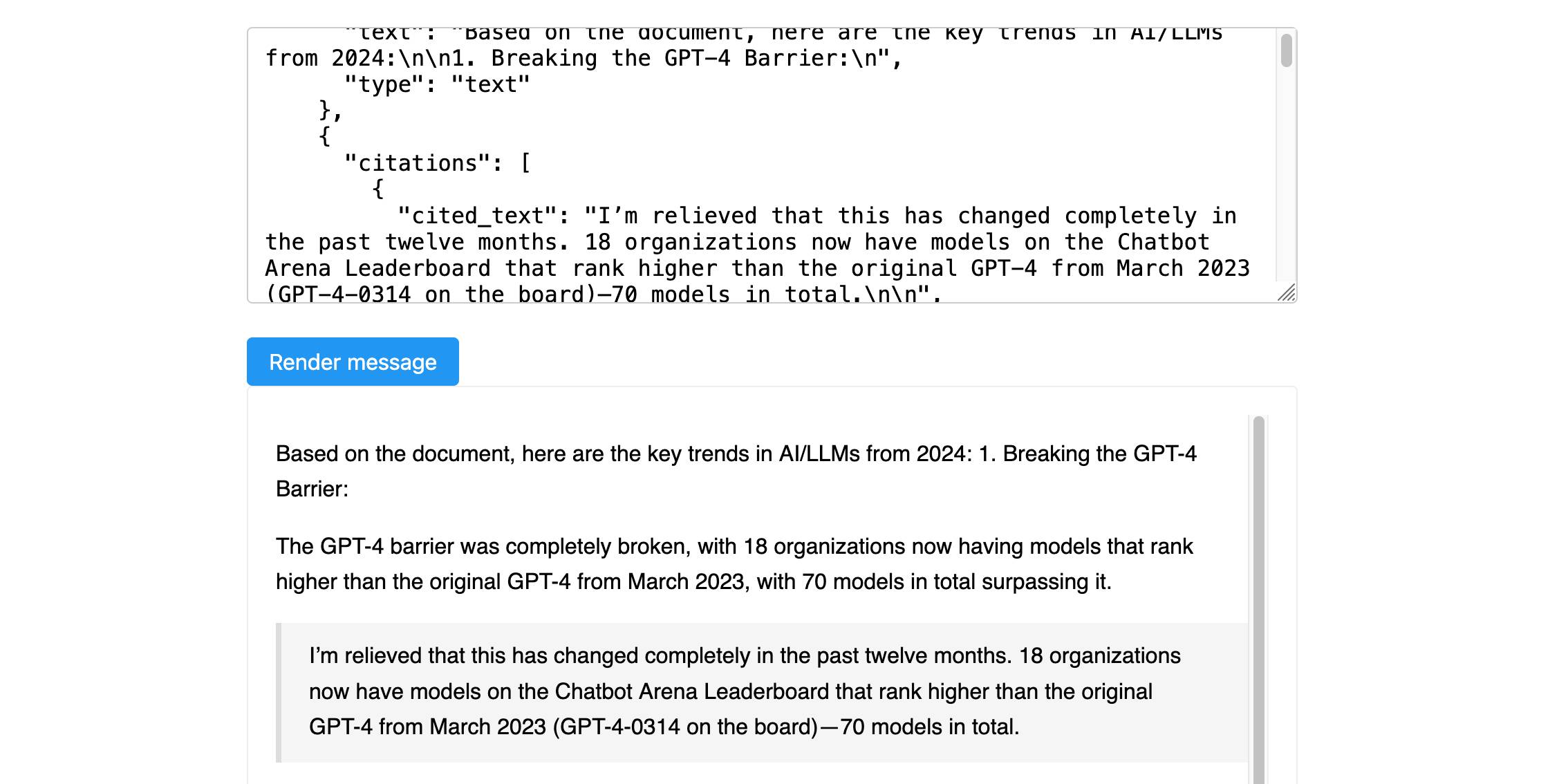
Anthropic’s new Citations API
Here’s a new API-only feature from Anthropic that requires quite a bit of assembly in order to unlock the value: Introducing Citations on the Anthropic API. Let’s talk about what …
Two billion citation links in Crossref help research travel further - Crossref
We’ve recently reached an important milestone for the research nexus: the works in our metadata corpus are now connected with over 2 billion citation links! This is a great opportunity to share a dedicated dataset and discuss why these are important for science.

Crossref: The sustainable source of community-owned scholarly metadata
This paper describes the scholarly metadata collected and made available by Crossref, as well as its importance in the scholarly research ecosystem. Containing over 106 million records and expanding at an average rate of 11% a year, Crossref’s metadata has become one of the major sources of scholarly data for publishers, authors, librarians, funders, and researchers. The metadata set consists of 13 content types, including not only traditional types, such as journals and conference papers, but also data sets, reports, preprints, peer reviews, and grants. The metadata is not limited to basic publication metadata, but can also include abstracts and links to full text, funding and license information, citation links, and the information about corrections, updates, retractions, etc. This scale and breadth make Crossref a valuable source for research in scientometrics, including measuring the growth and impact of science and understanding new trends in scholarly communications. The metadata is available through a number of APIs, including REST API and OAI-PMH. In this paper, we describe the kind of metadata that Crossref provides and how it is collected and curated. We also look at Crossref’s role in the research ecosystem and trends in metadata curation over the years, including the evolution of its citation data provision. We summarize the research used in Crossref’s metadata and describe plans that will improve metadata quality and retrieval in the future.

Attribution, Provenance, Reference, Citation, and AI for Research Applications – Understanding the Differences - The Scholarly Kitchen
Building robust citation and attribution into generative AI systems are foundational to usage, credit and trust. We need to expect more from AI.

Introducing Citations on the Anthropic API | Claude
Claude can now cite specific passages from your documents, delivering verifiable responses with built-in source tracking. Update: Now available in Amazon Bedrock. (June 30, 2025) Today, we're launching Citations, a new API feature that lets Claude ground its answers in source documents.

The new way we’ll do science
Papers should become human-readable views over a graph of data, tools, results, and certificates.

SemRepo: A Knowledge Graph for Research Software and Its Scholarly Ecosystem
We present SemRepo, an RDF knowledge graph comprising over 81 million triples describing nearly 200,000 GitHub repositories associated with scientific research. SemRepo captures repository-level metadata, such as contributors, issues, and programming languages, and interlinks this information with external scholarly knowledge graphs. In particular, repository authors are linked to their profiles in SemOpenAlex, repositories are connected to scholarly publications in LPWC, and research artifacts, such as datasets and experiments, are linked via MLSea-KG. This integration enables queries that span publications and their scholarly artifacts, which are typically fragmented across separate platforms. SemRepo supports analyses that are difficult to perform with existing resources in isolation, including provenance reconstruction across repositories and publications, as well as the systematic identification of risks to research reproducibility and software sustainability. By unifying research software with its scholarly context in a single graph, SemRepo provides an important infrastructure for large-scale analysis of software within the broader scientific research ecosystem.

Citing Less Critically: LLMs Reshape the Rhetoric and Reach of Scientific Citation
Scientific citations carry rhetorical intent. Scholars may cite prior work positively (supporting), negatively (contrasting), or neutrally (mentioning). As large language models (LLMs) increasingly assist scientific writing, whether they reproduce citations with the same rhetorical intent as humans remains unclear. We introduce a masked-citation task to compare human and LLM-generated citation behavior. For each citation context, an LLM generates a replacement citation sentence, producing a counterfactual corpus directly comparable to human citation. We analyze what, whom, and how models cite, using an LLM-as-a-judge to classify citation intent and a 20-million-edge coauthorship network to measure social distance between cited authors. Across six popular LLMs and 1,746 top NLP conference papers (63k+ contexts, 132k+ citations), three patterns emerge: (1) Compared with human citation, LLMs cite significantly less critically; (2) LLMs over-cite popular and older papers, a tendency amplified for contrasting citations where human writing more often draws on recent, niche work; (3) Whereas humans often cite within their close social network, especially for supporting citations, LLMs tend to draw on more socially distant authors. Together, these differences are double-edged: LLM citation reaches beyond a scholar's close collaborators while being less critical and amplifying visibility bias, reshaping the rhetoric and reach of scientific citation.
Zero-Click Readership: Are AI Overviews Changing the Way We Discover Research - The Scholarly Kitchen
Today's post asks: If research is increasingly accessed through AI-generated summaries rather than via primary sources, then what does it mean to “engage with research” at all?

How is science clicked on Twitter? Click metrics for Bitly short links to scientific publications
Abstract To provide some context for the potential engagement behavior of Twitter users around science, this article investigates how Bitly short links to scientific publications embedded in scholarly Twitter mentions are clicked on Twitter. Based on the click metrics of over 1.1 million Bitly short links referring to Web of Science (WoS) publications, our results show that around 49.5% of them were not clicked by Twitter users. For those Bitly short links with clicks from Twitter, the majority of their Twitter clicks accumulated within a short period of time after they were first tweeted. Bitly short links to the publications in the field of Social Sciences and Humanities tend to attract more clicks from Twitter over other subject fields. This article also assesses the extent to which Twitter clicks are correlated with some other impact indicators. Twitter clicks are weakly correlated with scholarly impact indicators (WoS citations and Mendeley readers), but moderately correlated to other Twitter engagement indicators (total retweets and total likes). In light of these results, we highlight the importance of paying more attention to the click metrics of URLs in scholarly Twitter mentions, to improve our understanding about the more effective dissemination and reception of science information on Twitter.

THREAD The first full year of tracking research on @bsky.app Hi, we are Altmetric, and we track how research is communicated across the web. We now have one full calendar year of Bluesky research data and thought we'd have a looksie.
Research tools 🔬

Interesting tools that assist with the research process.
Paperclip

Ronen Tamari (@ronentk.me)

Crossmark - Crossref
Crossmark - Crossref
Plaudit · Open endorsements from the academic community
Introducing the Elicit API - Elicit
