


A bold and eye-opening exposé on how power and propaganda distort the news, now more relevant than ever • With an updated introduction“[A] compelling indictment of the news media’s role in covering up errors and deceptions in American foreign policy.”—The New York Times Book Review Renowned scholars Edward S. Herman and Noam Chomsky reveal how U.S. news media, far from being independent watchdogs, often function as tools of elite influence. With probing analysis, they present their Propaganda Model, a framework that explains how systemic bias shapes the stories we’re told, the voices we hear, and the truths that remain hidden.Through deeply researched case studies, from the Vietnam War to coverage of “worthy” vs. “unworthy” victims, Manufacturing Consent exposes the structural forces that drive news organizations to reinforce power rather than question it. It’s a sobering portrait of a media system more interested in maintaining order than informing the public.This edition includes an introduction updating key examples and expanding the Propaganda Model’s relevance to issues like the coverage of NAFTA, the media’s treatment of global protests, and environmental regulation.Manufacturing Consent is a powerful assessment of how propagandistic the U.S. mass media are, how they systematically fail to live up to their self-image as providers of the kind of information that people need to make sense of the world, and how we can understand their function in a radically new way.Whether you’re a student, activist, or citizen looking to see beyond the headlines, this book will transform how you understand the media—and the world around you.
Language Models Trained on State Media Sources Launder Propaganda
Tech Policy Press is a nonprofit media and community venture intended to provoke new ideas, debate and discussion at the intersection of technology and democracy. We publish opinion and analysis.

State media control influences large language models
Millions of people around the world query large language models (LLMs) for information. Although several studies have compellingly documented the persuasive potential of these models1–10, there is limited evidence of who or what influences the models themselves, leading to a flurry of concerns about which companies and governments build and regulate the models. Here we show through six studies that government control of the media across the world already influences the output of LLMs via their training data. We use a cross-national audit to show that LLMs exhibit a stronger pro-government valence in the languages of countries with lower media freedom than in those with higher media freedom. This result is correlational, so to triangulate the specific mechanism of how state media control can influence LLMs, we develop a multi-part case study on China’s media. We demonstrate that media scripted and curated by the Chinese state appears in LLM training datasets. To evaluate the plausible effect of this inclusion, we use an open-weight model to show that additional pretraining on Chinese state-coordinated media generates more positive answers to prompts about Chinese political institutions and leaders. We link this phenomenon to commercial models through two audit studies demonstrating that prompting models in Chinese generates more positive responses about China’s institutions and leaders than do the same queries in English. The combination of influence and persuasive potential across languages suggests the troubling conclusion that states and powerful institutions have increased strategic incentives to leverage media control in the hopes of shaping LLM output.
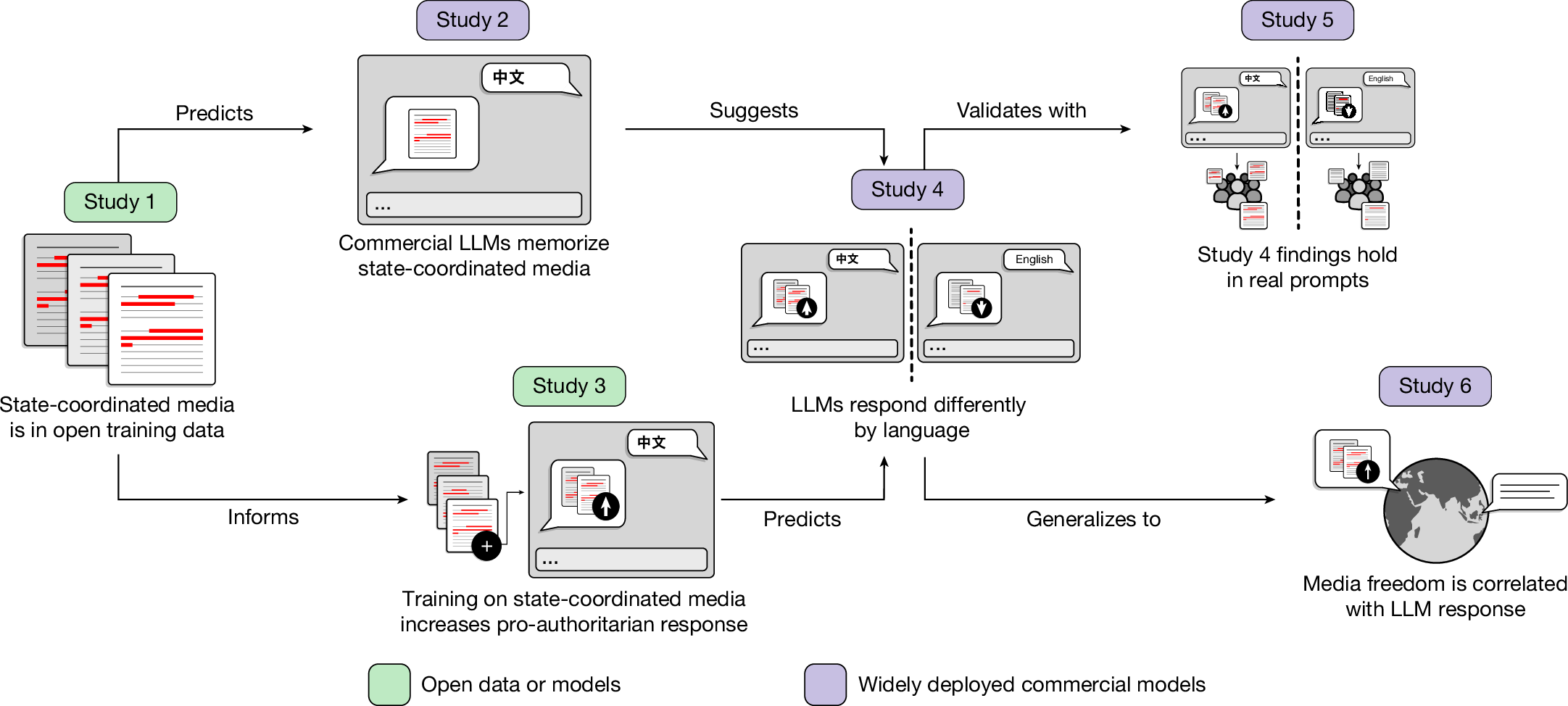
State media control influences large language models
Millions of people around the world query large language models (LLMs) for information. Although several studies have compellingly documented the persuasive potential of these models1–10, there is limited evidence of who or what influences the models themselves, leading to a flurry of concerns about which companies and governments build and regulate the models. Here we show through six studies that government control of the media across the world already influences the output of LLMs via their training data. We use a cross-national audit to show that LLMs exhibit a stronger pro-government valence in the languages of countries with lower media freedom than in those with higher media freedom. This result is correlational, so to triangulate the specific mechanism of how state media control can influence LLMs, we develop a multi-part case study on China’s media. We demonstrate that media scripted and curated by the Chinese state appears in LLM training datasets. To evaluate the plausible effect of this inclusion, we use an open-weight model to show that additional pretraining on Chinese state-coordinated media generates more positive answers to prompts about Chinese political institutions and leaders. We link this phenomenon to commercial models through two audit studies demonstrating that prompting models in Chinese generates more positive responses about China’s institutions and leaders than do the same queries in English. The combination of influence and persuasive potential across languages suggests the troubling conclusion that states and powerful institutions have increased strategic incentives to leverage media control in the hopes of shaping LLM output.
NYT: Boycott, Divest, Unsubscribe — WRITERS AGAINST THE WAR ON GAZA
The New York Times is not unique among media outlets in manufacturing consent for war, for exploitation, for genocide. It is, rather, exemplary. The Times’ reputation for liberalism, for rigor, for non-partisan independence is precisely what makes it so dangerous, because it hides what it really is: a publication that exists to serve the interests of U.S. imperialism.
Political Bias in the Media – Evidence from the Universe of French Broadcasts, 2002-2020 | ifo Institute | CESifo
How does the media bias the news? And in particular, how much does it cost owners to ensure that journalists comply with their stance? We compile a unique dataset of journalists and guests appearing on French television and radio shows between 2002 and 2020 to quantify the role played by journalist selection and compliance in political coverage. First, we leverage the movements of thousands of journalists between media outlets, and estimate a model in which the share of coverage for each political group is determined both by journalist and outlet components. We find that outlet-level decisions account for three-fourths of the differences in political coverage; in contrast, journalists’ personal editorial preferences play only a minor role. Second, we examine how journalists respond to a major takeover-induced editorial change. Using a difference-in-differences strategy, we show that while many journalists left in response to the shock, those who stayed largely adapted to the new editorial direction. Notably, exploiting unique data on journalist salaries, we show that this compliance came at nearly no cost for the new owner, reflecting journalists’ low bargaining power in an industry in crisis.

Media Ownership Monitor
Mass media influences how facts are viewed and debated in a society, contributing to crafting its public opinion. Independence and pluralism...

America’s Right-Wing Propaganda Problem Might Be Terminal - Dame Magazine
America’s descent into mass delusion isn’t happenstance. The demise of courageous journalism isn’t a happy accident. Its replacement with engagement-chasing infotainment and propaganda isn’t an error. It’s a global assault on reason and informed consensus, and corporations and authoritarian bullies like Donald Trump are both architects and benefactors. For decades, academics warned anybody who’d listen
Still Manufacturing Consent: An Interview with Noam Chomsky | Hacker News
The marking out of the symbiotic relationship between reliable information producers and journalists is also vital to understanding the media system. A reliable, centralised stream of new information content is the life blood of journalism organisations, with a strong emphasis on _reliable_ and _centralised_. This particular need that journalists have sees them often becoming dependent on state institutions and corporations at the expense of minority groups and labor. An example being the journalists 'on the beat' that used to hang out around the local courthouse because that's where the 'feeding trough' is. Or the reports so nicely formatted and condensed produced by the state departments such that journos merely have to copy-paste the information straight into their papers. Easy-peasy.
On Western Terrorism: From Hiroshima to Drone Warfare
In On Western Terrorism Noam Chomsky, world renowned dissident intellectual, discusses Western power and propaganda with filmmaker and investigative journalist Andre Vltchek. The discussion weaves together a historical narrative with the two men's personal experiences which led them to a life of activism. The discussion includes personal memories, such as the New York newsstand where Chomsky began his political education, and broadens out to look at the shifting forms of imperial control and the Western propaganda apparatus. Along the way the discussion touches on many countries of which the authors have personal experience, from Nicaragua and Cuba, to China, Chile, Turkey and many more. A blast of fresh air which blows away the cobwebs of propaganda and deception, On Western Terrorism is a powerful critique of the West's role in the world which will inspire all those who read it to think independently and critically.
Donald Trump just barred Washington Post reporters from campaign events. That should bother you.
Banning media is bad for democracy. Period.

Social Media Vs Democracy
How to Responsibly Report on Hacks and Disinformation
The run-up to the 2016 U.S. presidential election illustrated how vulnerable our most venerated journalistic outlets are to a new kind of information warfare. Reporters are a targeted adversary of foreign and domestic actors who want to harm our democracy. And to cope with this threat, especially in an election year, news organizations need to prepare for another wave of false, misleading, and hacked information. Often, the information will be newsworthy. Expecting reporters to refrain from covering news goes against core principles of American journalism and the practical business drivers that shape the intensely competitive media marketplace. In these cases, the question is not whether to report but how to do so most responsibly. Our goal is to give journalists actionable guidance.
Situational awareness
I consider this article to be a form of American propaganda. There are a number of things in here I agree with, or believe may happen, but don't necessarily ...

De Facto Journalism Co-op
Non-profit investigative journalism that shines a light on systems of power and abuses of rights and authority

Local News and National Politics
The level of journalistic resources dedicated to coverage of local politics is in a long-term decline in the US news media, with readership shifting to national outlets. We investigate whether this trend is demand- or supply-driven, exploiting a recent wave of local television station acquisitions by a conglomerate owner. Using extensive data on local news programming and viewership, we find that the ownership change led to (1) substantial increases in coverage of national politics at the expense of local politics, (2) a significant rightward shift in the ideological slant of coverage, and (3) a small decrease in viewership, all relative to the changes at other news programs airing in the same media markets. These results suggest a substantial supply-side role in the trends toward nationalization and polarization of politics news, with negative implications for accountability of local elected officials and mass polarization.
Local News and National Politics
The level of journalistic resources dedicated to coverage of local politics is in a long-term decline in the US news media, with readership shifting to national outlets. We investigate whether this trend is demand- or supply-driven, exploiting a recent wave of local television station acquisitions by a conglomerate owner. Using extensive data on local news programming and viewership, we find that the ownership change led to (1) substantial increases in coverage of national politics at the expense of local politics, (2) a significant rightward shift in the ideological slant of coverage, and (3) a small decrease in viewership, all relative to the changes at other news programs airing in the same media markets. These results suggest a substantial supply-side role in the trends toward nationalization and polarization of politics news, with negative implications for accountability of local elected officials and mass polarization.