


Self-supervised method for learning when to retrieve contextual information from a code repository speeds up code completion times by 70% while increasing accuracy.
RepoCoder: Repository-Level Code Completion Through Iterative Retrieval and Generation
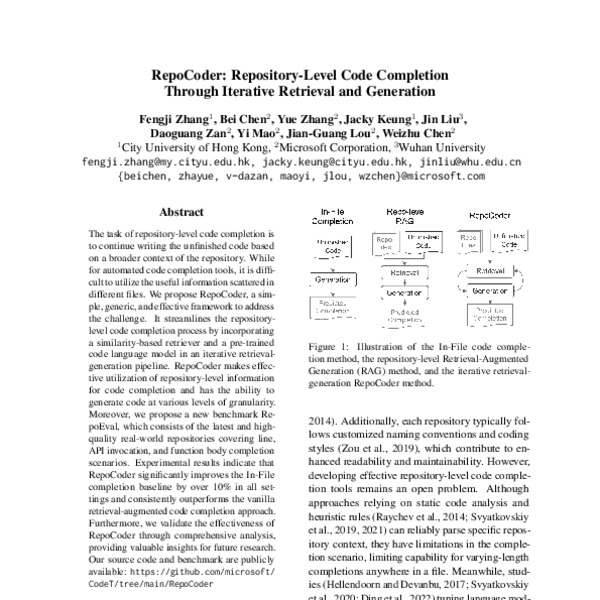
The task of repository-level code completion is to continue writing the unfinished code based on a broader context of the repository. While for automated code completion tools, it is difficult to utilize the useful information scattered in different files. We propose RepoCoder, a simple, generic, and effective framework to address the challenge. It streamlines the repository-level code completion process by incorporating a similarity-based retriever and a pre-trained code language model in an iterative retrieval-generation pipeline. RepoCoder makes effective utilization of repository-level information for code completion and has the ability to generate code at various levels of granularity. Moreover, we propose a new benchmark RepoBench, which consists of the latest and high-quality real-world repositories covering line, API invocation, and function body completion scenarios. Experimental results indicate that RepoCoder significantly improves the In-File completion baseline by over 10% in all settings and consistently outperforms the vanilla retrieval-augmented code completion approach. Furthermore, we validate the effectiveness of RepoCoder through comprehensive analysis, providing valuable insights for future research. Our source code and benchmark will be publicly available after the paper review.
Retrieval-Augmented Code Generation: A Survey with Focus on Repository-Level Approaches
Recent advancements in large language models (LLMs) have substantially improved automated code generation. While function-level and file-level generation have achieved promising results, real-world software development typically requires reasoning across entire repositories. This gives rise to the challenging task of Repository-Level Code Generation (RLCG), where models must capture long-range dependencies, ensure global semantic consistency, and generate coherent code spanning multiple files or modules. To address these challenges, Retrieval-Augmented Generation (RAG) has emerged as a powerful paradigm that integrates external retrieval mechanisms with LLMs, enhancing context-awareness and scalability. In this survey, we provide a comprehensive review of research on Retrieval-Augmented Code Generation (RACG), with an emphasis on repository-level approaches. We categorize existing work along several dimensions, including generation strategies, retrieval modalities, model architectures, training paradigms, and evaluation protocols. Furthermore, we summarize widely used datasets and benchmarks, analyze current limitations, and outline key challenges and opportunities for future research. Our goal is to establish a unified analytical framework for understanding this rapidly evolving field and to inspire continued progress in AI-powered software engineering.
Evaluating AGENTS.md: Are Repository-Level Context Files Helpful for Coding Agents?
A widespread practice in software development is to tailor coding agents to repositories using context files, such as AGENTS.md, by either manually or automatically generating them. Although this practice is strongly encouraged by agent developers, there is currently no rigorous investigation into whether such context files are actually effective for real-world tasks. In this work, we study this question and evaluate coding agents' task completion performance in two complementary settings: established SWE-bench tasks from popular repositories, with LLM-generated context files following agent-developer recommendations, and a novel collection of issues from repositories containing developer-committed context files. Across multiple coding agents and LLMs, we find that context files tend to reduce task success rates compared to providing no repository context, while also increasing inference cost by over 20%. Behaviorally, both LLM-generated and developer-provided context files encourage broader exploration (e.g., more thorough testing and file traversal), and coding agents tend to respect their instructions. Ultimately, we conclude that unnecessary requirements from context files make tasks harder, and human-written context files should describe only minimal requirements.

Github Code Search - Programmers' Goldmine
Learning new language or framework can sometimes be a struggle. Traditional approach is to read documentation which explains the concepts, and provides simple examples. Sometimes that might be enough, but what those documentations are often lacking are some advanced examples and usages in real projects.
Building an Open-Source Alternative to Cursor with Code Context - Milvus Blog
Code Context—an open-source, MCP-compatible plugin that brings powerful semantic code search to any AI coding agent, Claude Code and Gemini CLI, IDEs like VSCode, and even environments like Chrome.

Semble: Fast and Accurate Code Search for Agents
Fast and Accurate Code Search for Agents. Uses ~98% fewer tokens than grep+read
We asked 15,000 people who they are, and how they’re learning to code
More than 15,000 people responded to the 2016 New Coder Survey, granting researchers an unprecedented glimpse into how adults are learning to code. We’ve released the entire dataset of participants’ individual responses to all 48 questions — under th...

AI Code Reviews | CodeRabbit | Try for Free.
AI-first pull request reviewer with context-aware feedback, line-by-line code suggestions, and real-time chat.
Code Repository - Git Source Control | Harness
Host Git repositories in Harness, manage pull requests, and connect every commit to secure CI/CD workflows with source-to-deploy traceability.

The Coding Agent Data Deal
On user data control, coding agents as retrievers, and the value of your coding transcripts

The Coding Agent Data Deal
On user data control, coding agents as retrievers, and the value of your coding transcripts
OpenWiki: Open Source Repo Documentation for Coding Agents
OpenWiki generates and maintains codebase documentation so coding agents can find the repo context they need without loading everything into one instruction file.
best coding - Reddit Search!
Agent READMEs: An Empirical Study of Context Files for Agentic Coding
Agentic coding tools receive goals written in natural language, break them down into specific tasks, and write or execute code with minimal human intervention. Central to this process are agent context files (e.g., AGENTS.md and CLAUDE.md) that provide persistent, project-level instructions. In this paper, we conduct the first large-scale empirical study of 2,303 agent context files from 1,925 repositories to characterize their structure, maintenance, and content. We find that these files are not static documentation but complex, difficultto-read artifacts that evolve like configuration code through frequent, small additions. Our content analysis of 16 instruction types shows that developers prioritize functional context, such as test procedures (75.9%), implementation details (70.8%), and architecture (68.1%). We also identify a significant gap: non-functional requirements such as security (14.8%) and performance (14.5%) are rarely specified. These findings indicate that while developers use context files to make agents functional, they provide few guardrails to ensure that agent-written code is secure or performant, highlighting the need for improved tools and practices.