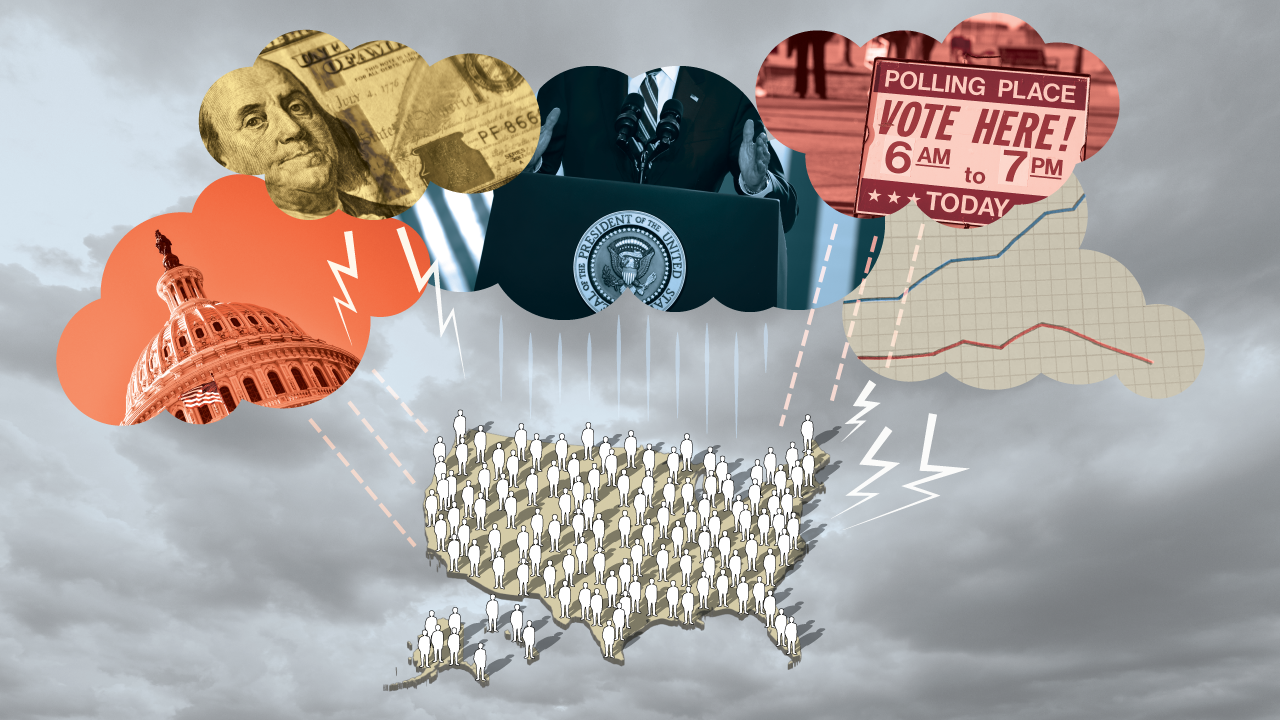
In this review, we survey the economics literature on echo chambers. We identify echo chambers as arising from a combination of two phenomena: ( a) the choice of individuals to segregate with like-minded ones, i.e., the creation of chambers, and ( b) behavioral biases that induce polarization when individuals exchange beliefs in these chambers, i.e., the echo. We summarize the literatures on these two phenomena and suggest how to combine the two literatures to gain insights about the effects of echo chambers on economic and political outcomes. We end by suggesting pathways for future research and discussing policy interventions to alleviate echo chambers.
There is no fresh air: A problem with the concept of echo chambers
Standardly, echo chambers are thought to be structures that we should avoid. Agents should keep away from them, to be able to assess a fuller range of evidence and avoid having their confidence in that information manipulated. This paper argues against that standard view. Not only can echo chambers be neutral or good for us, but the existing definitions apply so widely that such chambers are unavoidable. We are all in large numbers of echo chambers at any time – they can be found not just on social media or in political groups, but in almost every social or epistemic group we could categorise ourselves into. Because we are finite and fallible, we cannot escape them and need to exist in them just to get by. The concept, then, does not actually capture something as structurally problematic as the paradigmatic cases would suggest. Our way of using the term in social epistemology needs to change.

The marketplace of rationalizations
Recent work in economics has rediscovered the importance of belief-based utility for understanding human behaviour. Belief ‘choice’ is subject to an important constraint, however: people can only bring themselves to believe things for which they can find rationalizations. When preferences for similar beliefs are widespread, this constraint generates rationalization markets, social structures in which agents compete to produce rationalizations in exchange for money and social rewards. I explore the nature of such markets, I draw on political media to illustrate their characteristics and behaviour, and I highlight their implications for understanding motivated cognition and misinformation.

How Field Experiments in Economics Can Complement Psychological Research on Judgment Biases
This review summarizes results of field experiments examining individual behaviors across several market settings—from open-air markets to rideshare markets to tax-compliance markets—where people sort themselves into market roles wherein they make consequential decisions. Using three distinct examples from my own research on the endowment effect, left-digit bias, and omission bias, I showcase how field experiments can help researchers understand mediators, heterogeneity, and causal moderation involved in judgment biases in the field. In this manner, the review highlights that economic field experiments can serve an invaluable intellectual role alongside traditional laboratory research.

Persuasion: Empirical Evidence
We provide a selective survey of empirical evidence on the effects as well as the drivers of persuasive communication. We consider persuasion directed at consumers, voters, donors, and investors. We organize our review around four questions. First, to what extent does persuasion affect the behavior of each of these groups? Second, what models best capture the response to persuasive communication? Third, what are persuaders' incentives, and what limits their ability to distort communications? Finally, what evidence exists on the way persuasion affects equilibrium outcomes in economics and politics?
ECHO CHAMBERS AND EPISTEMIC BUBBLES
Discussion of the phenomena of post-truth and fake news often implicates the closed epistemic networks of social media. The recent conversation has, however, blurred two distinct social epistemic phenomena. An epistemic bubble is a social epistemic structure in which other relevant voices have been left out, perhaps accidentally. An echo chamber is a social epistemic structure from which other relevant voices have been actively excluded and discredited. Members of epistemic bubbles lack exposure to relevant information and arguments. Members of echo chambers, on the other hand, have been brought to systematically distrust all outside sources. In epistemic bubbles, other voices are not heard; in echo chambers, other voices are actively undermined. It is crucial to keep these phenomena distinct. First, echo chambers can explain the post-truth phenomena in a way that epistemic bubbles cannot. Second, each type of structure requires a distinct intervention. Mere exposure to evidence can shatter an epistemic bubble, but may actually reinforce an echo chamber. Finally, echo chambers are much harder to escape. Once in their grip, an agent may act with epistemic virtue, but social context will pervert those actions. Escape from an echo chamber may require a radical rebooting of one's belief system.
The persistence of cognitive biases in financial decisions across economic groups
While economic inequality continues to rise within countries, efforts to address it have been largely ineffective, particularly those involving behavioral approaches. It is often implied but not tested that choice patterns among low-income individuals may be a factor impeding behavioral interventions aimed at improving upward economic mobility. To test this, we assessed rates of ten cognitive biases across nearly 5000 participants from 27 countries. Our analyses were primarily focused on 1458 individuals that were either low-income adults or individuals who grew up in disadvantaged households but had above-average financial well-being as adults, known as positive deviants. Using discrete and complex models, we find evidence of no differences within or between groups or countries. We therefore conclude that choices impeded by cognitive biases alone cannot explain why some individuals do not experience upward economic mobility. Policies must combine both behavioral and structural interventions to improve financial well-being across populations.

We don’t have a hundred biases, we have the wrong model
Behavioral economics has identified dozens of cognitive biases that stop us from acting 'rationally'. But instead of building up a messier and messier picture of human behavior, we need a new model.

Facts and Myths about Misperceptions
Misperceptions threaten to warp mass opinion and public policy on controversial issues in politics, science, and health. What explains the prevalence and persistence of these false and unsupported beliefs, which seem to be genuinely held by many people? Though limits on cognitive resources and attention play an important role, many of the most destructive misperceptions arise in domains where individuals have weak incentives to hold accurate beliefs and strong directional motivations to endorse beliefs that are consistent with a group identity such as partisanship. These tendencies are often exploited by elites who frequently create and amplify misperceptions to influence elections and public policy. Though evidence is lacking for claims of a “post-truth” era, changes in the speed with which false information travels and the extent to which it can find receptive audiences require new approaches to counter misinformation. Reducing the propagation and influence of false claims will require further efforts to inoculate people in advance of exposure (for example, media literacy), debunk false claims that are already salient or widespread (for example, fact-checking), reduce the prevalence of low-quality information (for example, changing social media algorithms), and discourage elites from promoting false information (for example, strengthening reputational sanctions).
How the Cases You Choose Affect the Answers You Get: Selection Bias in Comparative Politics
This article demonstrates how the selection of cases for study on the basis of outcomes on the dependent variable biases conclusions. It first lays out the logic of explanation and shows how it is violated when only cases that have achieved the outcome of interest are studied. It then examines three well-known and highly regarded studies in the field of comparative politics, comparing the conclusions reached in the original work with a test of the arguments on cases selected without regard for their position on the dependent variable. In each instance, conclusions based on the uncorrelated sample differ from the original conclusions.
The Liar’s Dividend: Can Politicians Claim Misinformation to Evade Accountability?
This study addresses the phenomenon of misinformation about misinformation, or politicians "crying wolf"' over fake news. Strategic and false claims that stories are fake news or deepfakes may benefit politicians by helping them maintain support after a scandal. We posit that this benefit, known as the "liar's dividend," may be achieved through two politician strategies: by invoking informational uncertainty or by encouraging oppositional rallying of core supporters. We administer five survey experiments to over 15,000 American adults detailing hypothetical politician responses to stories describing real politician scandals. We find that claims of misinformation representing both strategies raise politician support across partisan subgroups. These strategies are effective against text-based reports of scandals, but are largely ineffective against video evidence and do not reduce general trust in media. Finally, these false claims produce greater dividends for politicians than alternative responses to scandal, such as remaining silent or apologizing.
If you rise, I fall: Equality is prevented by the misperception that it harms advantaged groups
Nine preregistered studies ( n = 4197) demonstrate that advantaged group members misperceive equality as necessarily harming their access to resources and inequality as necessarily benefitting them. Only when equality is increased within their ingroup, instead of between groups, do advantaged group members accurately perceive it as unharmful. Misperceptions persist when equality-enhancing policies offer broad benefits to society or when resources, and resource access, are unlimited. A longitudinal survey of the 2020 U.S. voters reveals that harm perceptions predict voting against actual equality-enhancing policies, more so than voters’ political and egalitarian beliefs. Finally two novel-groups experiments reveal that advantaged participants’ harm misperceptions predict voting for inequality-enhancing policies that financially hurt them and against equality-enhancing policies that financially benefit them. Misperceptions persist even after an intervention to improve decision-making. This misperception that equality is necessarily zero-sum may explain why inequality prevails even as it incurs societal costs that harm everyone. , Advantaged groups misperceive equality as harming their resource access, which predicts voting against equality policies.

The echo chamber effect on social media
Significance We explore the key differences between the main social media platforms and how they are likely to influence information spreading and the formation of echo chambers. To assess the different dynamics, we perform a comparative analysis on more than 100 million pieces of content concerning controversial topics (e.g., gun control, vaccination, abortion) from Gab, Facebook, Reddit, and Twitter. The analysis focuses on two main dimensions: 1) homophily in the interaction networks and 2) bias in the information diffusion toward like-minded peers. Our results show that the aggregation in homophilic clusters of users dominates online dynamics. However, a direct comparison of news consumption on Facebook and Reddit shows higher segregation on Facebook. , Social media may limit the exposure to diverse perspectives and favor the formation of groups of like-minded users framing and reinforcing a shared narrative, that is, echo chambers. However, the interaction paradigms among users and feed algorithms greatly vary across social media platforms. This paper explores the key differences between the main social media platforms and how they are likely to influence information spreading and echo chambers’ formation. We perform a comparative analysis of more than 100 million pieces of content concerning several controversial topics (e.g., gun control, vaccination, abortion) from Gab, Facebook, Reddit, and Twitter. We quantify echo chambers over social media by two main ingredients: 1) homophily in the interaction networks and 2) bias in the information diffusion toward like-minded peers. Our results show that the aggregation of users in homophilic clusters dominate online interactions on Facebook and Twitter. We conclude the paper by directly comparing news consumption on Facebook and Reddit, finding higher segregation on Facebook.

The political effects of X’s feed algorithm
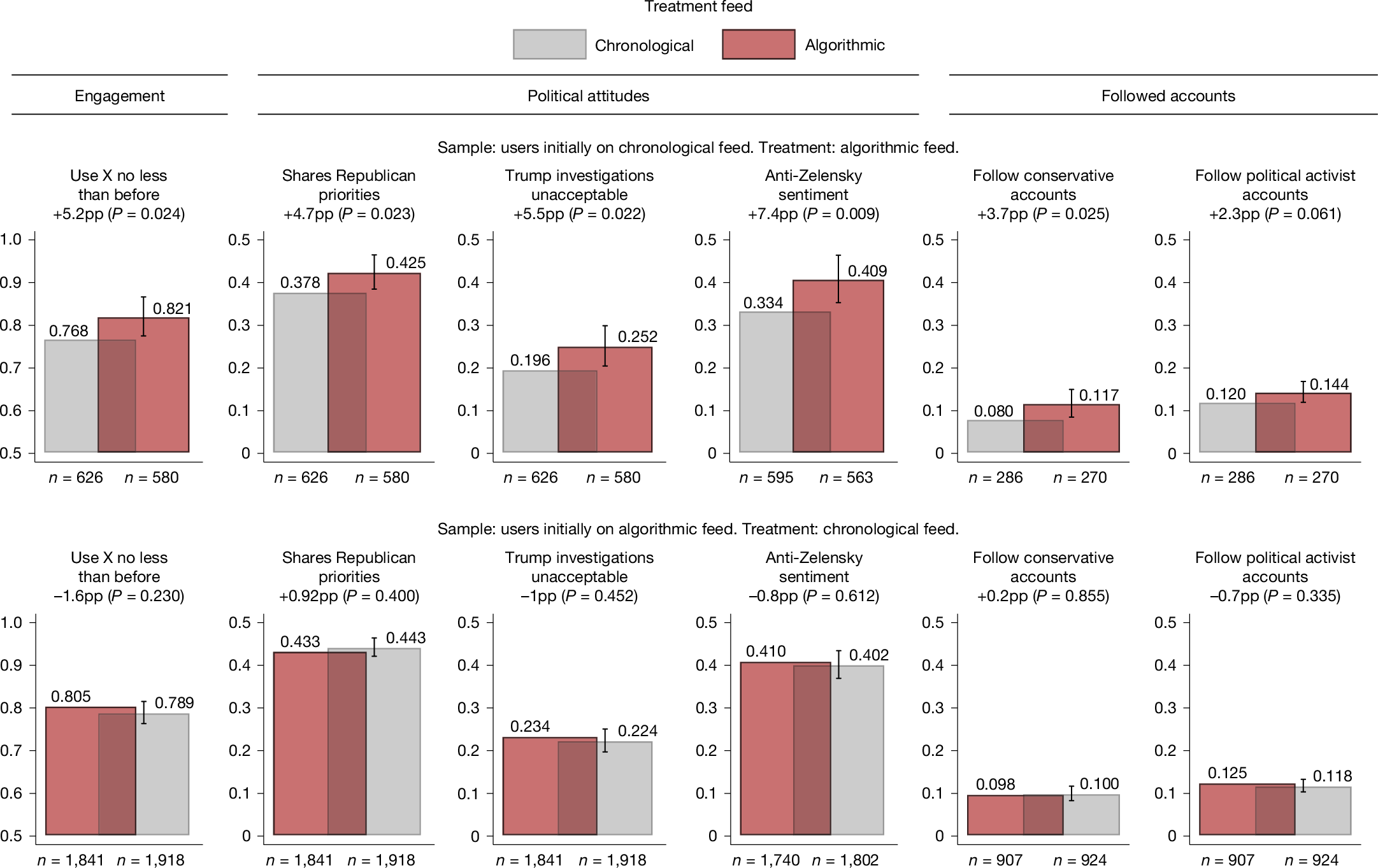
Feed algorithms are widely suspected to influence political attitudes. However, previous evidence from switching off the algorithm on Meta platforms found no political effects1. Here we present results from a 2023 field experiment on Elon Musk’s platform X shedding light on this puzzle. We assigned active US-based users randomly to either an algorithmic or a chronological feed for 7 weeks, measuring political attitudes and online behaviour. Switching from a chronological to an algorithmic feed increased engagement and shifted political opinion towards more conservative positions, particularly regarding policy priorities, perceptions of criminal investigations into Donald Trump and views on the war in Ukraine. In contrast, switching from the algorithmic to the chronological feed had no comparable effects. Neither switching the algorithm on nor switching it off significantly affected affective polarization or self-reported partisanship. To investigate the mechanism, we analysed users’ feed content and behaviour. We found that the algorithm promotes conservative content and demotes posts by traditional media. Exposure to algorithmic content leads users to follow conservative political activist accounts, which they continue to follow even after switching off the algorithm, helping explain the asymmetry in effects. These results suggest that initial exposure to X’s algorithm has persistent effects on users’ current political attitudes and account-following behaviour, even in the absence of a detectable effect on partisanship.
The political effects of X’s feed algorithm
Feed algorithms are widely suspected to influence political attitudes. However, previous evidence from switching off the algorithm on Meta platforms found no political effects1. Here we present results from a 2023 field experiment on Elon Musk’s platform X shedding light on this puzzle. We assigned active US-based users randomly to either an algorithmic or a chronological feed for 7 weeks, measuring political attitudes and online behaviour. Switching from a chronological to an algorithmic feed increased engagement and shifted political opinion towards more conservative positions, particularly regarding policy priorities, perceptions of criminal investigations into Donald Trump and views on the war in Ukraine. In contrast, switching from the algorithmic to the chronological feed had no comparable effects. Neither switching the algorithm on nor switching it off significantly affected affective polarization or self-reported partisanship. To investigate the mechanism, we analysed users’ feed content and behaviour. We found that the algorithm promotes conservative content and demotes posts by traditional media. Exposure to algorithmic content leads users to follow conservative political activist accounts, which they continue to follow even after switching off the algorithm, helping explain the asymmetry in effects. These results suggest that initial exposure to X’s algorithm has persistent effects on users’ current political attitudes and account-following behaviour, even in the absence of a detectable effect on partisanship.
Views of American politics, polarization and tone of political debate
In many ways, Americans’ emotions toward politics today are as negative as their evaluations of the country’s political system. Majorities say they always or often feel exhausted (65%) and angry…