


Computational developments—particularly artificial intelligence—are reshaping social scientific research and raising new questions for in-depth methods such as ethnography and qualitative interviewing. Building on classic debates about computers in qualitative data analysis, we revisit possibilities and dangers in an era of automation, large language model chatbots, and big data. We introduce a typology of contemporary approaches to using computers in qualitative research: streamlining workflows, scaling up projects, hybrid analytical methods, the sociology of computation, and technological rejection. Drawing from scaled team ethnographies and solo research integrating computational social science alongside in-depth observation, we describe methodological choices across study life cycles, from literature reviews through data collection, coding, text retrieval, and representation. We argue that new technologies hold potential to address long-standing methodological challenges when deployed with knowledge, purpose, and ethical commitment. Yet, a pragmatic approach—moving beyond technological optimism and dismissal—is essential given rapidly changing tools that are both generative and dangerous. Computation now saturates research infrastructure, from algorithmic literature searches to scholarly metrics, making computational literacy a core methodological competence in and beyond sociology. We conclude that when used carefully and transparently, contemporary computational tools can meaningfully expand, rather than displace, the irreducible insights of qualitative research.
Field Theory: AI as Social Science Question, Object & Tool
Uses of advanced artificial intelligence are changing how societies organize labor, govern, produce knowledge, and make meaning. In light of these developments, this essay argues that AI models, tools, and systems pose three interrelated imperatives for social science: they demand renewed attention to social theories of how technology, human experience, and social order are entangled; they require study as objects of inquiry in their own right; and they offer capabilities that may transform—or upend—the practice of social investigation itself. From Weber’s analysis of rationalization to Du Bois’s study of technology and inequality to contemporary scholarship on algorithmic governance, the essay examines what social science distinctively offers: the capacity to historicize the apparently unprecedented, to trace connections across scales, and to center those most affected by technological change. It identifies how algorithmic systems are remaking the distribution of opportunity and risk as a central task of social inquiry and asks what futures social science might help bring into being.
The Paper Factory
How can large language models (LLMs) contribute to social science research, and what parts of research remain stubbornly human? Building on existing LLM tools, we offer a multi-agent workflow capable of producing a full quantitative social science paper from an initial prompt. The workflow relies on researchers codifying their heuristics for doing data analysis, and we suggest some core design principles for researchers interested in building on this scaffolding. Using this case, we also examine what current LLM capabilities reveal about the organization of research. LLM agents can lower the cost of pursuing high-risk ideas, expand robustness and transparency, reduce concerns about the scientific file drawer, and force scholars to articulate the heuristics that create valuable work. But they also pose challenges, both in terms of the quality of papers and in the adequacy of scientific institutions to adapt. Meeting these challenges will require new institutional norms that make use of these tools observable, auditable, and accountable.
How public involvement can improve the science of AI
As AI systems from decision-making algorithms to generative AI are deployed more widely, computer scientists and social scientists alike are being called on to provide trustworthy quantitative evaluations of AI safety and reliability. These calls have included demands from affected parties to be given a seat at the table of AI evaluation. What, if anything, can public involvement add to the science of AI? In this perspective, we summarize the sociotechnical challenge of evaluating AI systems, which often adapt to multiple layers of social context that shape their outcomes. We then offer guidance for improving the science of AI by engaging lived-experience experts in the design, data collection, and interpretation of scientific evaluations. This article reviews common models of public engagement in AI research alongside common concerns about participatory methods, including questions about generalizable knowledge, subjectivity, reliability, and practical logistics. To address these questions, we summarize the literature on participatory science, discuss case studies from AI in healthcare, and share our own experience evaluating AI in areas from policing systems to social media algorithms. Overall, we describe five parts of any quantitative evaluation where public participation can improve the science of AI: equipoise, explanation, measurement, inference, and interpretation. We conclude with reflections on the role that participatory science can play in trustworthy AI by supporting trustworthy science.

LIMITS 2026 -- Workshop on Computing within Limits
LIMITS concerns the role of computing in human societies situated in a world of planetary boundaries and limits, such as limits of extractive logics, limits to a biosphere’s ability to recover, limits to our knowledge, or limits of technological solutions to societal issues. As an interdisciplinary group of researchers, practitioners, and scholars, we seek to reshape and orient the broader computing research agenda, grounded by an awareness that contemporary computing research is embedded in finite socio-ecological conditions and must reckon with with ecological limits in general, and climate- and climate justice-related limits in particular. LIMITS 2026 solicits submissions that move us closer towards computing that supports ecological and just futures for diverse human and non-human lifeforms and thriving biospheres.
Artificial intelligence tools expand scientists’ impact but contract science’s focus
Developments in artificial intelligence (AI) have accelerated scientific discovery1. Alongside recent AI-oriented Nobel prizes2–9, these trends establish the role of AI tools in science10. This advancement raises questions about the influence of AI tools on scientists and science as a whole, and highlights a potential conflict between individual and collective benefits11. To evaluate these questions, we used a pretrained language model to identify AI-augmented research, with an F1-score of 0.875 in validation against expert-labelled data. Using a dataset of 41.3 million research papers across the natural sciences and covering distinct eras of AI, here we show an accelerated adoption of AI tools among scientists and consistent professional advantages associated with AI usage, but a collective narrowing of scientific focus. Scientists who engage in AI-augmented research publish 3.02 times more papers, receive 4.84 times more citations and become research project leaders 1.37 years earlier than those who do not. By contrast, AI adoption shrinks the collective volume of scientific topics studied by 4.63% and decreases scientists’ engagement with one another by 22%. By consequence, adoption of AI in science presents what seems to be a paradox: an expansion of individual scientists’ impact but a contraction in collective science’s reach, as AI-augmented work moves collectively towards areas richest in data. With reduced follow-on engagement, AI tools seem to automate established fields rather than explore new ones, highlighting a tension between personal advancement and collective scientific progress.

Artificial intelligence and illusions of understanding in scientific research
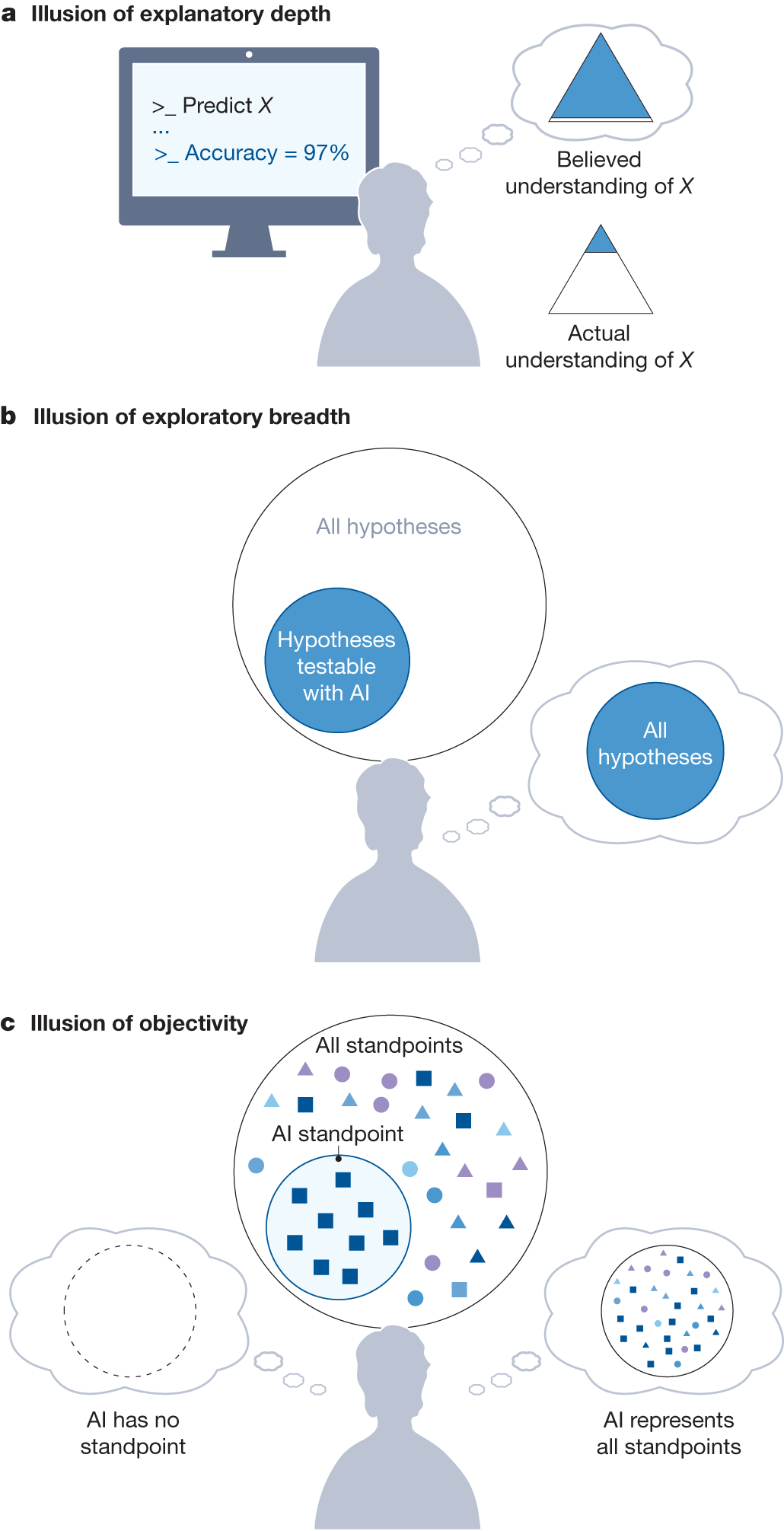
Scientists are enthusiastically imagining ways in which artificial intelligence (AI) tools might improve research. Why are AI tools so attractive and what are the risks of implementing them across the research pipeline? Here we develop a taxonomy of scientists’ visions for AI, observing that their appeal comes from promises to improve productivity and objectivity by overcoming human shortcomings. But proposed AI solutions can also exploit our cognitive limitations, making us vulnerable to illusions of understanding in which we believe we understand more about the world than we actually do. Such illusions obscure the scientific community’s ability to see the formation of scientific monocultures, in which some types of methods, questions and viewpoints come to dominate alternative approaches, making science less innovative and more vulnerable to errors. The proliferation of AI tools in science risks introducing a phase of scientific enquiry in which we produce more but understand less. By analysing the appeal of these tools, we provide a framework for advancing discussions of responsible knowledge production in the age of AI.
Steps Towards an Infrastructure for Scholarly Synthesis
Sharing, reusing, and synthesizing knowledge is central to the research process, both individually, and with others. These core functions are not supported by our formal scholarly publishing infrastructure: instead of the smooth functioning of functional infrastructure, researchers resort to laborious "hacks" and workarounds to "mine" publications for what they need, and struggle to efficiently share the resulting information with others. Information scientists have proposed an alternative infrastructure based on the more appropriately granular model of a discourse graph of claims, and evidence, along with key rhetorical relationships between them. However, despite significant technical progress on standards and platforms, the predominant infrastructure remains steadfastly document-based. Drawing from infrastructure studies, we locate the current infrastructural bottlenecks in the lack of local systems that integrate discourse-centric models to augment synthesis work, from which an infrastructure for synthesis can be grown. Through 3 years of research through design and field deployment in a distributed community of hypertext notebook users, we elaborate a design vision of what can and should be built in order to grow a discourse-centric synthesis infrastructure: a thriving "installed base" of researchers authoring local, shareable discourse graphs to improve synthesis work, enhance primary research and research training, and augment collaborative research. We discuss how this design vision -- and our empirical work -- contributes steps towards a new infrastructure for synthesis, and increases HCI's capacity to advance collective intelligence and solve infrastructure-level problems.

Metagov x Future of Science Seminar - Discourse Graphs with Matt Akamatsu
AI as the Catalyst of the New Paradigm of Science? | Cadmus Journal
The rapid advancement of Artificial Intelligence (AI) is reshaping the landscape of scientific inquiry. This article examines the challenges confronting modern science, including knowledge fragmentation, diminishing returns of current paradigms, and the disconnect between science and society. It explores how AI offers solutions enhancing collaboration and integrating knowledge—as well as considers the possible “darker side” of using AI in research. However, the advent of AI in science not only enhances scientific research but also redefines the role of human researchers and fosters a new paradigm of human understanding. By embracing these transformations, a more cohesive and responsive scientific enterprise can emerge.
LIMITS 2025 -- Workshop on Computing within Limits
The LIMITS workshop concerns the role of computing in human societies situated in a world of limits, such as limits of extractive logics, limits to a biosphere’s ability to recover, limits to our knowledge, or limits to technological solutions to societal issues. As an interdisciplinary group of researchers, practitioners, and scholars, we seek to reshape the computing research agenda, grounded by an awareness that contemporary computing research is intertwined with ecological limits in general, and climate- and climate justice-related limits in particular. LIMITS 2025 solicits submissions that move us closer towards computing that supports diverse human and non-human lifeforms and thriving biospheres.
Steps Towards an Infrastructure for Scholarly Synthesis
Sharing, reusing, and synthesizing knowledge is central to the research process, both individually, and with others. These core functions are not supported by our formal scholarly publishing infrastructure: instead of the smooth functioning of functional infrastructure, researchers resort to laborious ”hacks” and workarounds to ”mine” publications for what they need, and struggle to efficiently share the resulting information with others. Information scientists have proposed an alternative infrastructure based on the more appropriately granular model of a discourse graph of claims, and evidence, along with key rhetorical relationships between them. However, despite significant technical progress on standards and platforms, the predominant infrastructure remains steadfastly document-based. Drawing from infrastructure studies, we locate the current infrastructural bottlenecks in the lack of local systems that integrate discourse-centric models to augment synthesis work, from which an infrastructure for synthesis can be grown. Through 3 years of research through design and field deployment in a distributed community of hypertext notebook users, we elaborate a design vision of what can and should be built in order to grow a discourse-centric synthesis infrastructure: a thriving “installed base” of researchers authoring local, shareable discourse graphs to improve synthesis work, enhance primary research and research training, and augment collaborative research. We discuss how this design vision — and our empirical work — contributes steps towards a new infrastructure for synthesis, and increases HCI’s capacity to advance collective intelligence and solve infrastructure-level problems.
AI Scientists as Engines of Discovery: A Case for Development within Reformed Institutions
Agentic artificial intelligence (AI) systems are beginning to assist, accelerate, and partially automate scientific discovery, performing tasks that span literature synthesis, code generation, data analysis, hypothesis proposal, and model criticism. We argue that this transition is qualitative rather than incremental, and that suitably designed multi-agent systems may evolve from passive computational tools into ``AI scientists'' that can expand the hypothesis-generating and verification capacity of science. Such systems must be developed and deployed within a scientific ecosystem fit for purpose: institutions must be redesigned for verification, accountability, interpretability, and dual-use safety. We sketch how multi-agent architectures, illustrated by the prototype framework \textit{Denario}, accelerate the discovery cycle and traverse model spaces beyond human reach; examine what this implies for authorship, peer review, and the enduring role of human scientists; and close with recommendations for governing AI as an epistemic actor rather than a mere instrument.
Movement Data Science: Practices for Working in Solidarity with Social Justice Efforts
Although many data scientists are eager to promote social justice, their efforts often fall short, and in some cases even exacerbate existing injustices. This gap between intentions and impacts follows from issues in how data scientists conceptualize their role in social justice efforts: they typically act as technicians, aiming to develop technical tools that will produce social justice. This default role generally results in depoliticized techno-fixes that fail to produce substantive changes. In this paper, we contribute “movement data science” as a framework to guide data scientists in taking on more productive and equitable roles in social justice efforts. Our framework is inspired by movement lawyering, a practice used by lawyers to situate themselves in grassroots social movements. Movement data science suggests that data scientists should ground their efforts to advance justice in sustained and solidaristic relationships with social movements. We contribute a process with four essential practices to help data scientists build these relationships and identify roles to play within specific social justice efforts. Movement data science does not provide a simple blueprint for data scientists to follow, but it can help them support social justice movements in substantive ways that go beyond attempting to solve injustices with technical tools.

Where does the rigor go? Research software and the future of trustworthy science.
Generative AI now makes it dramatically easier to produce something that looks like research: analysis code, figures, literature reviews, even whole pap…
Our Approach to Artificial Intelligence
We are experimenting with using AI tools to extend our work as a small nonprofit, so that we can focus our time on reinforcing human connections, conversations, and communities that have eroded.

Agency plus automation: Designing artificial intelligence into interactive systems
Much contemporary rhetoric regards the prospects and pitfalls of using artificial intelligence techniques to automate an increasing range of tasks, especially those once considered the purview of people alone. These accounts are often wildly optimistic, understating outstanding challenges while turning a blind eye to the human labor that undergirds and sustains ostensibly “automated” services. This long-standing focus on purely automated methods unnecessarily cedes a promising design space: one in which computational assistance augments and enriches, rather than replaces, people’s intellectual work. This tension between human agency and machine automation poses vital challenges for design and engineering. In this work, we consider the design of systems that enable rich, adaptive interaction between people and algorithms. We seek to balance the often-complementary strengths and weaknesses of each, while promoting human control and skillful action. We share case studies of interactive systems we have developed in three arenas—data wrangling, exploratory analysis, and natural language translation—that integrate proactive computational support into interactive systems. To improve outcomes and support learning by both people and machines, we describe the use of shared representations of tasks augmented with predictive models of human capabilities and actions. We conclude with a discussion of future prospects and scientific frontiers for intelligence augmentation research.
