

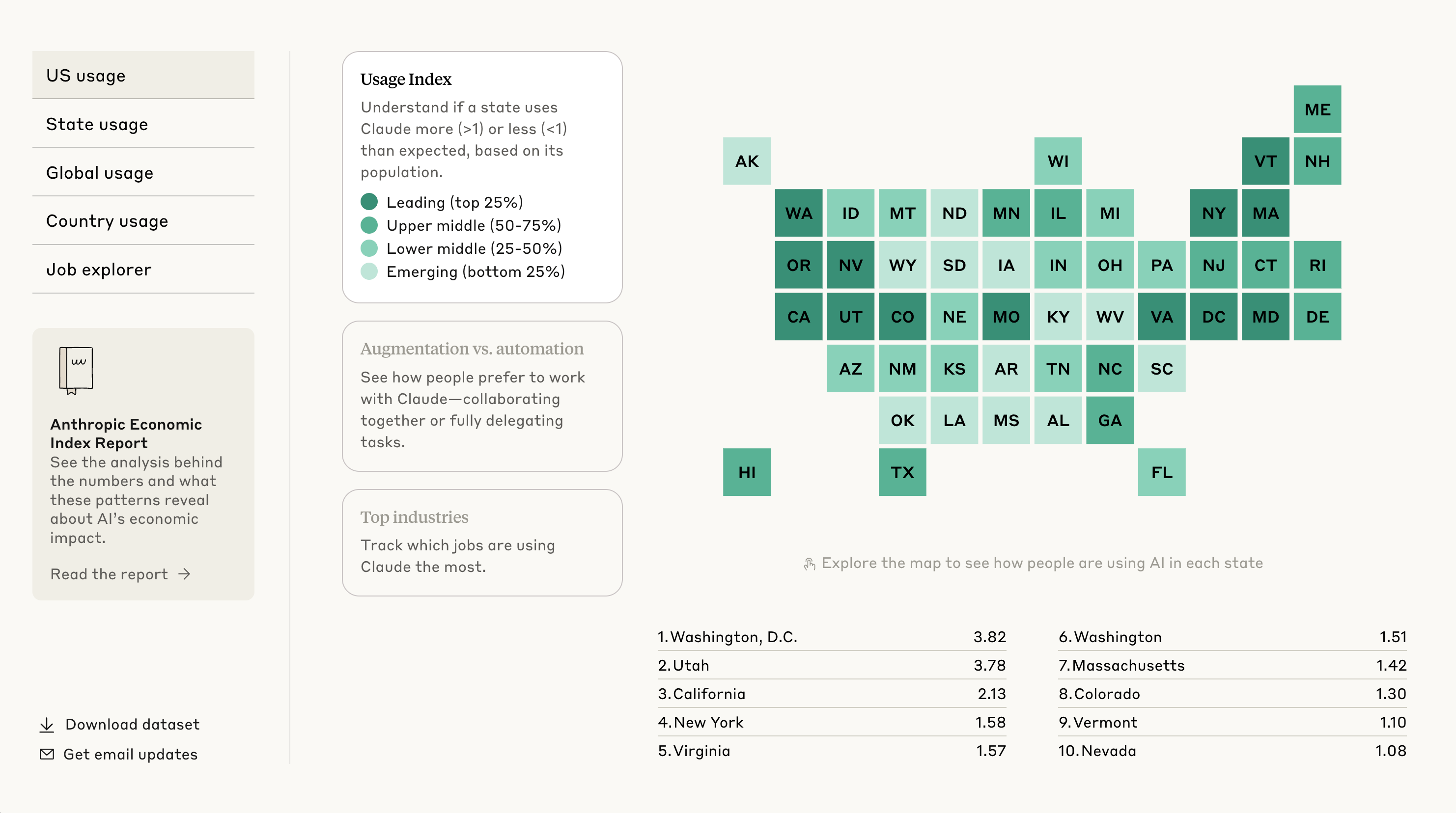
The Anthropic Economic Index reveals the shape of AI adoption across the world. Here, you can explore the data behind our research to understand how people are using Claude across every US state and hundreds of occupations. Track the topics that are trending where you live, and see how people are using AI to augment or automate their work—that is, whether they prefer to collaborate with, or delegate to, Claude.
Anthropic Economic Index report: Uneven geographic and enterprise AI adoption
In this report, we document patterns of Claude usage over time, in 150+ countries, across US states, and among businesses deploying Claude through the API. Based on a privacy-preserving analysis of 1 million conversations on Claude.ai and 1 million API transcripts, we have four key findings: (1) Users increasingly entrust Claude with more autonomy, with directive task delegation rising from 27% to 39% in the past eight months. (2) Claude usage is geographically concentrated with high income countries overrepresented in global usage relative to their working age population. (3) Local economic considerations shape patterns of use both in terms of topic and in mode of collaboration with Claude. (4) API customers use Claude to automate tasks with greater specialization among use cases most amenable to programmatic access. To enable researchers and policymakers to further study the impact of AI on the economy, we additionally open-source the underlying data for this report.

Labor market impacts of AI: A new measure and early evidence
Anthropic is an AI safety and research company that's working to build reliable, interpretable, and steerable AI systems.
The real AI economy is being built by ordinary people
Far from Silicon Valley pitch decks, workers across Asia and Africa are bypassing tech industry hype to quietly rewire their daily jobs — one prompt, workflow, and local problem at a time.

Claude
Claude is Anthropic's AI, built for problem solvers. Tackle complex challenges, analyze data, write code, and think through your hardest work.
Claude
Claude is Anthropic's AI, built for problem solvers. Tackle complex challenges, analyze data, write code, and think through your hardest work.
Half of Americans report using AI services, with information and productivity leading use cases
New Epoch AI/Ipsos poll reveals high AI engagement, diverse use cases, and emerging workplace integration

Differences in AI adoption in Europe and the US: Explanations and implications for productivity growth
The economic impact of generative AI will depend on the speed and breadth of adoption by workers and firms. Drawing on a survey of workers in the US and six European countries and a firm survey covering 32 European countries, this column explores the speed of AI adoption across countries and whether an ‘AI gap’ will exacerbate existing productivity differences between the US and Europe. There are large differences in AI adoption across countries, much of which are accounted for by management practices. Higher AI adoption rates are associated with faster productivity growth but not with changes in employment.

Scenarios for our Economic Future
The Anthropic Economics Team models the effects of AI on the economy of 2030.
Which Economic Tasks are Performed with AI? Evidence from Millions of Claude Conversations
Despite widespread speculation about artificial intelligence's impact on the future of work, we lack systematic empirical evidence about how these systems are actually being used for different tasks. Here, we present a novel framework for measuring AI usage patterns across the economy. We leverage a recent privacy-preserving system to analyze over four million Claude.ai conversations through the lens of tasks and occupations in the U.S. Department of Labor's O*NET Database. Our analysis reveals that AI usage primarily concentrates in software development and writing tasks, which together account for nearly half of all total usage. However, usage of AI extends more broadly across the economy, with approximately 36% of occupations using AI for at least a quarter of their associated tasks. We also analyze how AI is being used for tasks, finding 57% of usage suggests augmentation of human capabilities (e.g., learning or iterating on an output) while 43% suggests automation (e.g., fulfilling a request with minimal human involvement). While our data and methods face important limitations and only paint a picture of AI usage on a single platform, they provide an automated, granular approach for tracking AI's evolving role in the economy and identifying leading indicators of future impact as these technologies continue to advance.
AI FOR EPISTEMICS & COORDINATION
Civilization and technology have radically improved the human condition. Nonetheless, the world sometimes goes in directions which essentially nobody would prefer — e.g., nuclear arms races, unexpected financial crashes, predatory marketing, or ubiquitous political misinformation.
New from us: Anthropic just published scenarios for AI’s possible economic impacts, which range from minimal, to explosive GDP growth of 15% by 2030 as knowledge-worker unemployment hits 18%. I sat down with their co-founder Jack Clark to pick his brains on how they’re thinking about all of this.
