

Claude can now discover, learn, and execute tools dynamically to enable agents that take action in the real world. Here’s how.
Tool use with Claude
Connect Claude to external tools and APIs. Learn where tools execute and how the agentic loop works.
Introducing Agent Skills | Claude by Anthropic
Claude can now use Skills to improve how it performs specific tasks. Skills are folders that include instructions, scripts, and resources that Claude can load when needed. Claude will only access a skill when it's relevant to the task at hand.

hesreallyhim/awesome-claude-code
A hand-picked collection of the finest of resources for the most awesome of agents, Claude Code, the undisputed champion of coding companions, from the unstoppable team at Anthropic PBC. A delectable showcase of top tier skills, ambidextrous agents, scintillating status lines, top notch developer tooling, and also we have plugins
Introducing Agent Skills | Claude
Claude can now use Skills to improve how it performs specific tasks. Skills are folders that include instructions, scripts, and resources that Claude can load when needed. Claude will only access a skill when it's relevant to the task at hand.
Claude for Chrome | Claude
Bring Claude's AI assistance to your browser. Ask questions, analyze data, automate tasks, and navigate sites in Chrome. Works with Claude Code and Desktop.

Claude on Twitter / X
Claude now connects to the tools creative professionals already use.With the new Blender connector, you can debug a scene, build new tools, or batch-apply changes across every object, directly from Claude. pic.twitter.com/Kc3cBHTNpV— Claude (@claudeai) April 28, 2026

chore: bump Claude Code to 2.1.128 and Agent SDK to 0.2.128 · anthropics/claude-code-action@2cc1ac1
Contribute to anthropics/claude-code-action development by creating an account on GitHub.
Claude Code by Anthropic | AI Coding Agent, Terminal, IDE
Anthropic's agentic coding tool for developers. Claude Code understands your codebase, edits files, runs commands, and helps you ship faster.
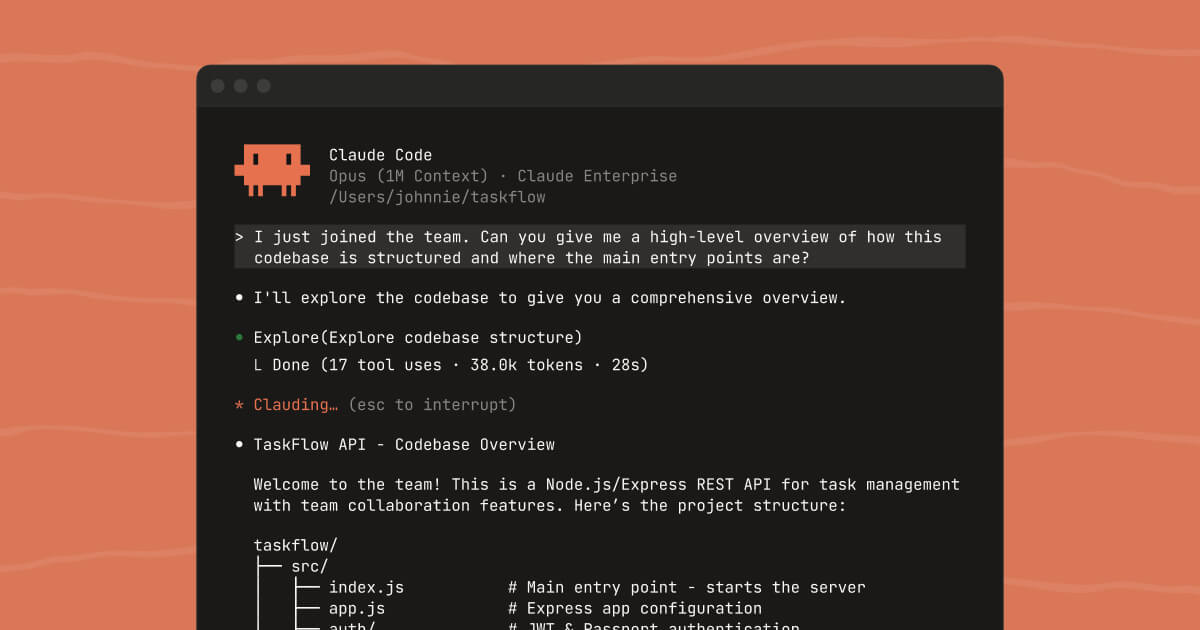
How Anthropic teams use Claude Code | Claude
Teams across Anthropic use Claude Code for everything from debugging production issues and navigating unfamiliar codebases to building custom automation tools. Here's how.

Overview - Claude Code Docs
Claude Code is an agentic coding tool that reads your codebase, edits files, runs commands, and integrates with your development tools. Available in your terminal, IDE, desktop app, and browser.

Overview - Claude Code Docs
Claude Code is an agentic coding tool that reads your codebase, edits files, runs commands, and integrates with your development tools. Available in your terminal, IDE, desktop app, and browser.
Overview - Claude Code Docs
Claude Code is an agentic coding tool that reads your codebase, edits files, runs commands, and integrates with your development tools. Available in your terminal, IDE, desktop app, and browser.
Anthropic experiments with real-time UI generation on Claude
What do we know so far? "Imagine with Claude" will be released as a temporary demo for certain plans (only Max?). Users will be interacting with a classic desktop UI where windows and apps are managed by the AI itself.
Customize Claude Code with plugins | Claude
Claude Code now supports plugins: custom collections of slash commands, agents, MCP servers, and hooks that install with a single command. Share your Claude Code setup with plugins Slash commands, agents, MCP servers, and hooks are all extension points you can use to customize your experience with...
New tools for building agents

Dive into Claude Code: The Design Space of Today's and Future AI Agent Systems
Claude Code is an agentic coding tool that can run shell commands, edit files, and call external services on behalf of the user. This study describes its comprehensive architecture by analyzing the publicly available TypeScript source code and further comparing it with OpenClaw, an independent open-source AI agent system that answers many of the same design questions from a different deployment context. Our analysis identifies five human values, philosophies, and needs that motivate the architecture (human decision authority, safety and security, reliable execution, capability amplification, and contextual adaptability) and traces them through thirteen design principles to specific implementation choices. The core of the system is a simple while-loop that calls the model, runs tools, and repeats. Most of the code, however, lives in the systems around this loop: a permission system with seven modes and an ML-based classifier, a five-layer compaction pipeline for context management, four extensibility mechanisms (MCP, plugins, skills, and hooks), a subagent delegation mechanism with worktree isolation, and append-oriented session storage. A comparison with OpenClaw, a multi-channel personal assistant gateway, shows that the same recurring design questions produce different architectural answers when the deployment context changes: from per-action safety classification to perimeter-level access control, from a single CLI loop to an embedded runtime within a gateway control plane, and from context-window extensions to gateway-wide capability registration. We finally identify six open design directions for future agent systems, grounded in recent empirical, architectural, and policy literature.
