

The second update from the Anthropic Economic Index

The Anthropic Economic Index
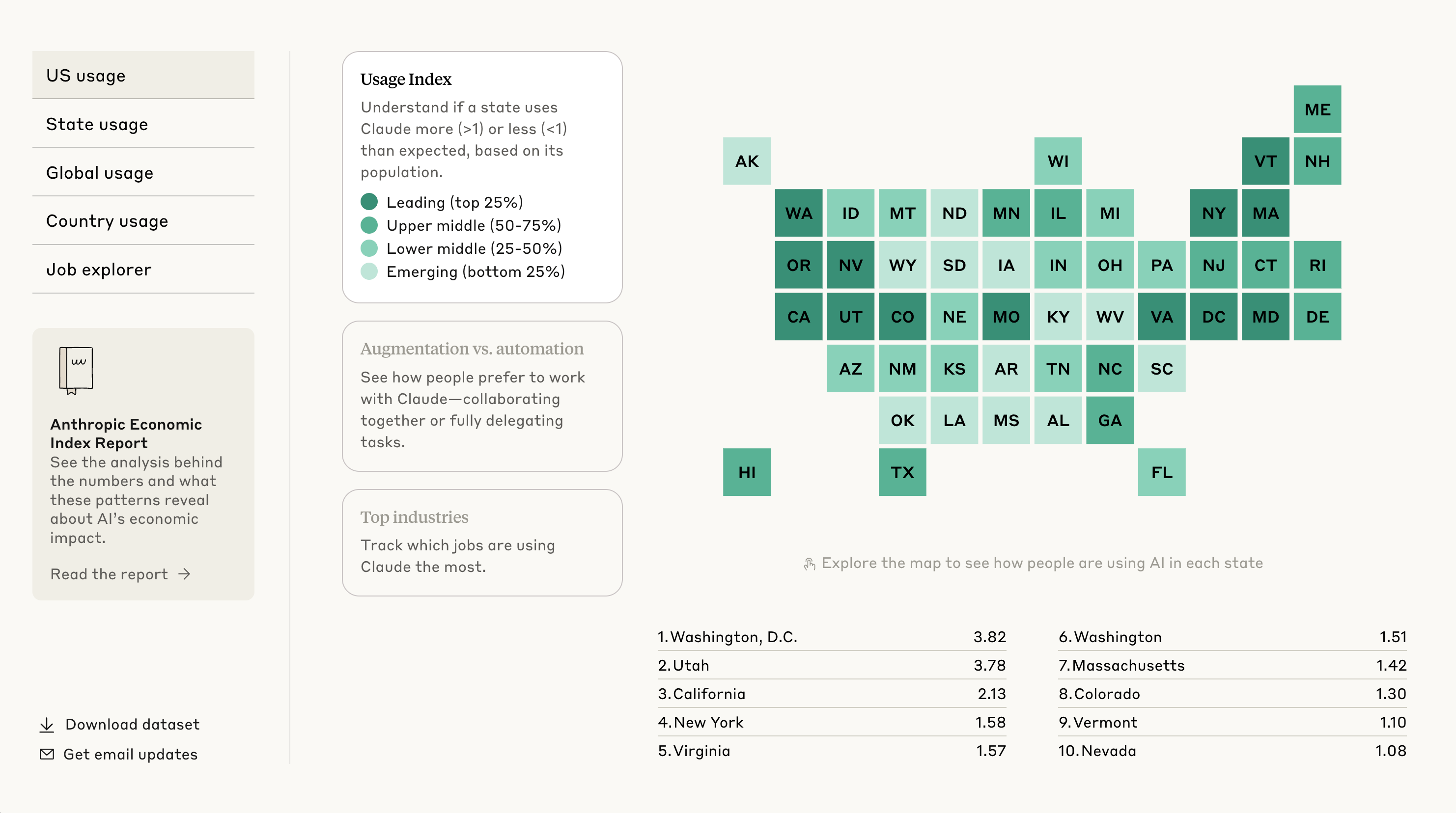
The Anthropic Economic Index reveals the shape of AI adoption across the world. Here, you can explore the data behind our research to understand how people are using Claude across every US state and hundreds of occupations. Track the topics that are trending where you live, and see how people are using AI to augment or automate their work—that is, whether they prefer to collaborate with, or delegate to, Claude.
Scenarios for our Economic Future
The Anthropic Economics Team models the effects of AI on the economy of 2030.
Imperialist appropriation in the world economy: Drain from the global South through unequal exchange, 1990–2015
Unequal exchange theory posits that economic growth in the “advanced economies” of the global North relies on a large net appropriation of resources and labour from the global South, extracted through price differentials in international trade. Past attempts to estimate the scale and value of this drain have faced a number of conceptual and empirical limitations, and have been unable to capture the upstream resources and labour embodied in traded goods. Here we use environmental input-output data and footprint analysis to quantify the physical scale of net appropriation from the South in terms of embodied resources and labour over the period 1990 to 2015. We then represent the value of appropriated resources in terms of prevailing market prices. Our results show that in 2015 the North net appropriated from the South 12 billion tons of embodied raw material equivalents, 822 million hectares of embodied land, 21 exajoules of embodied energy, and 188 million person-years of embodied labour, worth $10.8 trillion in Northern prices – enough to end extreme poverty 70 times over. Over the whole period, drain from the South totalled $242 trillion (constant 2010 USD). This drain represents a significant windfall for the global North, equivalent to a quarter of Northern GDP. For comparison, we also report drain in global average prices. Using this method, we find that the South’s losses due to unequal exchange outstrip their total aid receipts over the period by a factor of 30. Our analysis confirms that unequal exchange is a significant driver of global inequality, uneven development, and ecological breakdown.
Anthropic has surged to a trillion-dollar valuation on secondary markets, overtaking OpenAI.
Buyers are in a race to secure a dwindling supply of shares in Anthropic, driving the AI company's valuation on some platforms to $1 trillion.
A propos de la relation tortueuse entre le PIB et les empreintes macroécologiques
traduction française de "A response to Jonathan Aldred: On the tortuous relationship between GDP and macroecological footprints" de Timothée Parrique

Unequal exchange of labour in the world economy
Researchers have argued that wealthy nations rely on a large net appropriation of labour and resources from the rest of the world through unequal exchange in international trade and global commodity chains. Here we assess this empirically by measuring flows of embodied labour in the world economy from 1995–2021, accounting for skill levels, sectors and wages. We find that, in 2021, the economies of the global North net-appropriated 826 billion hours of embodied labour from the global South, across all skill levels and sectors. The wage value of this net-appropriated labour was equivalent to €16.9 trillion in Northern prices, accounting for skill level. This appropriation roughly doubles the labour that is available for Northern consumption but drains the South of productive capacity that could be used instead for local human needs and development. Unequal exchange is understood to be driven in part by systematic wage inequalities. We find Southern wages are 87–95% lower than Northern wages for work of equal skill. While Southern workers contribute 90% of the labour that powers the world economy, they receive only 21% of global income.

Milton Friedman
Blog de sciences économiques et sociales de Martin Anota. Traductions, revues de presse.
.png)
annotations: Les grands problèmes en macroéconomie : le chômage
Blog de sciences économiques et sociales de Martin Anota. Traductions, revues de presse.
The end of development economics
Some decades ago, development economists saw their approach as being distinctive compared to mainstream economics in general and better grounded in the reality of actual economies. This column argues that two trends over the last decades – the significant improvement in the average income of what were called developing countries and the homogenisation of economics methodology across the board – mean that the distinction between development economics and economics in general is increasingly untenable and indeed unnecessary.
The Portfolio Ideal Worker: Insecurity and Inequality in the New Economy
This output contributes to the following UN Sustainable Development Goals (SDGs)
Anthropic boasts revenue run rate of $30 billion as the Claude developer expands its partnership with Google and Broadcom
Anthropic’s revenue run rate is higher than the trailing 12-month revenues of all but 129 S&P 500 companies....

How employment is changing at Anthropic
How has AI restructured work and employment at Anthropic? As a company at the frontier of AI adoption, Anthropic could be a leading indicator of how AI will shift work organization, hiring, and labor demand across the economy.

annotations: A propos de la super-implication des super-riches dans la politique américaine
Blog de sciences économiques et sociales de Martin Anota. Traductions, revues de presse.
Patrick Artus : « 2050, c’est la disparition de l’Europe comme puissance économique »
Economiste aussi influent que productif, Patrick Artus raconte sa relation à la discipline, et anticipe les évolutions de l’économie mondiale au XXIe siècle – …

New from us: Anthropic just published scenarios for AI’s possible economic impacts, which range from minimal, to explosive GDP growth of 15% by 2030 as knowledge-worker unemployment hits 18%. I sat down with their co-founder Jack Clark to pick his brains on how they’re thinking about all of this.
