

Announcement of the new Anthropic Economic Index and description of the new data on AI use in occupations
The Anthropic Economic Index
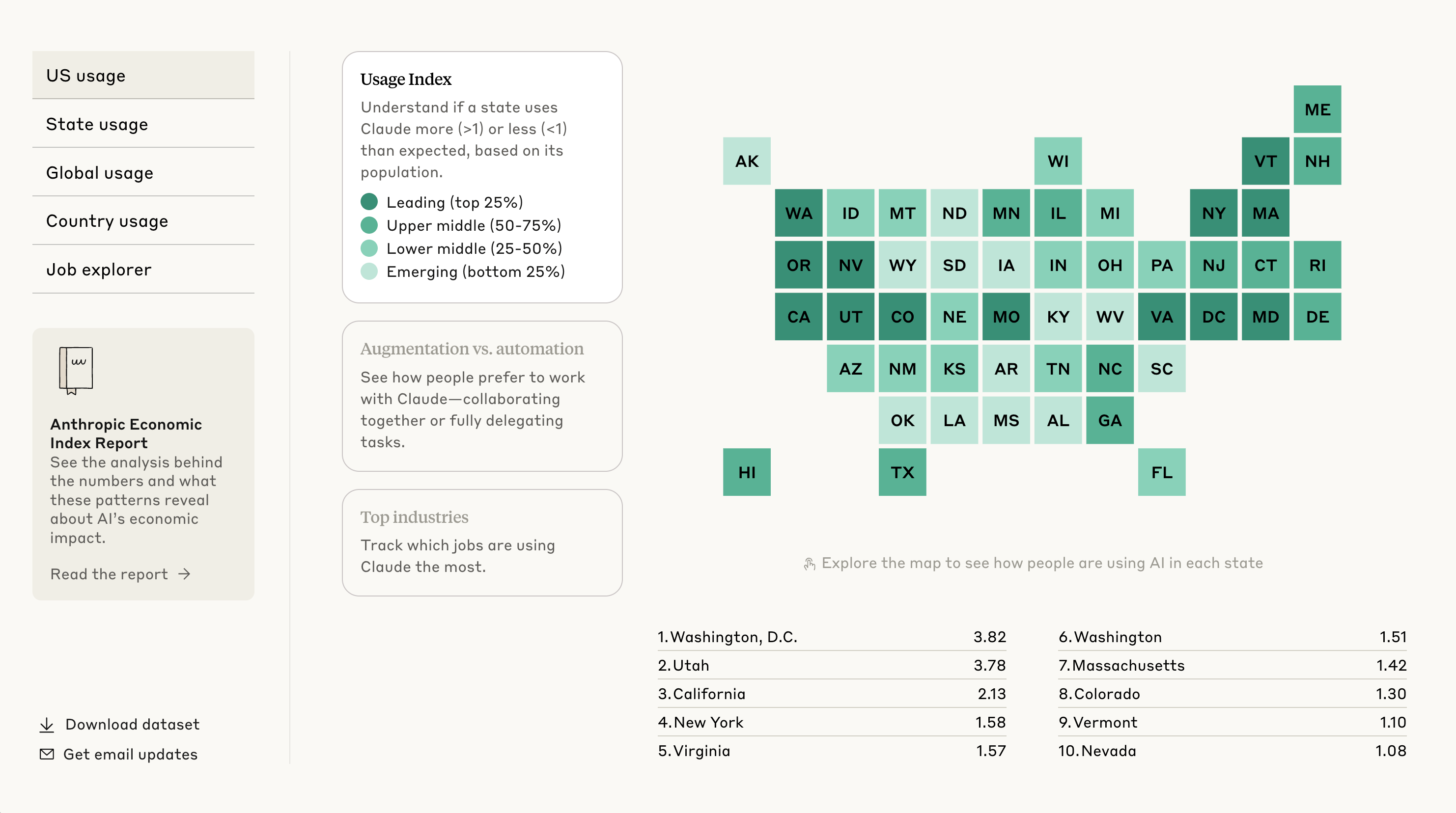
The Anthropic Economic Index reveals the shape of AI adoption across the world. Here, you can explore the data behind our research to understand how people are using Claude across every US state and hundreds of occupations. Track the topics that are trending where you live, and see how people are using AI to augment or automate their work—that is, whether they prefer to collaborate with, or delegate to, Claude.
How employment is changing at Anthropic
How has AI restructured work and employment at Anthropic? As a company at the frontier of AI adoption, Anthropic could be a leading indicator of how AI will shift work organization, hiring, and labor demand across the economy.

Anthropic Economic Index: Insights from Claude 3.7 Sonnet
The second update from the Anthropic Economic Index
Anthropic's internal AI use is now worth more than employee pay, at the prices it charges customers
Anthropic's IPO filing reveals a striking milestone: Its internal AI usage is now valued above employee compensation.
Scenarios for our Economic Future
The Anthropic Economics Team models the effects of AI on the economy of 2030.
Independent Assessment of AI R&D Acceleration at Anthropic in October 2026
METR's high-access assessment of the degree to which AI is accelerating AI research and development at Anthropic.
Home \ Anthropic
Anthropic is an AI safety and research company that's working to build reliable, interpretable, and steerable AI systems.

A Growing Gender Divide in the AI Economy — The Honest Economist
The article argues that AI is reshaping gender inequality even before the pay gap visibly widens. Women are more concentrated in clerical and administrative roles where AI can restructure work, while men are more concentrated in technical, AI-complementary roles. Among college graduates, the exposur

How AI can become pro-worker
The automation of blue-collar and office jobs using digital technologies has been an important driver of the rise in inequality since the 1980s. A new CEPR Policy Insight argues that a ‘human-complementary’ path for artificial intelligence could contribute more to productivity growth and help reduce economic inequality. The authors suggest five potential elements for policy attention to help move the US, Europe, and other economies onto this human-complementary path.

Half of Americans report using AI services, with information and productivity leading use cases
New Epoch AI/Ipsos poll reveals high AI engagement, diverse use cases, and emerging workplace integration

Anthropic Economic Index report: Uneven geographic and enterprise AI adoption
In this report, we document patterns of Claude usage over time, in 150+ countries, across US states, and among businesses deploying Claude through the API. Based on a privacy-preserving analysis of 1 million conversations on Claude.ai and 1 million API transcripts, we have four key findings: (1) Users increasingly entrust Claude with more autonomy, with directive task delegation rising from 27% to 39% in the past eight months. (2) Claude usage is geographically concentrated with high income countries overrepresented in global usage relative to their working age population. (3) Local economic considerations shape patterns of use both in terms of topic and in mode of collaboration with Claude. (4) API customers use Claude to automate tasks with greater specialization among use cases most amenable to programmatic access. To enable researchers and policymakers to further study the impact of AI on the economy, we additionally open-source the underlying data for this report.

Anthropic users face a new choice – opt out or share your chats for AI training | TechCrunch
Anthropic is making some major changes to how it handles user data. Users have until September 28 to take action.

Updates to Consumer Terms and Privacy Policy
Anthropic is an AI safety and research company that's working to build reliable, interpretable, and steerable AI systems.
Perspective: AI demand is inflated, and only Anthropic is being realistic
The main usage metric for artificial intelligence, called tokens, looks explosive on paper, but it may be significantly overstated.

AI and the Human Condition
AI might replace all of the jobs; that’s only a problem if you think that humans will care, but if they care, they will create new jobs.

New from us: Anthropic just published scenarios for AI’s possible economic impacts, which range from minimal, to explosive GDP growth of 15% by 2030 as knowledge-worker unemployment hits 18%. I sat down with their co-founder Jack Clark to pick his brains on how they’re thinking about all of this.
